- Tradition
- Psychological readingAnimal dreams
- Also read in
- The BibleSame symbol, other tradition
- Draws on
- Revonsuo, Jung, Artemidorus
- Reviewed
- 6 min read
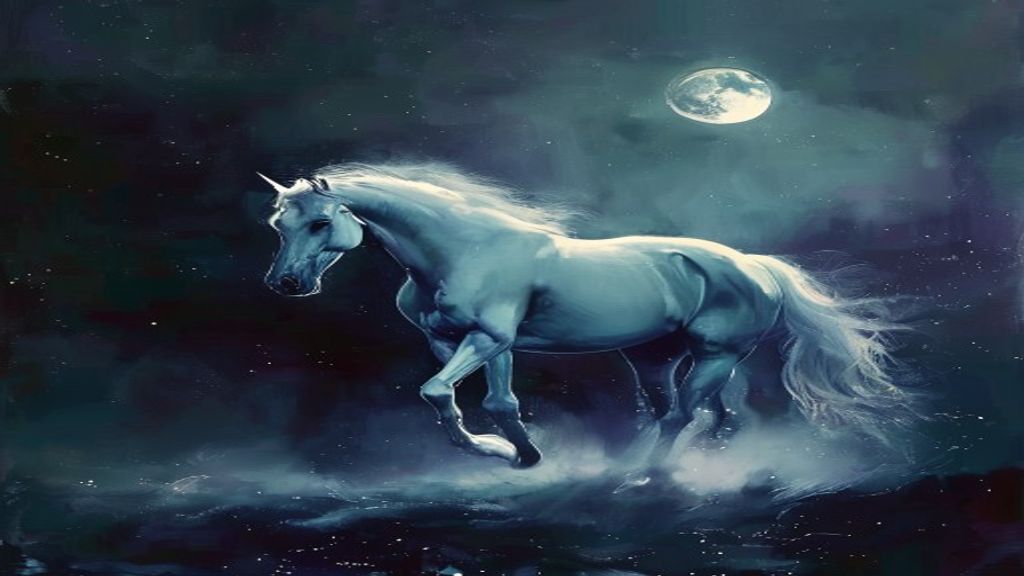
You’re standing somewhere open, a field or a road, and it comes into view from your left. Not running toward you, not away, just crossing your line of sight at a particular angle, and the light is wrong for the time of day, too clear, too white, so that the horse seems to carry its own brightness with it. You don’t move. It doesn’t stop. And when you wake you have the feeling, strange and hard to shake, that you witnessed something.
That’s the classic version, the dream as it tends to be told. Same light. Same angle. Same feeling of having been standing exactly where you were supposed to be. White horses have been doing something to the human imagination for a very long time, and whatever that thing is, it’s still running.
Four thousand years and still in service
- ~1200 BC
The Chester Beatty papyrus, one of the oldest dream texts we have, already sorts dreams into good and bad omens. The habit of reading dream images as signs is long established before anyone distinguishes a white horse from a black one.
- 2nd century AD
Artemidorus writes his Oneirocritica and insists that the same dream means different things for different dreamers, depending on age, status and occupation. A horse in a dream is never read in isolation from the person dreaming it.
- Medieval period
White horses carry apocalyptic weight in Judeo-Christian traditions, and simultaneously appear in Celtic mythology as mounts of the otherworld. The same image doing opposite work: divine justice and divine invitation.
- 19th-20th century
Freudian and Jungian analysis inherits the horse as symbol of natural drives. In the Jungian line, a white horse reads as the instinctual self refined, the powerful brought into a form the conscious mind can recognize and work with.
- Today
The dream keeps arriving. Whatever the image is carrying, it hasn’t been unloaded yet.
I find the durability of this image genuinely strange. We don’t live near horses. Most people in cities can go years without seeing one. And yet the white horse shows up in contemporary dream accounts with all the vividness of something personally experienced. Carl Jung argued that certain images operate below the personal layer, that they’re patterns too old to be fully explained by individual biography. I’m careful about making that claim too quickly, but white horse dreams are one of the places where I start to understand what he was pointing at.
What the white coat actually means
White in dreams most often signals clarity, transition, or something that has moved beyond a previous form. Not purity in the moral sense, but in the optical sense: all the frequencies together, nothing filtered out. The horse brings its own set of meanings: momentum, drive, the body’s energy moving with intention. Put those together and you get an image of directed, clarified force.
Which is why white horse dreams are most often read against specific kinds of moments. Major beginnings. The edge of big decisions. Recoveries after long difficulties. The dream rarely feels random to the person having it. It tends to be read as arriving when something in a person is actually ready to move, even if their waking mind is still debating.
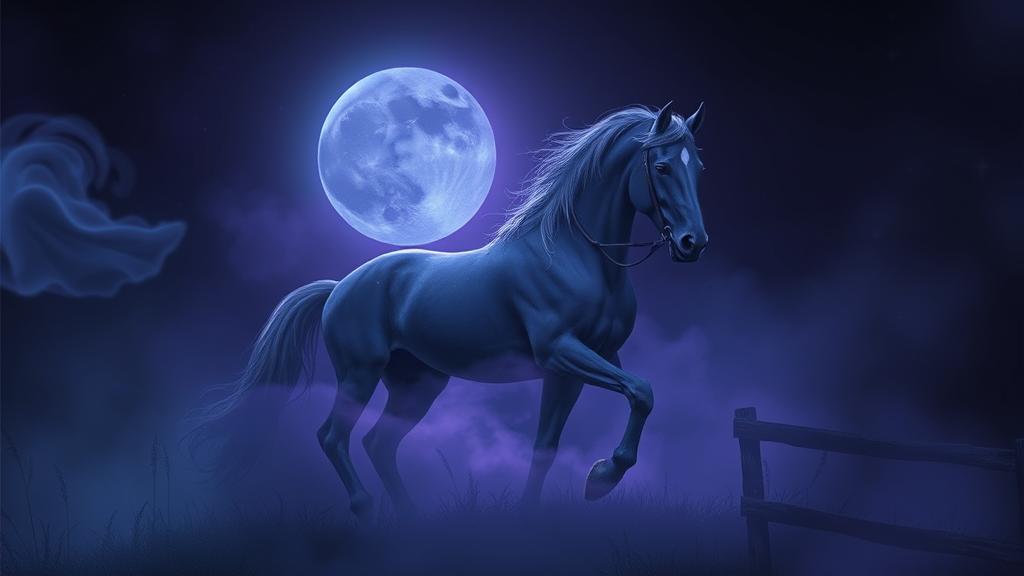
The contrast with the black horse is instructive. Where dreaming of a black horse often involves unowned intensity, raw energy that hasn’t been claimed, the white horse tends to feel like something the dreamer is already in relationship with. It’s not threatening. It’s not waiting to be approached. It simply passes, or stands, or arrives, with a kind of self-contained completeness that leaves a specific feeling behind.
A dream like a door opening one inch
Here’s what I find most interesting about white horse dreams: the action is usually minimal. The horse passes. The horse stands at a distance. The horse appears and you wake. Very rarely does it interact with the dreamer the way a dog would, or the way a snake in a dream tends to force a reaction. The white horse is phenomenological. It doesn’t demand a response. It simply presents itself, and the presentation is the entire content.
I read it as a dream that functions like a door opening one inch. You don’t walk through. You don’t have to. You just become aware that the door exists, that there’s light on the other side, and that the opening is deliberate. What you do next, whether you push further or let it close again, that’s waking life’s job.
Antti Revonsuo’s threat simulation model doesn’t fit this dream neatly, and that’s informative. There’s no threat to rehearse. No danger to process. The white horse dream is something else: closer to what Revonsuo’s framework can’t quite account for, a dream that seems to function as orientation rather than rehearsal. Something that says: here is where you are, here is what’s available to you right now.
For the contrast it offers, dreaming of an animal saving you sits well alongside this one. Both involve animals presenting themselves as gifts of a kind. But the saving dream is urgent and personal. The white horse dream is quieter and more impersonal, somehow. More like weather than like a conversation.
What if you were riding it
Riding the white horse changes the register significantly. Traditional readings would call this a strongly favorable sign, the dreamer aligning with their best fortune. Psychologically it’s closer to: whatever this clarity is, you’re in it. You’re not observing it. You’re the one moving.
A dream of riding a white horse tends to leave an unusual calm on waking. Not elation, exactly. Calm. As if something was momentarily settled. I’d take that feeling seriously. The dreaming mind is a reasonably good judge of when something has been genuinely integrated and when it’s being avoided, and calm after a white horse dream usually means the first thing.
And if the horse left you feeling ready to move rather than calm, dreaming of a cheetah is about speed, timing and full commitment: the same readiness at a much higher pace.
Back to that field. That angle of light. The classic telling puts the horse on the left, crossing right. Left to right is reading direction in cultures where writing moves that way; it’s also the direction of time as we tend to draw it. Maybe the dream is saying: something is moving forward. Maybe it’s just the geometry of peripheral vision, a surprise that makes the image vivid. I genuinely don’t know. But I find that I like not knowing, in this particular case. Some dreams should probably remain partly unresolved.
- Were you watching or riding? The distance tells you about your current relationship to whatever the horse represents.
- What was the quality of the light in the dream? Unusual light in white horse dreams tends to be the most loaded detail.
- What is ready to move in your life right now, even if your waking mind is still finding reasons to wait?
- Did the horse acknowledge you? If it did, what passed between you in that moment?
One symbol, two traditions
The disagreement is honest: one school sees white horse as self-communication, the other as an image to be discerned against Scripture. They can inform each other, but they do not merge.
A white horse in a dream generally signals clarity, readiness, or directed energy available to you right now. It tends to appear around significant transitions: something in you is ready to move even if your waking mind is still…
You are reading this oneTwo distinct white horses appear in Revelation: the first in chapter 6 whose rider goes forth to conquer (interpreted variously as conquest, false power, or the spread of the gospel), and the second in chapter 19 whose rider is…
Read the biblical meaning →Quick answers
What does dreaming of a white horse mean?
A white horse in a dream generally signals clarity, readiness, or directed energy available to you right now. It tends to appear around significant transitions: something in you is ready to move even if your waking mind is still deliberating. It’s one of the more consistently positive animal symbols across traditions.
Is a white horse in a dream a good sign?
Usually yes, or at least a meaningful one. Across cultures from ancient Egyptian dream texts to Jung’s framework, white horses carry associations with guided power, clarity, and movement toward something. The feeling you wake with is your best reading. Calm and clear is about as good as it gets.
What does it mean to ride a white horse in a dream?
That you’re aligned with the energy the horse represents, not watching it but in it. People often wake from this version with unusual steadiness rather than excitement.
Why do so many people have the same white horse dream?
The consistency, open field, white coat, specific quality of light, is one of the things that has puzzled dream researchers for decades. Jung attributed recurring cross-cultural images to what he called archetypal patterns. Whether or not you accept that framework, the shared geography of the dream suggests the image is tapping into something older than individual biography.
Sources for this reading
- Revonsuo, A. (2000). The reinterpretation of dreams: An evolutionary hypothesis of the function of dreaming. Behavioral and Brain Sciences, 23(6), 877-901.DOI
- Jung, C. G. (Ed.). (1964). Man and His Symbols. Doubleday.
- Artemidorus of Daldis (2nd century CE). Oneirocritica. English edition: Harris-McCoy, D. E. (2012). Artemidorus’ Oneirocritica: Text, Translation, and Commentary. Oxford University Press.
Full bibliography on Sources and method. Found a mistake? Tell us and see the corrections log.