- Tradition
- Psychological readingAnimal dreams
- Draws on
- Revonsuo, Artemidorus
- Reviewed
- 6 min read
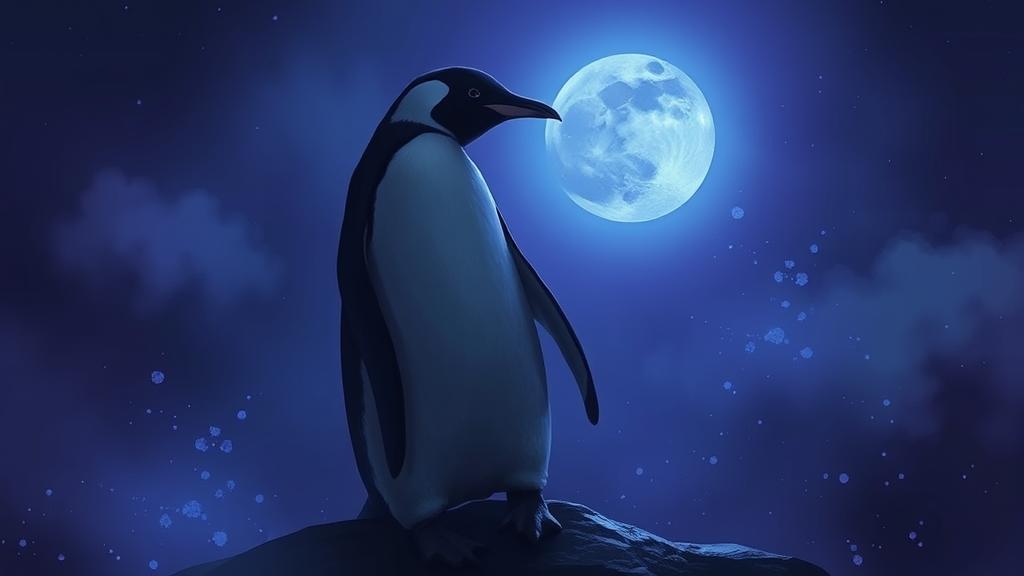
A penguin dream is easy to wave off as a joke, a cartoon animal with nothing to say. It does arrive looking faintly absurd: perfectly still on a kitchen counter, say, wearing the formal black-and-white look of someone waiting to be seated at a restaurant. You may even wake laughing. But the image refuses to leave your mind for the rest of the day, and that persistence is the first sign the dream isn’t a mistake.
That’s the penguin’s trick. Of all the animals that turn up in dreams, it is one of the few that manages to be simultaneously dignified and ridiculous, and I think that tension is doing a lot of the work. Your mind chose this animal on purpose.
A penguin in a dream often surfaces around themes of composure under awkward circumstances, belonging in a place where you don’t quite fit, or warmth that’s well hidden beneath a formal or capable exterior. It can also be the mind’s way of gently noting a situation where you’re doing the right things in the wrong environment.
The formal stranger in the wrong room
Penguins are exquisitely adapted for a world most creatures can’t survive. They’re just not adapted for yours. That misfit-perfectly-suited quality is the first thing I look for in this dream. Is the penguin in its element, or is it out of place? Those are two very different messages.
A penguin in water, fluid and fast and entirely in command, tends to reflect competence. You’re in your medium. Things are moving the way they’re supposed to. But a penguin on land, waddling with that particular formal dignity, carries a different feeling: doing the thing correctly in circumstances that weren’t designed for you. Which is an experience almost everyone has had in their working life at least once, and that a surprising number of people seem to be living continuously.
Take a dreamer who has just started a job she is technically qualified for but socially completely wrong for. She keeps showing up, doing good work, standing on the counter, waiting to be useful. The penguin can say what she hasn’t yet said to herself.
Warmth is the underrated part
Here’s what gets missed in most dream interpretations of this animal: penguins keep each other warm. Emperor penguins in Antarctica rotate through the center of a huddle, the coldest outside spots cycling inward so no individual bird bears the cold too long. It’s one of the most quietly cooperative behaviors in the animal kingdom, and it happens in the harshest possible setting.
A penguin dream might be about that. Not awkwardness, not misfit dignity, but the work of staying warm in cold conditions through sheer proximity and persistence. If the dream had a feeling of warmth or companionship, if there were multiple penguins and the overall sense was something like solidarity, that’s where I’d put my attention. Who in your life is cycling through the difficult position so you don’t have to hold it alone?
What tradition made of unusual animals
Artemidorus, cataloguing dreams in the second century, didn’t have penguins to work with, and his animals were those of his own world. But the idea behind his method, that meaning depends on the dreamer and the circumstances, is still useful here. A good way to apply it is to ask about an animal’s characteristic behaviors first, not its symbolic freight. What does it actually do? How does it move? Apply that before you apply any cultural meaning.
By that method: a penguin is cold-adapted, formally dressed, awkward on land and extraordinary in water, social, warm to its own, and impossible to take entirely seriously. Apply those qualities to the situation your dream was processing. One of them will fit precisely.
The Jungian approach to animal dreams leans toward the shadow, the instinctual material we’ve pushed below awareness. For most large predators that reading is obvious. For a penguin it’s less about repressed power and more about the persona, the formal presentation we wear in the world. A penguin is essentially a perfect persona: impeccable surface, extraordinary capacity, and a private life conducting itself in deep cold water that no one else sees.
The recurring penguin
A penguin dream can come back. The same penguin on the counter, or the same one standing by a door, or waddling patiently through a hallway in someone’s childhood home. Recurring animals in dreams are worth taking seriously, not because they’re omens but because they’re persistent questions.
Antti Revonsuo’s threat simulation work is interesting here but doesn’t quite apply. A penguin isn’t a threat. It’s something else entirely: a puzzle, a gentle companion, a mirror in formal dress. If it keeps coming back, the question it carries probably hasn’t been answered yet. That could be as simple as where do I actually belong? It could be more specific.
The ostrich is the other famous bird that cannot fly, and dreaming of an ostrich asks a different question about it: not where the bird belongs, but what you are refusing to lift off from. The cold world the penguin is built for has its own dream in ice, where something is held still, and the huddle in a penguin dream is the warm answer to it.
The kitchen-counter penguin is one of those images that works as its own joke and its own symbol simultaneously. Suppose the dreamer does eventually leave the job: the penguin was then clearer about it than she was willing to be. For a creature that can’t fly, it can give a dreamer a lot of lift.
- Was the penguin in water or on land? Which element was I watching?
- Did the dream feel absurd, warm, or quietly sad? The feeling is most of the interpretation.
- Where in my life am I doing things correctly in an environment that wasn’t built for me?
- Is the penguin me, or is it someone I know who shows up formally but has a great deal going on underneath?
Quick answers
What does it mean to dream of a penguin?
It most often touches on themes of dignity in awkward circumstances, belonging somewhere you don’t quite fit, or warmth that’s hidden under a formal exterior. The setting matters most: a penguin in water signals competence, on land signals navigating the wrong environment with effort.
Is a penguin dream a good sign?
Generally yes, or at least a gentle one. The penguin isn’t a threatening symbol. It tends to show up when you’re handling something difficult with more composure than you’re getting credit for, or when the question of where you truly belong is worth revisiting.
What does it mean if I was the penguin in my dream?
That’s the most direct form. You felt the waddling dignity yourself. It tends to reflect a sense of doing the right things in a context that doesn’t suit you, moving carefully through terrain that wasn’t designed for how you move. The dream isn’t criticizing you. It’s describing a structural mismatch.
Why do I keep dreaming about penguins?
Recurring penguin dreams usually carry a persistent unanswered question, often something about belonging, environment, or the gap between your public competence and your private experience. The dream keeps arriving because the question hasn’t been addressed yet, not because something is wrong.
Sources for this reading
- Revonsuo, A. (2000). The reinterpretation of dreams: An evolutionary hypothesis of the function of dreaming. Behavioral and Brain Sciences, 23(6), 877-901.DOI
- Artemidorus of Daldis (2nd century CE). Oneirocritica. English edition: Harris-McCoy, D. E. (2012). Artemidorus’ Oneirocritica: Text, Translation, and Commentary. Oxford University Press.
Full bibliography on Sources and method. Found a mistake? Tell us and see the corrections log.