Animal Dreams
Dreaming of a Chameleon: What It Says About the Self You Keep Adjusting
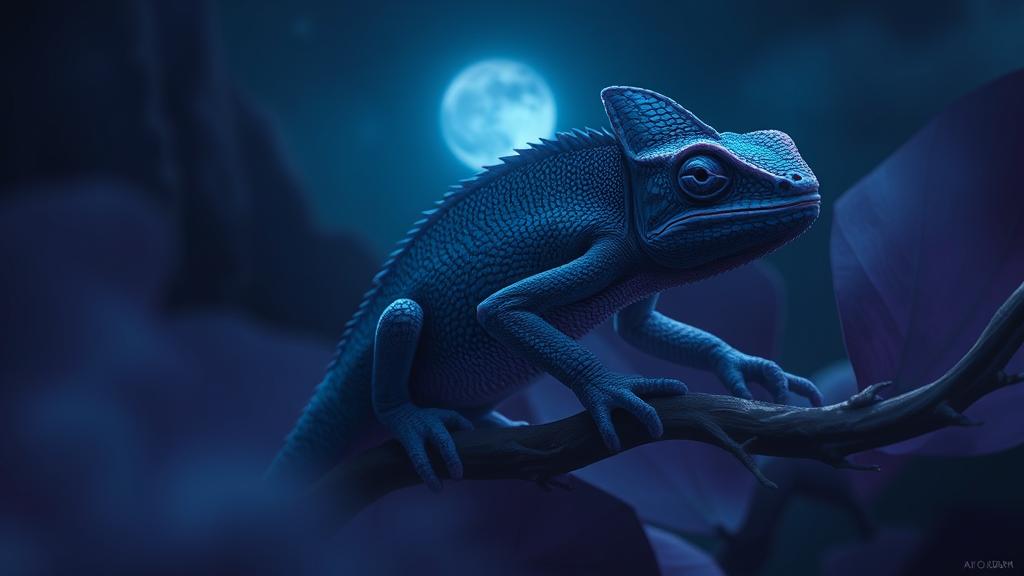
My old desk calendar had a chameleon on the cover. I kept it long after the year ran out because something about the image wouldn’t let go: the creature perched on a branch, eye rotating independently, the color already shifting before anything had even moved nearby. I thought it was alertness. Later I thought it was anxiety wearing beautiful skin. That distinction matters a lot when you’re trying to read a chameleon dream.
A chameleon in a dream usually points to the labor of adapting: to a workplace, a relationship, a role you’ve taken on. The color-changing reads as either a skill you’re proud of or a habit that’s wearing you out, and the dream’s tone tells you which. It almost never means simple dishonesty.
The eye that watches everything at once
What makes the chameleon strange as a dream animal is that it does two things simultaneously, and they contradict each other. It watches. And it hides. Those aren’t the same instinct dressed up together. They’re in tension. When you dream of one, the first question isn’t what color it turned but which of those functions your mind was underlining.
People who report this dream tend to be in transitional periods. A new job where the culture is still opaque. A relationship where they’re still learning what the other person needs. A family gathering that requires a slightly different version of them than the one who drove there. The chameleon doesn’t appear when you’re settled. It appears when you’re in the middle of the read, eye rotating, trying to figure out what color to turn.
Jung’s framework of the house as the self doesn’t map directly onto animals, but his larger idea does: that the creatures appearing in dreams tend to carry something your waking mind is either using or suppressing. A chameleon as a dream figure usually represents a capacity for social flexibility that you’ve relied on heavily enough that it’s become its own kind of weight. You’re good at it. That’s the problem.
What the color shift is actually doing
You’re consciously adapting and it’s working. The dream is almost congratulatory. The chameleon is competent; so are you. But watch for exhaustion hiding under that competence.
The performance is failing. You feel legible in a situation where you wanted cover. This version often arrives during identity stress: you can’t be what a place requires, and the dream knows it.
Possibly the most interesting variant. Something in you has stopped shifting. Could be integration, could be stubbornness, could be that you’ve finally stopped caring what a particular room requires.
Overwhelming social or professional demand. You’re cycling through versions of yourself trying to find the right one. The dream is less an interpretation than a mirror: yes, you’re exhausted.
Loss of adaptability, or relief at it. Something that required constant performance has ended. Let yourself feel whichever emotion the dream left you with; it’s the more useful data point.
Artemidorus, writing his dream compendium in the second century, read shape-shifting creatures as omens of social transformation, often favorable ones. I find that reading too optimistic by default, but there’s something in it. If you’re dreaming of a chameleon and you wake curious rather than anxious, he’s probably right. The animal that appeared was showing you something you can do, not something done to you.
The version that stayed with me
A colleague told me about a recurring chameleon dream she had during a job change. In it, the animal was always on her shoulder, weight barely there, and it kept changing color based on whoever she was talking to. She found it comforting at first, then unbearable. The dream didn’t change. What changed was how she felt about being the kind of person whose shoulder it lived on.
That’s not a Jungian reading or a threat-simulation in Revonsuo’s sense. It’s closer to what Revonsuo would describe as the rehearsal function of dreaming: the brain preparing for social scenarios, running the adaptation loop in the night so the day is less costly. Whether that’s reassuring depends entirely on whether you want to keep adapting, or whether you’re ready to stop.
If you’re also navigating dreams about other creatures in your sleep right now, the piece on dreaming of a firefly explores a different kind of visibility anxiety, and dreaming of a black snake goes into what it means when the dream-animal carries real menace rather than just watchfulness.
A question worth sitting with
Is the color-changing in your dream effortless or labored? Because those are different dreams that look the same on the surface. Effortless adaptation is a gift. Labored adaptation is a signal, and it’s one you’ve probably been receiving in your waking hours too, just quieter.
The calendar with the chameleon is long gone. But I still think about that eye. The one that doesn’t need the head to turn. It watches in two directions at once and I don’t know whether that’s vigilance or the anatomical definition of being pulled apart. Maybe it’s the same thing.
- Was the color-changing effortless or did it feel like labor?
- Who was in the dream’s environment that the chameleon was responding to?
- Do I actually want to keep being this flexible, or is something in me ready to just be one color?
- If the chameleon was failing to match its background, what in my waking life feels similarly exposed?
Quick answers
What does it mean to dream of a chameleon?
It usually points to the labor of social or professional adaptation. The chameleon represents a capacity for flexibility that you may be proud of or exhausted by, and the dream’s emotional tone is what tells you which.
Does a chameleon in a dream mean someone is being deceptive?
Not typically. The deceit reading is intuitive but usually wrong. More often the chameleon reflects your own shifting, not someone else’s. If deception is the theme, look for who in the dream owns the animal, not the animal itself.
What does it mean when the chameleon can’t change color in my dream?
That variant often signals an identity mismatch: you’re in a situation that requires a performance you can’t pull off, or don’t want to. It tends to arrive during transitions where the expected version of you and your actual version have drifted apart.
Why do I keep dreaming of a chameleon?
Recurring versions usually mean the adaptation question is unresolved. You’re still running the loop: figuring out who to be in a given context without having decided whether you want to keep doing it. The dream stops when you either commit to the role or acknowledge the cost.