- Tradition
- Psychological readingAnimal dreams
- Also read in
- The BibleSame symbol, other tradition
- Draws on
- Revonsuo, Hartmann, Artemidorus
- Reviewed
- 6 min read
Ernest Hartmann argued in Dreams and Nightmares (1998) that a dream takes the dominant emotion and puts it into a central image. The ant is a useful test of that idea, because it looks too small to carry anything. A dream about ants feels like it should be minor, background material, not worth reporting. Yet the feelings attached to it are rarely boring: overwhelmed, purposeful, trapped in a system, driven by something you didn’t choose, watched.
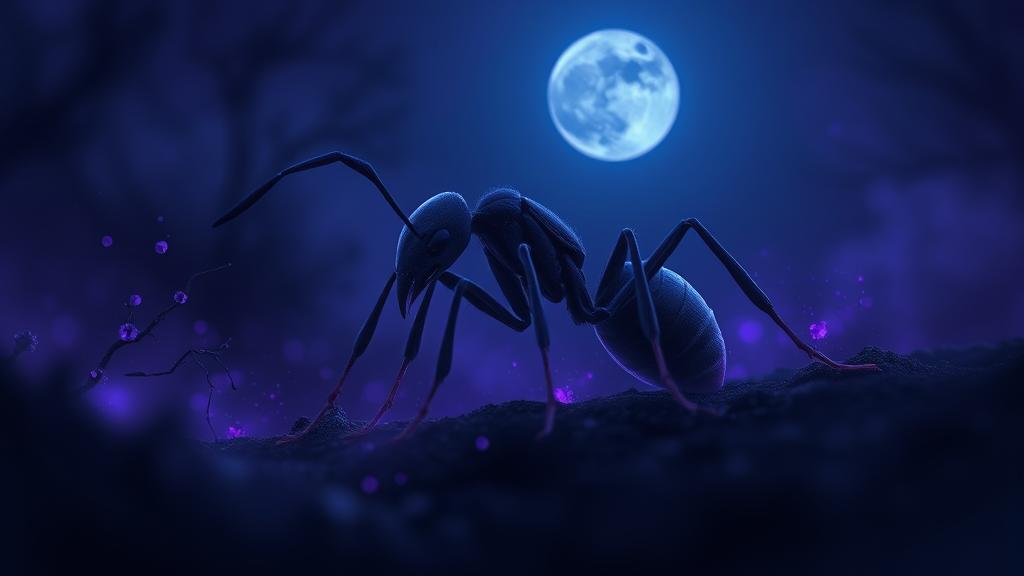
Think of a single ant crossing a cracked sidewalk, carrying something three times its own size. Most people have seen it and felt an involuntary pause, a little spike of something between admiration and unease. It’s the effort-to-size ratio that does it. The thing is impossibly small to be working that hard. That pause is almost exactly what ant dreams feel like from the inside, and it’s the right place to start. Those feelings are worth taking seriously.
Dreaming of ants usually touches on collective effort, duty, small accumulated pressures, or feeling like a piece of a larger system you didn’t design. One ant tends to mean focus and purpose; many ants tend to signal overwhelm, cooperation, or something building quietly in your life. The ant’s relationship to work is always the central thread.
What the ant is carrying
The sidewalk image holds across ant dreams because the common thread isn’t the ant’s size or number. It’s what it’s hauling. Dreams of ants carrying things, food, material, objects, sometimes people in more surreal versions, are usually about labor and its distribution. Are you the ant carrying too much? Are you watching the ant and feeling the wrong kind of envy? Or are you somewhere inside the colony, moving without quite remembering choosing to?
Jungian thinking about symbols is useful here, even though the ant is not one of its famous images. The ant fits a particular category: the creature that operates through the group, where the individual is both real and secondary. Dreaming of that kind of creature often surfaces when someone is navigating a tension between personal will and collective obligation. Between what you want to do and what the system requires of you. That reading holds up well, though it is fair to be uncertain where the framework ends and pattern-matching begins.
A word on Artemidorus
Artemidorus, writing in the second century, held that the same dream means different things for different dreamers, depending on age, status and occupation, and the same logic of context applies to where the ants are: in your house or outside it, on your body or on the ground. That topographical attention is genuinely useful. Ants in your house in a dream carry a different weight than ants in a field. Ants on your skin carry a different weight still, usually pointing toward something that’s getting under your defenses rather than something at a comfortable distance.
Working through what the dream might be saying
- Start with quantityOne ant and a thousand ants are almost different dreams. A single ant tends to be a message about focused effort or a small thing that deserves more attention than it’s getting. Many ants almost always involve accumulation: small stresses, small obligations, small tasks that have built into something heavier than any one of them should be.
- Notice what they’re doingMarching in formation is different from scattered chaos, which is different from carrying things, which is different from building or dismantling. The activity is usually the closest mirror of the waking situation.
- Where are they?Ants in your home touch on domestic life, routine, what’s quietly eating away at your private space. Ants on your body are more intimate and usually point toward something you’ve internalized that you haven’t consciously examined. Ants outdoors, in a natural setting, tend to be the least urgent version of the dream.
- What were you feeling?Purposeful watching is not the same as helpless watching. Ants you’re trying to stop read differently from ants you’re observing with something like respect. The emotional tone underneath almost always matters more than the visual detail.
- Did you belong to the colony?Dreams where you’re somehow part of the ant movement, directed, organized, part of something larger, tend to appear during times of high obligation and low individual choice. They’re worth paying attention to, not because the colony is bad, but because the dream is asking whether you’ve chosen to be in it.
Revonsuo would have something to say about ants as threat simulation, and it’s a fair frame for the more distressing versions: ants covering you, ants getting inside, ants that can’t be stopped. Those dreams register something as genuinely threatening. But most ant dreams don’t feel like threat. They feel like a complicated relationship with effort, and that’s a slightly different psychological neighborhood.
The specific weight of small things
Dreaming of a heron tends to carry stillness and patience, a very different animal energy. Ant dreams are almost never still. They’re about motion, purpose, collective direction. And I think they catch people off guard because we tend to think of meaningful dream symbols as large or dramatic. A heron is cinematic. An ant seems like noise.
But the ant is a genuinely strange symbol if you spend time with it, because it holds two things at once that almost never coexist: extraordinary individual capability and complete subordination of that capability to a larger plan. The ant is both impressive and, in some sense, not free. That’s a tension that a lot of people are living in ways they haven’t fully articulated to themselves, and the dream surfaces it through the smallest possible messenger.
Back to that sidewalk. The ant with the load three times its size. What makes the image stick isn’t that it’s struggling. It usually isn’t. It’s that it knows exactly where it’s going. Dreams of a dromedary also involve a purposeful traversal of hard terrain, a burden carried without complaint, but the scale is different. The ant does it with nothing but instinct and chemistry and the direction of something it didn’t choose. The dream, when it uses this creature, is usually asking you to look at what you’ve been carrying without complaint, and whether the destination is actually yours.
I don’t have a tidy answer for that. I’m not sure the dream does either.
- Was I watching the ants or part of them? The difference between observer and participant tells me something about my relationship to the systems I’m in.
- What were the ants carrying or building, and is there something in my life right now that requires that kind of accumulated, patient effort?
- Did the ants feel purposeful or chaotic? Purposeful points toward obligation and direction; chaos points toward overwhelm or a situation that’s gotten beyond its original structure.
- Is there something small in my life I’ve been dismissing because of its size, that the dream might be taking more seriously than I am?
One symbol, two traditions
The disagreement is honest: one school sees ant as self-communication, the other as an image to be discerned against Scripture. They can inform each other, but they do not merge.
Dreaming of ants usually touches on collective effort, duty, small accumulated pressures, or feeling like a piece of a larger system you didn’t design. One ant tends to mean focus and purpose; many ants tend to signal overwhelm…
You are reading this oneProverbs 6 and 30 associate ants with practical wisdom, seasonal preparation, and initiative without requiring external supervision. This is the nearest thing to a biblical symbol the ant carries.
Read the biblical meaning →Quick answers
What does dreaming of ants mean?
Ants in dreams most often point to labor, collective effort, small accumulated pressures, or a sense of being part of a system you didn’t fully choose. The meaning shifts considerably depending on whether you’re watching one ant or thousands, and whether you feel purposeful or overwhelmed.
Is dreaming of ants a good or bad sign?
Neither straightforwardly. Ants are positive symbols in many traditions, associated with industry, discipline, and community. The dream tilts negative when the ants signal something out of control, invasive, or when the dreamer feels trapped inside the colony’s logic rather than directing their own effort.
What does it mean to dream of ants crawling on you?
Ants on your body tend to point toward something that’s gotten under your skin in a waking-life sense: a worry, an obligation, a criticism you’ve absorbed more than you realized. The feeling in the dream matters: discomfort with no urgency is different from panic.
Why do I keep dreaming about ants?
Recurring ant dreams often coincide with periods of high obligation and low personal choice, times when you’re doing a great deal but not feeling entirely like the author of that effort. The dream tends to recede when the balance shifts, or when you acknowledge what you’ve been carrying without naming it.
Sources for this reading
- Revonsuo, A. (2000). The reinterpretation of dreams: An evolutionary hypothesis of the function of dreaming. Behavioral and Brain Sciences, 23(6), 877-901.DOI
- Hartmann, E. (1998). Dreams and Nightmares: The New Theory on the Origin and Meaning of Dreams. Plenum Trade.
- Artemidorus of Daldis (2nd century CE). Oneirocritica. English edition: Harris-McCoy, D. E. (2012). Artemidorus’ Oneirocritica: Text, Translation, and Commentary. Oxford University Press.
Full bibliography on Sources and method. Found a mistake? Tell us and see the corrections log.