- Tradition
- Psychological readingAnimal dreams
- Also read in
- The BibleSame symbol, other tradition
- Draws on
- Revonsuo, Jung
- Reviewed
- 5 min read
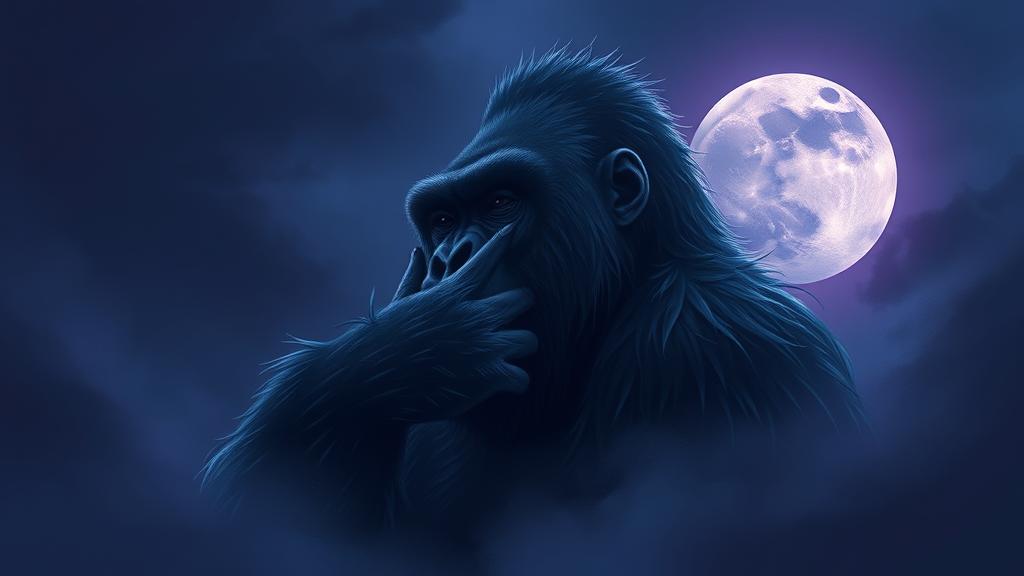
Gorilla dreams get filed under aggression: raw strength, something to be feared or claimed. The dream itself tends to be quieter than that. Other large animals in dreams run, or charge, or stalk. The gorilla just sits there and looks at you, and the dreamer is less frightened than held in place and assessed. Something that large, that still, that entirely certain of itself. You can run from a charging thing. You can’t really run from a presence.
That quality, the gorilla that simply sits and does not need to move to establish everything, is more unsettling than any of the other options, and it is the center of most gorilla dreams. The question it raises is not what the animal will do. It is what it is waiting for.
The weight of the thing
Jungian readings of powerful figures in dreams tend to ask what they demand of the dreamer rather than what they threaten. A figure that simply occupies space and holds your gaze is asking a question, not issuing a warning. The gorilla, in this reading, is a part of the self that has been waiting to be acknowledged. Not the shadow exactly, though it might share territory with it. Something older. Something that doesn’t need to explain itself because it’s been there longer than the explaining part.
I find this more useful than the reflexive ‘power dream’ reading that reduces the gorilla to a symbol of strength to be claimed or feared. That reading isn’t wrong. It’s just incomplete. Strength that just sits and waits for you to catch up is a different quality than strength that needs to show itself.
- Ancient & classical
Gorillas were almost certainly unknown to Mediterranean dream interpreters, since the gorilla as a concept reached Europe only in the 19th century. Its symbolic weight arrived without the usual ancient scaffolding, which means modern dreams carry the meaning the animal itself suggests rather than any inherited gloss.
- Early modern
When gorillas entered Western imagination in the 1800s, they arrived as monsters first: creatures half-human and wholly terrifying. That shadow of the primitive, threatening version of the human persisted in the culture, and it is easy to see how it would color dreams of the animal.
- 20th century
Jung’s framework of the collective unconscious opened space for thinking about what ancient, powerful animal figures mean when they appear in dreams. The great ape became less about threat and more about what we recognize of ourselves in the animal, which is the more honest discomfort.
- Contemporary
Gorilla dreams tend to be remembered for the animal’s stillness and gaze. Documentary footage, nature photography, and wildlife programs have given the dreaming mind a rich store of gorilla imagery, almost all of it characterized by gravity, social intelligence, and that particular quietness.
When the gorilla threatens
Not every gorilla dream is still and watchful. Some people dream of a charging gorilla, or a gorilla that has broken through a door, and those dreams carry real fear. Antti Revonsuo’s threat simulation theory would say the brain is doing exactly what it’s built for: rehearsing the encounter with something overwhelming. I think that’s right, though the ‘something overwhelming’ is rarely an actual gorilla. It tends to be a situation, or a person, whose power you feel as physical even when it isn’t.
A charging gorilla and a still gorilla are dreaming of entirely different things. The emotional weather is the read, not the animal.
What the gorilla might be showing you about your life right now
The gorilla has one quality that almost no other large animal carries in the same way: social authority that doesn’t require aggression. In a gorilla group, the silverback’s presence alone changes the behavior of every other animal. No threat is issued. The authority is ambient. When that image shows up in a dream, it’s worth asking whether there’s a force in your waking life operating the same way, authority that doesn’t announce itself but that you’ve been organizing your behavior around anyway.
That might be a person, a role you’re in or want to be in, an unspoken expectation that weighs on everything without ever being named. The gorilla in the dream sits in the center of the space and you can’t stop looking at it. That’s not terror. That’s recognition. A white horse is a different version of this, a powerful animal that presents itself openly rather than silently, and the contrast between those two experiences is worth considering if you’re trying to understand what your dream was pointing at.
A dream like this can loosen its hold in a particular way: not when you work out what the gorilla wanted, but when you stop trying to figure that out and start asking what you’ve been avoiding sitting still long enough to feel. The answer doesn’t need to be said out loud to be real. There’s something to that. Some dreams do their work before you understand them, and adding language to them is almost beside the point. Almost. If what you’re carrying is the sensation of something massive and silent at the edge of your life, a peacock is the counterweight: the animal that makes itself entirely visible rather than simply present. And vermin is the opposite kind of presence, small and multiplying where the gorilla is single and still, which can clarify what sort of presence is actually disturbing you.
- Did the gorilla’s stillness feel safe or menacing? Both answers are honest.
- Is there a presence in my life, a person, a role, an expectation, that has authority without ever having to announce it?
- What did I do in the dream when the gorilla looked at me? Did I hold ground, retreat, or wait?
- Is there something I’ve been avoiding sitting with because it’s too large to approach directly?
One symbol, two traditions
Psychology keeps gorilla inside your own story, a symbol your mind built from your days. The biblical tradition looks outward instead, and asks whether Scripture gives the image any voice at all.
A gorilla in a dream most often represents authority, presence, or power that doesn’t need to explain itself. Because the animal’s dominance is usually quiet rather than violent, the dream tends to point at a force in your waking…
You are reading this oneA protective gorilla dream might be read through the Psalm 91 framework, which describes God’s protection in imagery of sheltering and guarding. The God of Scripture is repeatedly described as a strong defense, a refuge, and a…
Read the biblical meaning →Quick answers
What does it mean to dream of a gorilla?
A gorilla in a dream most often represents authority, presence, or power that doesn’t need to explain itself. Because the animal’s dominance is usually quiet rather than violent, the dream tends to point at a force in your waking life that holds weight without announcing it, which might be external or a part of yourself you haven’t fully acknowledged.
Is dreaming of a gorilla a bad sign?
Not inherently. A still, watchful gorilla is often more about recognition than threat. The version that charges or breaks through something carries more obvious anxiety, but even then the dream is giving you something to work with rather than predicting anything.
What does it mean when a gorilla chases you in a dream?
Something feels overwhelming and you’ve been running from it rather than turning to face it. Revonsuo’s threat simulation theory is relevant: the brain rehearses what feels dangerous. The gorilla rarely represents a literal threat. It usually represents a situation or relationship where the other party’s power is hard to match.
What does it mean to see a gorilla just watching you?
This is the most commonly reported version, and in many ways the most interesting. A gorilla that simply sits and holds your gaze is asking something of you without issuing any threat. Jung’s framework would suggest it’s a part of yourself, or a figure in your life, whose presence demands acknowledgment you’ve been withholding. The inability to look away is the message.
Sources for this reading
- Revonsuo, A. (2000). The reinterpretation of dreams: An evolutionary hypothesis of the function of dreaming. Behavioral and Brain Sciences, 23(6), 877-901.DOI
- Jung, C. G. (Ed.). (1964). Man and His Symbols. Doubleday.
Full bibliography on Sources and method. Found a mistake? Tell us and see the corrections log.