- Tradition
- Psychological readingAnimal dreams
- Also read in
- The BibleSame symbol, other tradition
- Draws on
- Revonsuo, Jung, Artemidorus
- Reviewed
- 5 min read
The goose in the dream doesn’t so much chase you as refuse to move. It stands in the path, or follows a few steps behind, and it is not big enough to hurt you badly and absolutely does not care. That specific standoff, your reasonableness against something that has no interest in being reasonable, is what a lot of goose dreams seem to be about. You tend to wake annoyed rather than afraid, still half-rehearsing an argument.
The thing I find most interesting about goose dreams is that they’re almost never about the goose. The bird is almost always a proxy. The question is, a proxy for what.
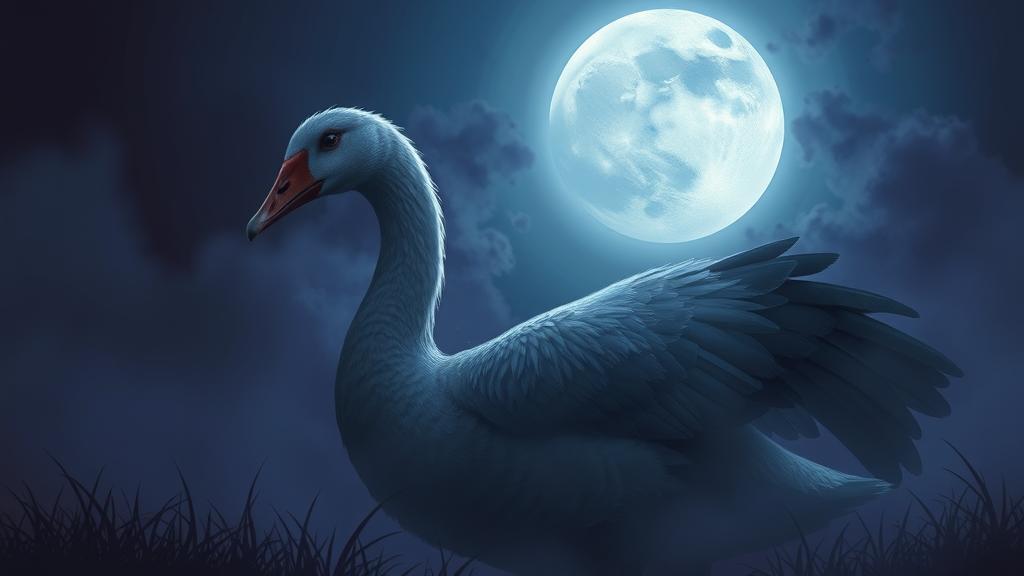
A goose in a dream most often represents something territorial and persistent: a situation, a person, or a part of yourself that holds its ground aggressively, doesn’t negotiate, and doesn’t care about your discomfort. Your response to the goose is usually more revealing than the goose itself.
The goose across cultures
| Tradition | How it reads the symbol |
|---|---|
| Ancient Egypt | The goose was sacred to Geb, god of the earth, and appeared in creation myths as the ‘Great Cackler’ whose honk broke the primordial silence. A dream goose here carried weight: it was a sound that started things. |
| Ancient Rome | The geese of the Capitoline Hill were credited with saving Rome by raising the alarm at night, cackling when the Gauls crept up. Dreaming of a goose in this tradition was a guardian image, a warning that arrived before the threat. |
| Germanic/Northern European | Geese appear in folk wisdom as animals that see through pretense. A goose chasing you was sometimes read as your own conscience in pursuit, making a racket until you dealt with something you’d been walking past. |
| Chinese tradition | Wild geese were messengers, carrying letters between lovers separated by distance or circumstance. A goose dream could signal communication that’s been delayed or a message you’re still waiting on. |
| Medieval European | The ‘goose’ as a term for a foolish person ran alongside the animal as a dream image, creating an ambiguity: were you dreaming of your own naivety, or of someone else’s stubborn unreasonableness? Both readings survived. |
Why the noise matters
Geese are loud. That’s not incidental. In dreams, sound is often the carrier of meaning more than image, and a honking, hissing goose is a dream that’s decided to be loud about something your waking mind has been keeping quiet. Revonsuo’s threat-simulation framework handles this kind of dream well: the dream is rehearsing the experience of being confronted by something that won’t move. Whether that thing is a conflict, a boundary being crossed, or a part of your own personality you’ve been trying to manage, the drill is the same. Face it or step around it. And if you step around it, it’ll be there tomorrow.
If the goose in your dream was aggressive and you stood your ground, that’s worth sitting with. A dream of a swarm of bees has the same shape, being confronted by a force that won’t negotiate, except that the bees arrive as many where the goose arrives as one.
What Jung would do with this
Jung read animals in dreams as figures for the instinctual side of the psyche, the part that operates below conscious management. A goose complicates this: it’s a bird that mostly stays on the ground, that’s louder than it is wise-looking, that has a reputation for obstinacy. I’d argue the dream-goose is a shadow figure in bird form: a part of yourself that you haven’t fully claimed, territorial and loud and difficult to like.
The interesting question isn’t whether the goose represents someone in your life or a part of yourself. Often the dream blurs that line deliberately. The person who holds ground and won’t give an inch and honks at you when you get close: sometimes that’s the difficult colleague, and sometimes that’s you in a relationship where you’ve dug in hard and you’re not sure anymore why.
Artemidorus held that the same dream means different things for different dreamers, and the same logic applies to the goose itself: a goose that was eating calmly means something different from a goose in pursuit. That approach still works. If your dream goose was guarding something, it was guarding something you care about whether you’d admit it or not. If it was chasing you, you’ve been avoiding something that won’t stop following.
A dream of spiders unsettles in a different way, not through force but through presence. If the goose dream left you more rattled than the situation seemed to warrant, that contrast is worth holding: some animals carry disproportionate weight.
The most common version
The most common version is this: you’re trying to get somewhere, the goose is in the way, and it won’t move. You wake frustrated. The obstacle it points to usually has no rational reason to be an obstacle, a bureaucratic wall, a relationship that’s stuck, a habit that keeps reasserting itself. The dream reduces it to its pure form: an unreasonable, honking thing standing exactly where you need to go.
A dream of a cricket is its quieter inverse, something small and persistent that fills the silence rather than the path. If you’ve been having both, your mind is working with the full range of what won’t leave you alone.
- Was the goose blocking your path or simply present? What in your waking life holds that same immovable quality?
- Did you try to reason with it, avoid it, or stand firm? What does that response say about how you’re handling something similar?
- Is the territorial thing in your life someone else, or is it a part of you that’s dug in and won’t back down?
- What was the goose guarding, if anything? That object or space might be the actual subject.
One symbol, two traditions
Read side by side, the two traditions pull in different directions: goose as a signal from your own mind, or goose as an image to test against the text. Knowing which question you are asking is half the interpretation.
A goose in a dream most often represents something territorial and persistent: a situation, a person, or a part of yourself that holds its ground aggressively, doesn’t negotiate, and doesn’t care about your discomfort. Your…
You are reading this oneThe biblical authors didn’t assign symbolic meaning to every creature they knew. The birds that do carry scriptural symbolism (eagle, dove, raven, sparrow) appear in specific narrative and prophetic contexts that gave them…
Read the biblical meaning →Quick answers
What does it mean to dream of a goose?
Usually it points to something territorial and persistent in your life: a person, a situation, or a part of yourself that holds its ground and isn’t interested in being reasonable. Your emotional response to the goose in the dream tells you a lot about how you’re handling it.
Is a goose chasing you in a dream a bad omen?
It’s not an omen so much as a signal that something you’ve been avoiding is still following you. The chase usually stops, in dreams and in life, when you turn around and deal with it.
What does a calm, peaceful goose mean in a dream?
That’s the rarer version, and it leans toward guardianship or patience. Something reliable and a little unglamorous is keeping watch. The Roman tradition read the goose as a faithful alarm: quiet when things are safe, loud when they’re not.
Why do I keep dreaming of a goose chasing me?
Recurring chase dreams, whatever the animal, usually mean there’s something unresolved that you’ve been stepping around rather than facing. The goose returns until the confrontation happens or the underlying situation changes.
Sources for this reading
- Revonsuo, A. (2000). The reinterpretation of dreams: An evolutionary hypothesis of the function of dreaming. Behavioral and Brain Sciences, 23(6), 877-901.DOI
- Jung, C. G. (Ed.). (1964). Man and His Symbols. Doubleday.
- Artemidorus of Daldis (2nd century CE). Oneirocritica. English edition: Harris-McCoy, D. E. (2012). Artemidorus’ Oneirocritica: Text, Translation, and Commentary. Oxford University Press.
Full bibliography on Sources and method. Found a mistake? Tell us and see the corrections log.