- Tradition
- Psychological readingPeople dreams
- How common
- 16.8%of people have had itNielsen et al., 2003
- Draws on
- Domhoff, Cartwright, Hartmann
- Reviewed
- 5 min read
A werewolf dream is usually experienced less as a monster arriving than as something familiar changing its meaning. Take a laugh: big, warm, room-filling, the kind you could hear through two closed doors and feel immediately better about the afternoon. Then, months later, the same sound at the same frequency starts landing like something to brace for rather than enjoy. That is the texture of these dreams: familiarity curdled. A face you recognize, a presence you trusted, and then the moment when it isn’t quite that anymore.
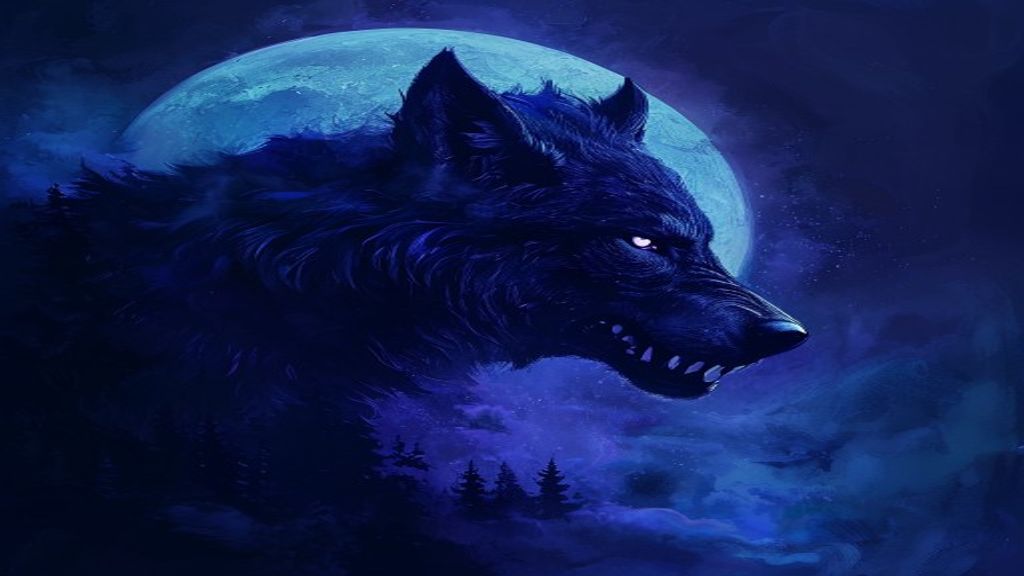
A werewolf in a dream is almost never a stranger. It’s usually someone you know, or a version of yourself, whose behavior has become unpredictable or frightening. The transformation is the subject, not the monster.
The transformation is always about someone specific
Werewolf dreams don’t only follow horror films (though those happen). More often they belong to periods when someone close has become unreliable in ways you can’t quite name yet. A partner whose temper appears and disappears without pattern. A parent sliding into something you don’t have language for. A friend who keeps promising things and then not doing them, and you’re still not sure if it’s deliberate or if they can’t help it. The wolf is the part your waking mind won’t say directly: this person frightens me now, and I don’t know when it’ll happen again.
The moon detail matters more than people give it credit for. In these dreams the trigger is usually environmental, something outside the werewolf’s control, and that’s important data. It means your dreaming mind is still holding space for the explanation. The moon made them do it. Not a verdict, just an acknowledgment: there are forces here I don’t understand. That’s a different dream than one where the monster chooses to attack.
The shape your fear takes
Usually means you saw the change coming and had no power to stop it. The witness position is grief’s position. You’re processing something you already know.
The relationship has become something you’re managing around rather than in. You’ve learned its rhythms enough to stay ahead of them. That’s exhausting and your dream knows it.
The most uncomfortable version. Something in your own behavior has been coming out differently than you intend. Or you fear it might. Most people dismiss this one fastest.
This is the clearest the dream gets. Your mind has named the relationship. Ask who it is and whether you’ve said, even privately, what their wolf-self does to you.
Love is still in this dream. You haven’t given up on the person. That’s worth knowing. It also means you’re carrying the transformation as a problem to solve, which may not be yours to solve.
What these dreams share is what researcher Rosalind Cartwright spent years demonstrating: dreaming doesn’t just replay difficult emotions, it works on them. The werewolf scenario is almost a formal exercise in holding two things at once. This is the person I love. This is what they become. Can those coexist? The dream runs the simulation again and again until you can sit with the answer.
When it’s you holding the wolf
The self-as-werewolf version deserves its own moment because it is easy to skip. It’s tempting to analyze the dream about a parent or a partner at length and mention almost in passing, oh, and sometimes I’m the werewolf. That’s the one to stay with. Hartmann, who spent a lot of time mapping how strong emotions crystallize into dream images, would probably say that your own werewolf is an emotion that’s been getting out before you’ve decided to release it. Rage is the obvious candidate. But so is grief. So is desire. So is the need for control, which can look completely reasonable from inside and very frightening from outside.
The uncomfortable question: does someone in your waking life brace slightly when you’re in a certain mood? Not in a way anyone would name, just in a way you’ve clocked? That’s worth sitting with honestly. The dream might not be accusation. It might just be a mirror you can look at sideways.
What the moon keeps doing
G. William Domhoff’s continuity hypothesis says our dreams track our real preoccupations, and werewolf dreams fit that pattern almost too neatly. They tend to belong to periods of relational uncertainty: when someone’s behavior has become unreadable, when the good days and bad days have no discernible logic, when you’re learning to scan for signs. The moon is the variable you can’t control. When do you see it? is really when do you run?
There’s also the creature’s double identity, the part that makes werewolf mythology so durable across so many cultures. It’s not a monster born a monster. It was human first. That duality is a lot of work for a symbol to carry, and the fact that your sleeping mind reaches for it means something. It’s not giving up on the person entirely. It’s asking: which form is the real one? I genuinely don’t know the answer to that one. I’m not sure the question has a clean answer.
Back to the laugh. The same sound, the same frequency, and your body doing its old calculation in the half-second before it lands. Dreams about thieves share that watchfulness, the scanning for what might be taken before it is. And dreams of romantic encounters with people who’ve frightened you can carry the same two-form logic: who did I want this person to be? The werewolf dream is honest in a way a lot of daytime thinking isn’t. It tells you exactly how much you’ve been managing.
If you dream about someone you love as a werewolf and wake up feeling guilty about it, I’d ask you to be a bit gentler with yourself. The dream isn’t a betrayal. It’s a report. Dreaming of your dead mother shows the same capacity, the full complexity of who a person was to you, difficult parts and all. The dream is not saying this person is a monster. It’s saying something about them has become unpredictable to you, and that matters.
- Who was the werewolf? Do I know them in waking life?
- Did I witness the transformation, flee from it, or was I transformed myself?
- What triggers the change in the dream? Weather, an event, a person?
- Am I bracing for something similar in waking life, and have I said that to anyone?
Quick answers
What does dreaming of a werewolf mean?
Usually it signals that someone familiar has become unpredictable or frightening. The transformation is the key image: your sleeping mind is working through the experience of watching something trusted become unsafe. Occasionally the werewolf is yourself, which points to an emotion that’s been escaping before you choose to express it.
Is a werewolf dream a warning?
It’s less a warning than a report of something you probably already sense. If the dream recurs, it’s worth asking whether you’ve been managing around someone’s behavior without naming that you’re doing it. The dream isn’t telling you anything you don’t know. It’s asking you to say it clearly.
Why do I dream of someone I love as a werewolf?
Because the dream can hold contradictions that waking life finds hard to speak. It doesn’t mean you see this person as a monster. It means your mind is trying to reconcile who they are to you with how their behavior sometimes lands. That’s not disloyalty. That’s honesty.
What if I’m the werewolf in my dream?
That version is worth sitting with carefully. It usually points to an emotion that surfaces before you’ve decided to show it, something others might be bracing for even if no one says so. It’s the dream’s version of self-knowledge, and it deserves the same serious attention as the dream about someone else.
Sources for this reading
- Domhoff, G. W. (2003). The Scientific Study of Dreams: Neural Networks, Cognitive Development, and Content Analysis. American Psychological Association.
- Domhoff, G. W. (1996). Finding Meaning in Dreams: A Quantitative Approach. Plenum Press.
- Cartwright, R. D. (2010). The Twenty-four Hour Mind: The Role of Sleep and Dreaming in Our Emotional Lives. Oxford University Press.
- Hartmann, E. (1998). Dreams and Nightmares: The New Theory on the Origin and Meaning of Dreams. Plenum Trade.
- Nielsen, T. A., Zadra, A. L., Simard, V., Saucier, S., Stenstrom, P., Smith, C., & Kuiken, D. (2003). The typical dreams of Canadian university students. Dreaming, 13(4), 211-235.DOI
Full bibliography on Sources and method. Found a mistake? Tell us and see the corrections log.