- Tradition
- Psychological readingNature dreams
- How common
- 27.3%of people have had itNielsen et al., 2003
- Also read in
- The BibleSame symbol, other tradition
- Draws on
- Domhoff, Jung, Artemidorus
- Reviewed
- 6 min read
It is tempting to read a fire dream as a warning, a disaster on its way. That reading misses what happens first: you notice the fire before you decide what to do about it. Whether you run, watch, get warm or burn is secondary to that moment of recognition, the instant your dreaming self has to decide what the fire means. That pause is the whole thing. Something in us knows fire is different.
Think of the familiar ritual of writing old grudges, a bad year, a name that needs releasing on slips of paper and burning them. The flame takes each slip in under a second, and that is what fire does that water can’t. It ends things completely. It doesn’t carry the residue downstream. A dream can borrow that image with a twist: you are the one who wrote the slips, and you don’t know whose name is on them.
Fire in dreams is almost never a simple disaster symbol. The key distinction is whether the fire is controlled or out of control, and whether it’s consuming something you valued or something that needed to go. Controlled fire, a hearth, a candle, something burning at a distance you’re watching, tends to signal transformation, passion, or creative energy. Uncontrolled fire spreading through your own spaces is usually about anger, urgency, or something in your life threatening to overtake you.
How old fire dreams are
| Tradition | How it reads the symbol |
|---|---|
| Ancient Greece | People came to the temples of Asclepius to sleep and receive a healing dream, a practice known as dream incubation. What they saw there was read as divine contact and as part of a cure, which sits easily with the idea of fire as something that purifies and transforms. |
| Chester Beatty papyrus, about 1200 BC | This dream book sorts dreams into good and bad omens. Fire can sit in either column, which is why the question of whether it is controlled or uncontrolled matters so much. |
| Artemidorus, 2nd c. | Wrote in the Oneirocritica that the same dream means different things for different dreamers, depending on age, status and occupation. For fire, that makes the dreamer’s situation the first question: a hearth for someone who keeps a house and a blaze for someone with everything at stake are not the same dream. |
| Jung | Read dream images as compensating for what the waking attitude leaves out. In a Jungian reading, a fire that breaks out is an emotion that has outgrown its container, while a fire you lit intentionally is something different: creative urgency you’ve actually invited. |
| Contemporary dream research | Domhoff’s continuity hypothesis holds that dreams extend waking concerns. For fire it predicts exactly this: the dream isn’t creating fire, it’s noticing that fire is already what your waking life feels like. |
Rage that wears a fire costume
In dreams where fire consumes homes, cars, workplaces, your own body, the emotion that fits best is often not fear. It’s anger you haven’t let yourself feel. Fire is anger’s natural image in a way that almost nothing else is, and the dream tends to arrive when that anger has been compressed long enough to need an exit. The house burning down is a brutal way of saying: this thing you’ve been living in isn’t sustainable. Something’s got to give.
Jung’s framework is useful here, if you can set aside the century of distance. Read through it, an uncontrolled fire is energy that has exceeded its container. That reads as abstract until you picture a dreamer whose bedroom is on fire three nights running during a situation at work they keep describing as “fine”. It isn’t fine. The bedroom is telling them so. The fire dream is a pressure gauge, not a prophecy.
Artemidorus, to his credit, was already making the point that matters here in the second century: the same dream means different things for different dreamers, depending on age, status and occupation. The fire itself doesn’t settle anything. What settles it is who is dreaming and what they have at stake. A fire you can stand near and feel the heat of without being consumed reads very differently from fire that chases you through rooms or jumps from building to building, which points to forces in your life moving faster than you can manage. The practical question is the one worth borrowing: does the fire help you or hurt you?
When fire clears rather than destroys
Not every fire dream is a warning. The controlled burn is a real thing in both ecology and the unconscious. Wildfire management works partly on the principle that a smaller, directed fire prevents the larger uncontrolled one. A dream can use fire in exactly this way: standing back, watching something that was overgrown or accumulated or stale burn away cleanly, and feeling, not afraid, but relieved. Sometimes honestly glad. It suits a person in the middle of genuine change, a career ending, a relationship that has run its course, a belief system quietly collapsing. The fire dream doesn’t mourn what it burns. It just burns. And then it shows you what was always underneath.
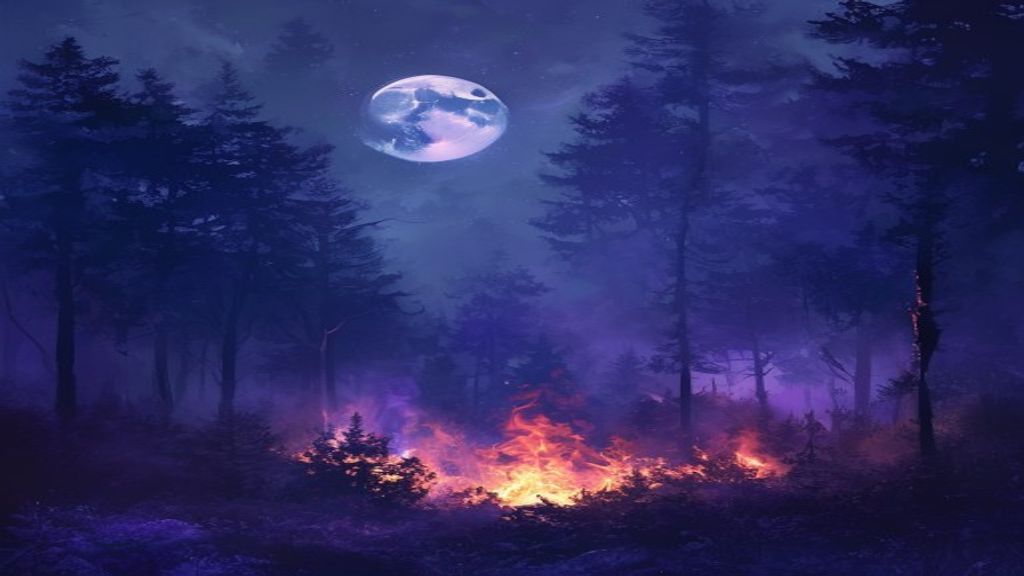
If fire appears alongside other natural elements in your dream landscape, it’s worth asking what each element is doing. The most interesting dreams are the ones where fire and something tender coexist, a fire burning in a garden, a flame that somehow doesn’t reach a single flower. Those are transformation dreams, not destruction dreams. They’re doing something precise. There’s also a particular version where fire and fog appear in the same landscape, which I think of as the dream where urgency and confusion have had to share the same room: something wanting to burn through toward clarity, and something else refusing to let the air clear.
Back to those slips of paper, and the name nobody can read. It may not matter whose name it was. What matters is that the dreamer wrote it. In waking life they weren’t ready to write it; in the dream, they already had. That’s what fire does to time. It makes things previous. You don’t burn what’s still needed. And sometimes the dream knows what’s no longer needed before you do.
One last thing worth noting: if the fire dream involves something like a storm alongside it, electrical or atmospheric, the reading usually shifts from slow accumulated pressure toward something sudden and externally triggered. The source of the heat changes. That distinction, whether the fire came from inside or outside the structure, is the detail that tells you where to look.
- Was the fire something I controlled, something watched from a distance, or something that was coming for me?
- What was it burning, and was any part of me glad to see it go?
- Have I been carrying anger I’ve been calling something else, worry, exhaustion, disappointment?
- Did the fire leave anything behind, and if so, what survived?
One symbol, two traditions
A psychologist asks what fire felt like and what it echoes in your week. The biblical reader asks a different question entirely: what does Scripture say when this image appears, and what does it stay silent about?
Fire in dreams is almost never a simple disaster symbol. The key distinction is whether the fire is controlled or out of control, and whether it’s consuming something you valued or something that needed to go. Controlled fire, a…
You are reading this oneFire in Scripture is the same symbol used for divine presence, purification, judgment, and the Holy Spirit. Before deciding what a fire dream means, it’s worth asking which biblical fire feels closest to what you experienced.
Read the biblical meaning →Quick answers
What does dreaming of fire mean?
It depends almost entirely on whether the fire is controlled or not, and whether you’re the one who lit it. Controlled fire, a hearth or candle or bonfire, points to passion, transformation, or creative energy. Uncontrolled fire spreading through your spaces tends to signal anger, urgency, or pressure that’s exceeded what you’ve consciously acknowledged.
Is dreaming of fire dangerous or a bad omen?
No, and historically fire in dreams has often been read as the opposite of a bad omen: a purifying force, a transformation, a signal of change rather than disaster. The threatening version exists when fire is chasing you or consuming something you valued. Even then it’s information about your emotional state, not a prediction.
What does it mean to dream of your house on fire?
This is the most common fire dream variant, and it almost always connects to feeling that something in your domestic life, your daily structure, your sense of safety, is under intense pressure. The house in dreams often stands for the self, so a burning house can point to a period when your current way of living feels unsustainable. It’s not pleasant, but it’s rarely subtle about what it’s pointing at.
Why do I keep dreaming of fire?
Recurring fire dreams usually mean the pressure or transformation the fire represents hasn’t resolved in waking life. If the fire is tied to anger, the recurrence often means that anger is still waiting for acknowledgment or outlet. If the fire feels cleansing, the recurrence may mean a transition that’s underway but not complete. The dream stops when something changes, not necessarily everything, but the specific thing the fire was pointing at.
Sources for this reading
- Domhoff, G. W. (2003). The Scientific Study of Dreams: Neural Networks, Cognitive Development, and Content Analysis. American Psychological Association.
- Domhoff, G. W. (1996). Finding Meaning in Dreams: A Quantitative Approach. Plenum Press.
- Jung, C. G. (Ed.). (1964). Man and His Symbols. Doubleday.
- Artemidorus of Daldis (2nd century CE). Oneirocritica. English edition: Harris-McCoy, D. E. (2012). Artemidorus’ Oneirocritica: Text, Translation, and Commentary. Oxford University Press.
- Nielsen, T. A., Zadra, A. L., Simard, V., Saucier, S., Stenstrom, P., Smith, C., & Kuiken, D. (2003). The typical dreams of Canadian university students. Dreaming, 13(4), 211-235.DOI
Full bibliography on Sources and method. Found a mistake? Tell us and see the corrections log.