- Tradition
- Psychological readingPeople dreams
- Also read in
- The BibleSame symbol, other tradition
- Draws on
- Domhoff, Cartwright, Hartmann
- Reviewed
- 5 min read
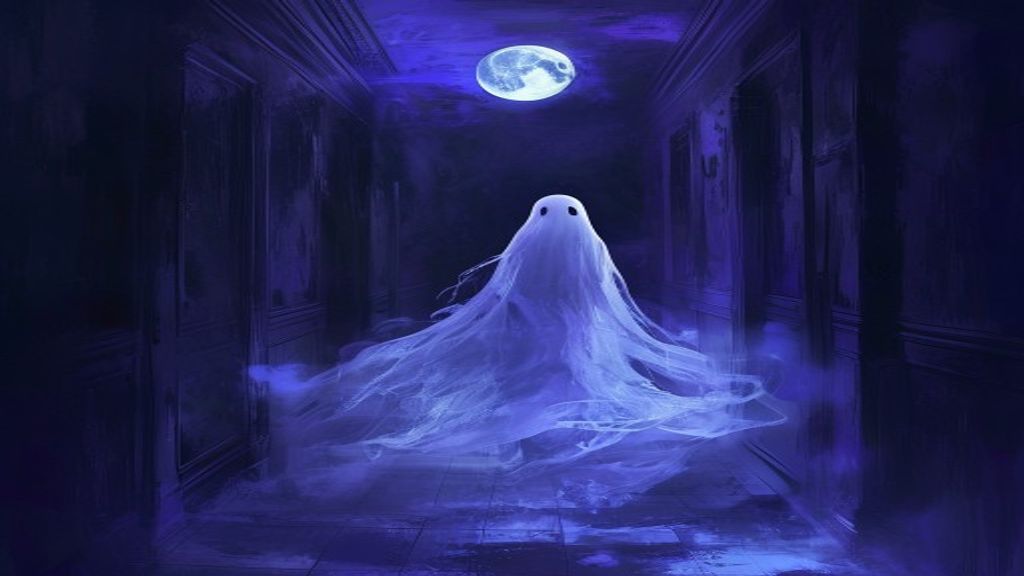
Who is the ghost in a ghost dream? The obvious answer is someone who has died, the simpler kind of grief, where your mind keeps placing them in rooms they no longer occupy. That answer is often wrong. The ghost is as likely to be an ex-colleague, an estranged sibling, a friend who moved away and slowly stopped answering messages: someone alive and fine somewhere who is simply no longer present in your life. That changes how the symbol reads.
What a ghost actually is in these dreams
A ghost is a presence that hasn’t resolved. That’s the core of it, across almost every version of this dream. Not always a person who has died. Often a version of a relationship, a version of a self, a period of life that ended without a proper ending. The ghost-ness isn’t about death. It’s about incompleteness. The figure is there but can’t quite land. The conversation starts but doesn’t finish. You see them but they can’t quite see you, or you can’t make them hear you, or they hear you and say nothing back.
That quality of almost-contact is what I find most specific about this dream type. It’s not the horror of an empty room. It’s not the menace of a werewolf. It’s quieter than either: the particular ache of something present and unreachable at the same time. Most people wake from ghost dreams not frightened but strangely sad, or strangely tender. Which tells you a lot.
A ghost in a dream usually represents something unfinished: a relationship that ended without resolution, a version of yourself from another time, or an emotion that never got its proper acknowledgment. Fear is less common than sadness.
How long humans have been dreaming this
- Ancient world
The Chester Beatty papyrus, dated around 1200 BC, sorts dreams into good and bad omens. A dream of the dead sits naturally inside that scheme, as a sign to be read rather than a malfunction to be dismissed.
- Classical antiquity
Artemidorus, writing in the second century CE, held that the same dream means different things for different dreamers, depending on age, status and occupation. That leaves room for a dream of the dead to be an omen for one person and simply emotional residue, what we’d now call grief processing, for another.
- Medieval and early modern
Ghost dreams became entangled with theology: purgatory, prayers for the dead, the soul’s unfinished account. The haunting figure needed something from the living. This framing, the ghost who requires an act of completion, is psychologically astute even stripped of its religious context.
- 19th and 20th centuries
Freudian thought treats such figures as repressed material, the dead standing in for what the living mind couldn’t face directly. Jungian thought goes further and finds in them images of the selves we’ve shed, old selves haunting current ones. Both frameworks share an assumption: the ghost is unfinished business.
- Contemporary research
Cartwright’s work on dreaming and mood regulation, studied in people going through divorce, supports the broader idea that dreams help the mind work through loss. The dream visits aren’t pathology. They’re part of how the mind closes open loops.
The unfinished thing is the point
Hartmann, who studied how emotional intensity shapes dream imagery (Dreams and Nightmares, 1998), would say that ghost dreams happen when something has been left in a state of suspension. Not processed, not dismissed, just left. His framework suggests the image arrives when the feeling needs a form, and the ghost is the form for feelings that have nowhere to go yet. Grief that hasn’t been said. An apology that was never offered or received. A relationship that ended with a silence instead of a sentence.
The recurring ghost dream is worth paying particular attention to. Domhoff’s continuity hypothesis would predict this: the ghost keeps returning because the open loop in waking life hasn’t closed. The dream visits as punctually as a calendar reminder. Sometimes gently, sometimes with increasing urgency. The question is always the same: have you finished with this? Or more precisely, has this finished with you?
The ghost who isn’t dead
This version deserves its own section because it surprises people to notice it. You dream of someone as a ghost, wake up, and realize they’re alive. They live in another city. You haven’t spoken in four years. You think of them rarely. And yet there they are, slightly translucent, moving through a house that might be yours.
I think this is the dream’s most precise use of the symbol. The person hasn’t died but the relationship has, or a version of it has, and the ending was soft enough that it didn’t register as an ending. There was no rupture, no final conversation, just a gradually widening silence until you realized you’d stopped trying. The dream is telling you the relationship is haunting you precisely because it was never concluded. That’s different from grief. It’s closer to something left on the stove.
A widespread instinct about ghost dreams, across many cultures, is that the ghost needs something, and once given, it rests. Whether you take that literally or psychologically, the logic holds. What it needs might be acknowledgment. An internal goodbye you haven’t performed. Permission to stop taking up space. Sometimes just being recognized: yes, you happened, you mattered, and now I’m letting you settle.
Dreams of a lost friend often have this quality, that unfinished texture, especially when the loss was gradual. Being completely alone is what the dream can feel like once the ghost leaves, a specific silence where the presence was. Ordinary dreams of a friend feel different, warmer, more present, and that contrast is one of the ways to tell whether the visit was a ghost visit or just a memory.
I don’t have a clean ending for this one. Ghost dreams are the type I find hardest to interpret in a tidy way, because what they’re asking for is so individual, so specific to the relationship or the self that’s doing the haunting. What often helps is something small and private: a letter written and not sent, a name spoken out loud alone in a room, allowing yourself to feel the weight of an ending you’d been keeping light. Not a ritual. Just a completion.
- Who or what was the ghost? Dead, or simply gone from my life?
- What was the nature of the contact in the dream, what were we trying to do or say?
- Is there something I never finished with this person or this period of my life?
- What would completion feel like, and is it still possible, even privately?
One symbol, two traditions
Where the psychological read treats ghost as a mirror of your inner state, the biblical tradition treats it as something to weigh, prayerfully, against what Scripture actually says.
A ghost in a dream usually represents something unfinished: a relationship that ended without resolution, a version of yourself from another time, or an emotion that never got its proper acknowledgment. Fear is less common than…
You are reading this oneWithin a biblical framework, the most useful questions are about the emotional content rather than the identity of the figure. What is unresolved, ungrieved, or unforgiven that this dream might be surfacing? The biblical…
Read the biblical meaning →Quick answers
What does dreaming of a ghost mean?
Usually it points to something unfinished: a relationship that ended without resolution, a person or period you haven’t properly grieved, or an old self you’re still carrying. The ghost isn’t necessarily a literal dead person. It’s whatever hasn’t found its ending yet.
Is it normal to dream of someone who has died?
Completely normal, and research by Rosalind Cartwright suggests these dreams can actually help with grief rather than hinder it. Dreams that feel warm or even ordinary, where the deceased person is just present, tend to be part of how the mind processes loss. Distressing ghost dreams often signal something left unfinished between you.
What if the ghost in my dream is someone who’s still alive?
This is more common than people expect. It usually means the relationship has ended, or significantly changed, without a clear conclusion. The person lives on but the version of your relationship that you knew has become a ghost. The dream’s timing and texture are often pointing at something that needs acknowledgment.
Why do I keep dreaming about the same ghost?
Recurrence is the dream asking the same question until it gets an answer. Something in the relationship or the loss hasn’t been completed internally. People often find the dreams ease when they do something small: name what they’re still holding, allow themselves to grieve something they’d kept at arm’s length, or simply acknowledge that this person mattered.
Sources for this reading
- Domhoff, G. W. (2003). The Scientific Study of Dreams: Neural Networks, Cognitive Development, and Content Analysis. American Psychological Association.
- Domhoff, G. W. (1996). Finding Meaning in Dreams: A Quantitative Approach. Plenum Press.
- Cartwright, R. D. (2010). The Twenty-four Hour Mind: The Role of Sleep and Dreaming in Our Emotional Lives. Oxford University Press.
- Hartmann, E. (1998). Dreams and Nightmares: The New Theory on the Origin and Meaning of Dreams. Plenum Trade.
- Artemidorus of Daldis (2nd century CE). Oneirocritica. English edition: Harris-McCoy, D. E. (2012). Artemidorus’ Oneirocritica: Text, Translation, and Commentary. Oxford University Press.
Full bibliography on Sources and method. Found a mistake? Tell us and see the corrections log.