- Tradition
- Psychological readingPeople dreams
- Also read in
- The BibleSame symbol, other tradition
- Draws on
- Domhoff, Jung, Cartwright
- Reviewed
- 5 min read
One plain question gets you furthest with a demon dream: what did it want? Not rhetorically. If you just woke up with one still vivid behind your eyes, that’s the question you’re probably sitting with, and it’s the right one to start with. Not “is this a bad omen” and not “what does the symbolism represent” in that arm’s-length way people use to avoid the actual feeling. Just: what did it want?
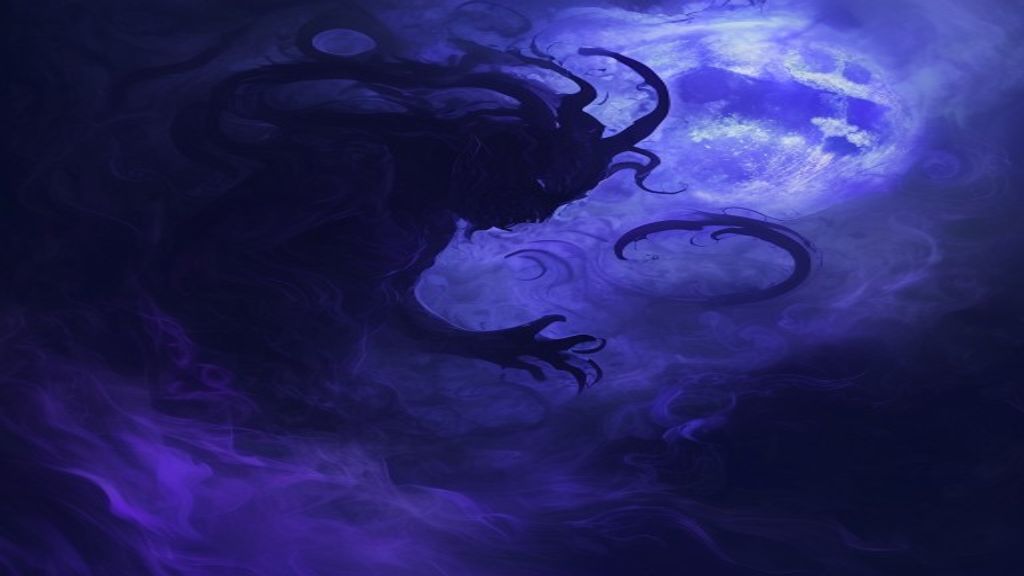
A demon in a dream almost never signals literal danger. It tends to represent an emotion, a situation, or a part of yourself that feels threatening and that you’ve been keeping at a distance. The demon’s behavior in the dream tells you more than its appearance does.
The hiss of dead air
Think of an old television switching to static late at night. Not white noise exactly. More like a pressure. A hiss with weight to it. If you have ever lain awake behind a thin wall, certain something was on the other side of that sound, you know what a demon dream carries: not the monster itself but the quality of its presence. The sense that something is pressing on the wall between you and it. Few descriptions of demon dreams involve a creature with horns. They describe a figure, a shape, sometimes just a feeling of held breath in a corner of the room. The form is almost beside the point. What stays is the pressure.
Two ways to read the same figure
The demon is external
Something in your life is exerting that hissing pressure. A relationship with a power imbalance. A job that feels coercive. A pattern of being around someone who takes more than they give. The demon arrives with a face you almost recognise, or in a place you know, because your sleeping mind is already pointing at the source. In dreaming of divorce, the same pressure turns up in a relationship that is coming apart, often before the problem has been named aloud.
The demon is internal
The other reading is harder to sit with. The demon is a rejected piece of you. Carl Jung called this the shadow, the parts of yourself you’ve decided are too dangerous to own, anger you were trained not to feel, ambition that seemed greedy, desires that felt wrong. When those parts stop being sublimated, they put on a costume. The costume is usually whatever frightens you most. That’s not a flaw in the dream. That’s precision.
What the demon does matters more than what it looks like
A demon that chases you is different from one that watches you. One that speaks is different from one that is silent. One that you are running from is very different from one that you, at some point in the dream, turn and face. The running version is the most common. And honestly, it makes sense. We spend considerable waking energy avoiding whatever is too uncomfortable to look at directly. The dream just gives the avoidance a body. What changes things is when the dream shifts and you stop running, sometimes without understanding why. You just turn around, and something about the demon changes when you do. Rosalind Cartwright’s work on dreaming and mood regulation, studied in people going through divorce, points the same way. Dreams, especially recurring ones, are partly the mind working through something it can’t resolve while awake. The demon recurs because the discomfort hasn’t been faced. When it’s faced, even in sleep, even in a dream where the logic is loose and wrong, something shifts.
If it had your face
Short section, because there’s only one thing to say about it: a demon that looks like you, or that you slowly realise is you, is the shadow in its clearest form. It’s not a disturbing dream. Or rather, it’s disturbing in an accurate way. Something you’ve disowned is asking for a conversation.
The recurring demon and why it keeps coming back
Domhoff’s continuity hypothesis would argue, and I think he’d be right, that the demon keeps coming back because whatever it represents is still present in your waking life. The dream isn’t creating the pressure. It’s reporting it. If you’re dreaming of the same figure night after night, the question isn’t how to stop the dream. It’s what in your life still has that quality of dead air against the wall. Some of that might be a relationship. A demon dream can blur into a dream about a specific difficult person, and sometimes the two are the same dream. When the demon shares qualities with someone close and complicated, the link is probably not symbolic. Dreaming of your cousin deals with exactly that kind of unfinished bond turning up in sleep. It’s fairly direct. Hartmann’s work on how intense emotion becomes a central image in dreams is useful here. The demon isn’t chosen randomly. It’s the mind’s best image for the specific emotional quality that’s active. Which means the features of the demon are actually information. Its size, how much space it takes up, whether it can be outrun. These are your own emotional measurements of what you’re carrying.
I’m cautious about telling people to “confront” things. It sounds like advice that works neatly in a therapist’s office and falls apart at 3am. But there’s a simpler version: just name what the demon represents. Not to anyone else necessarily. Just to yourself, clearly, without softening it. “This is about my anger.” “This is about the job I’m staying in because I’m scared.” Naming doesn’t fix anything, but it can change the dream. Not immediately, maybe not this week, but it can. The figure needs to become specific before it stops needing to be monstrous. Dreaming of a witch is the nearest sibling of this dream: another feared figure that usually stands for power you haven’t integrated yet. It’s worth treating the two as chapters of the same book rather than separate nightmares.
The static stops, eventually. And what often becomes clear in hindsight is that the sound was never the frightening part. What frightened was how easily something could be projected onto it, how much a mind in the dark needs something to be on the other side of the wall. The demon in your dream works the same way. It’s wearing the shape of your own projection. That’s not a reason to dismiss it. It’s a reason to look at what’s doing the projecting.
- What was the demon doing? Chasing, watching, waiting, speaking?
- Did the demon have a familiar quality, a voice, a presence, a face I almost knew?
- Is there something in my waking life that’s been pressing on the wall I’ve been ignoring?
- If I had to give the demon a name that wasn’t “demon”, what would it be?
One symbol, two traditions
Where the psychological read treats demon as a mirror of your inner state, the biblical tradition treats it as something to weigh, prayerfully, against what Scripture actually says.
A demon in a dream almost never signals literal danger. It tends to represent an emotion, a situation, or a part of yourself that feels threatening and that you’ve been keeping at a distance. The demon’s behavior in the dream…
You are reading this oneThe biblical framework for demonic attack is James 4:7: submission to God followed by resistance. If a dream of attack leaves you with a persistent sense of spiritual danger, the tradition’s response is practical: prayer…
Read the biblical meaning →Quick answers
What does it mean to dream of a demon?
A demon in a dream usually represents an emotion or situation you’ve been treating as too dangerous to face directly. It can point to an external pressure like a controlling relationship or to an internal one like anger or ambition you’ve rejected. The demon’s behaviour tells you more than its appearance does.
Is dreaming of a demon a bad sign?
Not inherently. It’s an uncomfortable sign, which is different. The dream is pointing at something real, and dreams that disturb us often carry more useful information than peaceful ones. The discomfort is the message, not a verdict.
Why do I keep having the same demon dream?
Recurring demon dreams usually mean whatever the demon represents is still unresolved in your waking life. The dream repeats because the situation hasn’t changed or the feeling hasn’t been acknowledged. When you name the source, the dream tends to shift.
What does it mean if the demon looked like me?
A demon with your own face is Carl Jung’s shadow in its clearest form: a part of yourself you’ve decided is unacceptable and pushed away. It’s an uncomfortable dream with an honest message. Whatever you’ve disowned is asking to be recognised.
Sources for this reading
- Domhoff, G. W. (2003). The Scientific Study of Dreams: Neural Networks, Cognitive Development, and Content Analysis. American Psychological Association.
- Domhoff, G. W. (1996). Finding Meaning in Dreams: A Quantitative Approach. Plenum Press.
- Jung, C. G. (Ed.). (1964). Man and His Symbols. Doubleday.
- Cartwright, R. D. (2010). The Twenty-four Hour Mind: The Role of Sleep and Dreaming in Our Emotional Lives. Oxford University Press.
- Hartmann, E. (1998). Dreams and Nightmares: The New Theory on the Origin and Meaning of Dreams. Plenum Trade.
Full bibliography on Sources and method. Found a mistake? Tell us and see the corrections log.