- Tradition
- Psychological readingPlace dreams
- Draws on
- Domhoff, Jung, Artemidorus
- Reviewed
- 6 min read
Every museum has a storage room bigger than its galleries. Most of what a museum owns is never shown. Curators decide what gets lit and labeled, and the rest sits in archive boxes in climate-controlled dark. That ratio, the vast invisible collection against the small curated display, is probably the most honest thing a museum can tell you. And it’s the first thing worth thinking about in a museum dream.
What got selected for the display case? Who decided it was worth preserving? Those are the questions that open the dream, and they’re almost never about history. They’re about you. What version of your past has been framed and lit and placed behind glass, and what’s still in the storeroom?
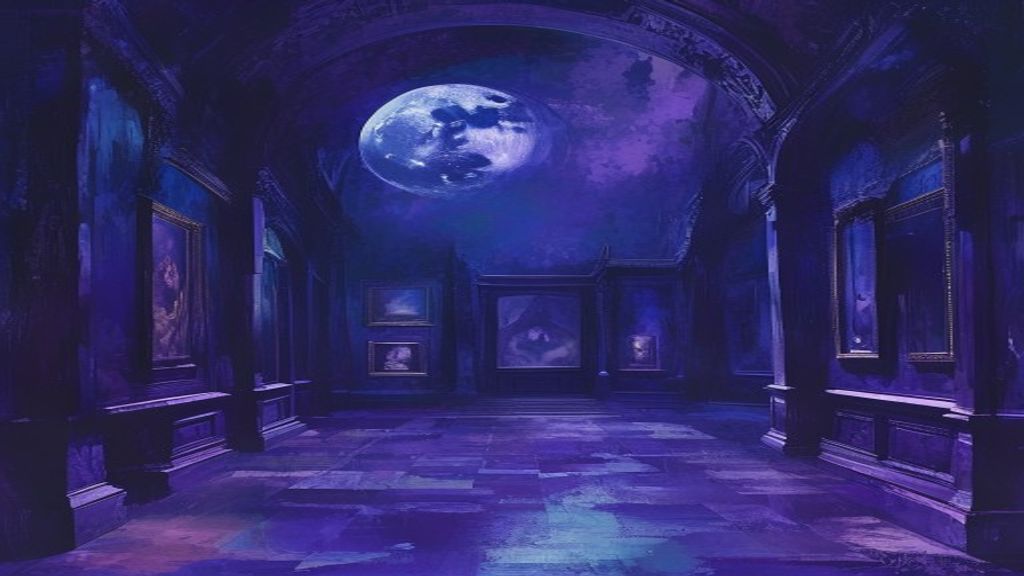
A museum in a dream is memory made architectural. It holds preserved versions of the past, sometimes proudly, sometimes with a museum’s slight airlessness. What’s on display, and who gets to walk through, tells you which parts of your history are still governing your present.
The exhibit you keep walking past
Picture an object that gets requested for exhibition over and over. Each time the crate is opened, the same small deterioration has continued in storage. It looks fine under glass. But every time someone unwraps it, you can see that time hasn’t actually stopped for it. The preservation is partial. It slows the process; it doesn’t end it.
That’s the anchor for museum dreams. Not the grand atrium, not the famous artifact. The object in the crate that looks preserved but isn’t, quite. Because the museum dream’s most common emotional register is exactly that: the past appears contained, curated, under control, and there’s still something restless about it. You’re looking at it through glass and you can feel it’s not as sealed as the display suggests.
People tend to dream of museums during the parts of life when they’re doing a lot of reviewing. After a long relationship ends. When a career chapter closes. In the particular quiet after a parent dies and you suddenly hold a box of photographs you’ve never seen. The museum appears and says: here is what has been preserved. Here is the official version. The dream doesn’t ask whether the official version is accurate.
How the same building reads differently across traditions
| Tradition | How it reads the symbol |
|---|---|
| Ancient Greek | Artemidorus held in the Oneirocritica that the same dream means different things for different dreamers, depending on age, status and occupation. A curator, a student and someone sorting a dead parent’s papers would not dream the same building. Who you are comes before what the building holds. |
| Jungian | Jung’s house-as-self framework extends naturally here: the museum is a specific kind of house, one devoted to keeping the past intact. Jungian readers tend to focus on which objects are in the collection. A room full of childhood artifacts points to the inner child; a room with no recognizable objects might indicate shadow material, the parts of yourself that haven’t been claimed or named yet. |
| Contemporary Western | Researchers working in the Domhoff tradition would read the museum as a fairly direct reflection of where your waking attention is sitting. If you’ve been preoccupied with a past relationship, a past version of yourself, a story you keep retelling, the museum is where that preoccupation builds its architecture. |
| Islamic dream tradition | Classical Islamic dream interpretation pays close attention to the dreamer’s role and standing inside the dream. A museum, or its historical equivalent, would be read partly in terms of what you were doing inside it: visiting as an observer is different from working there, from being exhibited there, from being locked in after closing. |
Being exhibited versus doing the exhibiting
There’s a version of the museum dream I find genuinely unsettling in a productive way. You’re not visiting the collection. You’re in it. Behind glass, labeled, part of the permanent exhibition. Other people move through the gallery and look at you with the polite interested faces people wear in museums, the face that is not quite seeing.
This dream tends to belong to people who feel their sense of self has become fixed by someone else’s narrative. You’ve been curated. The label beneath you was written by someone who knew an earlier version, or who needed you to stay that version. Sometimes that someone is a parent, sometimes it’s a former partner, sometimes it’s an organization. The display case keeps you at exactly the temperature required for preservation, which is, notably, not the temperature of living.
The opposite dream, where you’re doing the curating, deciding what goes in which room, writing the labels, is more ambivalent. It might be healthy self-authorship. It might be the anxious need to control your own story before anyone else does. The distinction usually lives in whether the museum feels like a gift to visitors or a fortress.
When a room is locked
Brief, because this version is simple: a locked room in a museum is a memory or a part of the self that hasn’t been examined yet. Not lost. Not destroyed. Preserved and inaccessible. The door being locked in the dream doesn’t mean you shouldn’t open it. It usually means you haven’t decided to yet.
What gets preserved and what’s still in storage
Jung wrote about the house as an image of the self, with different floors corresponding to different layers of the psyche. A museum is a house with a curatorial project. It doesn’t just hold the past; it makes arguments about which parts of the past matter. If you’ve been dreaming of a museum, it might be worth asking: what’s in my permanent collection? What’s in storage? And most usefully, who has been doing the selecting?
Domhoff would note, rightly, that this is probably not an exotic or mystical question. It’s the ordinary question of where your attention is anchored. If you keep returning to a particular era, a particular relationship, a particular version of yourself, your dreams will build a building around it. The museum is what you get when that returning has been going on long enough that it’s started to feel like history rather than feeling.
If what you noticed was the storeroom rather than the galleries, dreaming of an attic full of memories is the private version of the same question: what you have stored rather than discarded, and whether storing it was wise or just postponed. If the locked room was what held you, dreaming of a locked door asks whether the door is blocked or simply unopened. And if what sat behind the glass was one person’s face, dreaming of a photograph is about the face that won’t stay still.
Back to the object in the crate. Preservation that slows but doesn’t stop. The thing under glass that is still, very slightly, changing. It’s an open question whether that’s a frightening thought or a reassuring one. It may be both, and the museum dream is one of the few symbols that can hold both at the same time without collapsing.
- Whose collection was this, who curated what went on display?
- Were you a visitor, an exhibit, a worker, or someone who had come after closing?
- Was there a room that was locked, or something behind glass you couldn’t quite see clearly?
- What period of your life did the objects seem to belong to?
Quick answers
What does dreaming of a museum mean?
It typically represents memory made structural: the parts of your past that have been preserved and put on display, either by you or by others. The dream often arrives during periods of personal review, after a major ending, a loss, or a life transition, when you’re implicitly auditing what to keep and what to let go.
What does it mean to be exhibited in a museum in a dream?
Being behind glass in your own dream is one of the more pointed versions. It tends to belong to people who feel their identity has been fixed by someone else’s version of them, a parent, a partner, a job title. The display case is preservation, but it’s not the same as living.
Is dreaming of a museum good or bad?
Neither, and usually both. The museum can be a place of valuable preservation and a place of airless stasis. The feeling inside the dream does most of the deciding: if the museum felt like a gift to yourself, the archiving is probably healthy. If it felt like being kept, it’s worth asking what’s keeping you.
Why do I dream of finding unknown rooms in a museum?
Unknown rooms in a museum tend to hold unexamined memories or unexplored parts of the self, things that were collected but never displayed. The locked-room version in particular points to something preserved and inaccessible, not destroyed, but not yet looked at squarely.
Sources for this reading
- Domhoff, G. W. (2003). The Scientific Study of Dreams: Neural Networks, Cognitive Development, and Content Analysis. American Psychological Association.
- Domhoff, G. W. (1996). Finding Meaning in Dreams: A Quantitative Approach. Plenum Press.
- Jung, C. G. (Ed.). (1964). Man and His Symbols. Doubleday.
- Artemidorus of Daldis (2nd century CE). Oneirocritica. English edition: Harris-McCoy, D. E. (2012). Artemidorus’ Oneirocritica: Text, Translation, and Commentary. Oxford University Press.
Full bibliography on Sources and method. Found a mistake? Tell us and see the corrections log.