- Tradition
- Psychological readingPlace dreams
- Draws on
- Domhoff, Artemidorus
- Reviewed
- 5 min read
A conveyor belt moves in a loop. That image is doing most of the work before you’ve consciously registered anything else about the dream. The belt isn’t going anywhere, exactly. Things appear at one end, get processed, disappear at the other, and the belt is already coming around again. If you’ve dreamed a factory, you probably felt that loop as the emotional center of it, even if nothing bad happened in the dream at all.
What the factory is doing in your dream
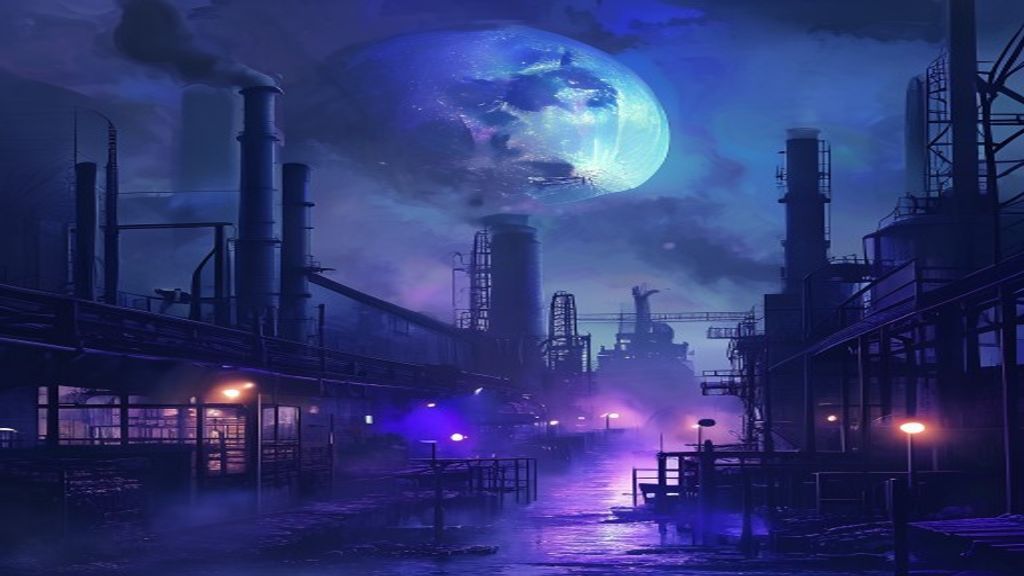
Factory dreams are almost never about factories. They’re about the experience of being a component in a system, of producing on schedule, of the gap between your own pace and the pace the machine runs at. The dreamers aren’t necessarily factory workers. They can be teachers, project managers, caregivers, parents: anyone who produces in volume on a structure they didn’t design. The factory is just the most honest visual metaphor the sleeping mind can reach for. It doesn’t flatter you, and it doesn’t apologize for that.
What happens in the factory matters enormously. A factory that’s running smoothly, where you move with some purpose and things come off the line correctly, reads very differently from a factory that’s jammed, understaffed, or running a product you can’t identify. The machinery itself, whether it’s loud or eerily silent, whether it’s vast and indifferent or broken down and waiting, is doing real interpretive work. Pay attention to whether the factory feels like it belongs to you in some sense, or whether you arrived as a stranger inside someone else’s operation.
Dreaming of a factory usually reflects your relationship to productivity and output in waking life: either the pressure to keep producing on someone else’s schedule, a sense that you’re a cog in a system larger than yourself, or occasionally, the satisfying opposite, creative work that’s actually moving forward. The feeling inside the factory is the interpretation.
An old forge, a modern line
Artemidorus, writing his dream manual in the second century, didn’t have factories in his vocabulary, but his world had workshops, mills and forges, and his rule that the same dream means different things for different dreamers, depending on age, status and occupation, transfers more cleanly than you’d expect. A forge means one thing to a smith and another to a clerk. The forge that runs hot and steady is easy to read as work going well; the forge that won’t light, or that burns everything, speaks for itself. What I find interesting about that old setting is how little the essential anxiety has shifted: am I producing enough, is the work going out correctly, who controls the fire. Modern dreamers asking those same questions just happen to dream in fluorescent light.
Whether the factory is yours
A Jungian reading would ask a question that sounds simple and isn’t: is this your factory? Not in a legal sense, but in the sense of ownership over the process. It would treat a large institutional building in a dream as a part of the self that has grown beyond individual control, a structure we inhabit but didn’t quite build. I’m usually skeptical when century-old theory is applied wholesale to contemporary dreams, but this one is hard to dismiss. When someone dreams of a factory they can’t find their way out of, or where the product on the line is unclear, or where someone else is setting the speed, the waking situation often involves that same dynamic: work that outgrew the person doing it, or pressure that originates somewhere the dreamer can’t see. The building became the boss.
G. William Domhoff’s continuity hypothesis would strip the symbolism and say the same thing without the architecture metaphor: your dreams reflect your daily preoccupations, and if your daily preoccupation is keeping up with a system that doesn’t quite fit your natural pace, the factory is simply that system, rendered at night. Both readings land in the same place. The factory in your dream is a portrait of an obligation, and the question is whether you recognize the work coming off the line as yours.
Which factory are you in
When the dream keeps coming back
Recurring factory dreams are the kind I’d take seriously as a signal. Not an urgent one, but a patient one. A factory that appears again and again across weeks or months is a mind that keeps circling back to the same productivity question, and the question hasn’t been answered. Usually because it can’t be answered at 2 a.m. But sometimes because the person hasn’t let themselves ask it during the day.
Some versions of the factory dream arrive sideways, almost as a footnote: a production line where the dreamer is packing boxes they can’t see into. Ask what is being produced and there is a long pause, and then no answer at all. That’s the version of the factory dream that stays longest. Not the loud one with broken machinery and obvious distress. The quiet one where the line is running and no one knows what it’s making. Dreaming of a ruined house is about structures that have outlasted their purpose, the factory’s quieter cousin once the line has stopped meaning anything. And dreaming of a museum is the opposite: preserved things rather than produced ones, which is a different relationship to time and effort entirely.
- Was the factory yours in some sense, or were you a visitor inside someone else’s operation?
- What was being produced? Could you identify it, and did it feel like yours?
- Was the machinery running at a pace that matched you, or faster, or not at all?
- Is there a part of your waking life right now that feels like a production quota you didn’t set?
Quick answers
What does dreaming of a factory mean?
It usually reflects your relationship to productivity and output: whether you feel like a component in a system, whether the work feels like yours, and whether the pace you’re running at is sustainable. The state of the machinery and whether you recognize the product are the key details.
Is dreaming of a factory a bad sign?
Not necessarily. A factory that’s running well and making something you recognize can be a genuinely constructive dream. The uncomfortable versions tend to be the ones with no visible product, an unsustainable pace, or a line that keeps breaking down.
What does it mean to be lost in a factory in a dream?
Disorientation inside a factory tends to appear during transitions, new roles, career shifts, or any period when your sense of purpose hasn’t caught up with your actual circumstances. You’re in the building; you just don’t know where your station is yet.
Why do I keep dreaming about working in a factory when I don’t work in one?
The factory is rarely about the literal workplace. It’s a very honest image for the experience of producing on a schedule and at a pace that someone else designed. Any role with consistent output demands, caregiving, teaching, project work, can generate this dream.
Sources for this reading
- Domhoff, G. W. (2003). The Scientific Study of Dreams: Neural Networks, Cognitive Development, and Content Analysis. American Psychological Association.
- Domhoff, G. W. (1996). Finding Meaning in Dreams: A Quantitative Approach. Plenum Press.
- Artemidorus of Daldis (2nd century CE). Oneirocritica. English edition: Harris-McCoy, D. E. (2012). Artemidorus’ Oneirocritica: Text, Translation, and Commentary. Oxford University Press.
Full bibliography on Sources and method. Found a mistake? Tell us and see the corrections log.