- Tradition
- Psychological readingPlace dreams
- Also read in
- The BibleSame symbol, other tradition
- Draws on
- Domhoff, Artemidorus
- Reviewed
- 5 min read
A grey stone wall in late afternoon light. Not dramatic, not a fairy tale, just the particular color old stone turns when the sun is low and the shadow is already climbing the wall faster than you’d expect. You stand outside the gate and can’t tell whether you’re being kept out or have decided not to go in. That ambiguity is, I think, the whole castle dream in miniature.
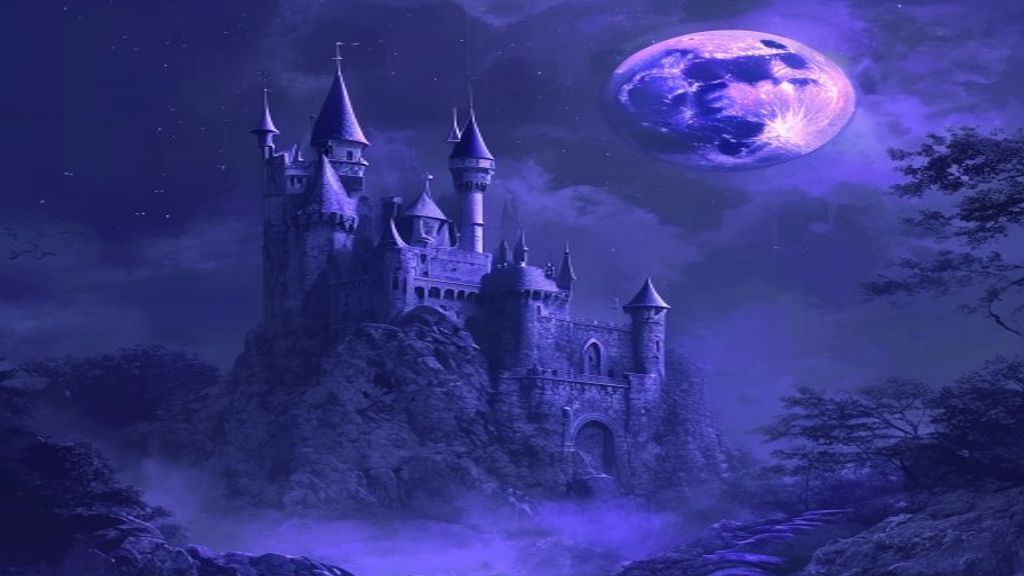
A castle in a dream is almost always about protection: whether you’re inside it (safe, or trapped), outside it (excluded, or free), or watching it fall apart. The walls are psychological first and architectural second.
Inside or outside the gate
The first thing to notice about a castle dream is where you are in relation to the walls. Inside tends to mean safety, structure, established identity. There’s something you’ve built around yourself, a set of rules, a way of living, a relationship with clear walls around it. Outside tends to mean you’re approaching something, or being kept from it.
A Jungian reading of enclosed structures treats them as images of the defended self. The moat, the drawbridge, the portcullis: all psychological mechanisms for keeping something out. The question that reading pushes you toward isn’t ‘what does the castle mean’ but ‘what are you defending, and does it still need defending?’ Because a castle that was built for a war that ended is now just a building that’s gotten harder and harder to heat.
That last image is the one worth holding on to. The unheatable castle. Perfectly intact, perfectly cold.
How to read the condition of the walls
Artemidorus and the old vocabulary
Artemidorus’s central point, that the same dream means different things for different dreamers depending on age, status and occupation, suits the castle well. A fortified house means one thing to someone who has just inherited a family home and another to someone who has just left one. I find that more useful than any fixed lookup, because it points at something the castle dream does carry: a sense of time. These buildings are old. They carry history in the stone, and lineage and reputation are the part of a life built to be inherited or remembered.
When you dream of a castle, you’re often dreaming of something with a past. Your own or not. And the question might be whether you’re inhabiting that history or just haunting it.
The version with the tower
Brief detour, because this comes up. Many castle dreams include a tower, usually with something or someone in it. The tower is the elevated, isolated piece: the part of the self that watches but doesn’t engage, or the aspiration that’s been cordoned off from the rest of life. Dreaming of a tower is a subject of its own, since height and isolation carry meaning without any walls around them, but when the tower appears inside a castle dream, it tends to represent the most defended part of whatever the castle is protecting. The keep inside the keep.
The emotional logic of fortifications
Here’s what I think castle dreams are doing that palace dreams aren’t: they’re asking about necessity. A palace is about status. A castle is about survival. Specifically, about whether the defensive structure you built is still in proportion to the actual threat.
The continuity hypothesis would note that this is just continuity: your dreaming mind is tracking the emotional architecture of your waking life, and if you’ve built walls, it’ll show you the walls. Fair enough. But I think there’s something slightly more specific happening with castle dreams, which is that the dream is often asking: are these walls yours, or did you inherit them? Because a lot of the emotional castles people walk around in were built by someone else, for circumstances that are decades old, and the current occupant is just the one paying the heating bill for a place they’d never have designed.
If the castle in your dream felt familiar in that particular way, the way a house you didn’t choose still feels like yours, that’s the question. Dreaming of a cold room pairs naturally with this one, for exactly that reason: inherited structures that no longer generate warmth. And if the castle was ruined or you found yourself in a graveyard nearby, dreaming of a cemetery at night is the nearest kin, since both are places where the past is kept standing because no one has managed to let it go.
That afternoon light on grey stone, and the gate you keep standing outside of. Whether you ever go in is the part the dream rarely settles. Some dreams don’t have the decency to resolve.
- Was I inside or outside the castle, and which felt more like my natural position?
- What condition were the walls in? Are the defenses I’m carrying still proportionate?
- Whose castle was it, and did it feel inherited or built by me?
- Is there something in my waking life I’m protecting past the point where the protection helps?
One symbol, two traditions
The two schools are not reading the same book: psychology asks what castle is doing in your waking life, while the biblical tradition tests the image against Scripture and leaves the meaning with God.
A castle in a dream is almost always about protection: whether you’re inside it (safe, or trapped), outside it (excluded, or free), or watching it fall apart. The walls are psychological first and architectural second.
You are reading this oneThe Psalm 18 tradition reads fortresses as God’s protection, yes. But the protection in those psalms is God himself, not a building. If your dream seemed to offer you shelter, the biblical question is whether that shelter is…
Read the biblical meaning →Quick answers
What does it mean to dream of a castle?
A castle is almost always about a defended structure in your life: a relationship, an identity, a set of habits you’ve built walls around. The dream’s job is to show you the walls. Your job is to decide if they still serve you or if you’ve forgotten they’re optional.
Is dreaming of a castle a good sign?
Depends entirely on what’s happening in the dream. A solid castle where you feel protected and at home can reflect a period of genuine stability. A castle you’re locked inside, or one that’s falling apart, is pointing at something that needs attention. Neither is a verdict, just information.
What does it mean if the castle is ruined?
Something you’ve organized yourself around, an identity, a relationship, a belief about how life works, is showing signs of structural damage. That can feel like loss. It can also be overdue. Ruins in dreams tend to show up when a collapse that’s already happening in waking life hasn’t been fully acknowledged.
Why do I dream of trying to get inside a castle?
Usually access or belonging: something organized, established, or formally structured that you’re trying to enter. Worth checking whether you actually want what’s inside, or whether the castle is just impressive from the outside and the real interest is being included rather than the thing itself.
Sources for this reading
- Domhoff, G. W. (2003). The Scientific Study of Dreams: Neural Networks, Cognitive Development, and Content Analysis. American Psychological Association.
- Domhoff, G. W. (1996). Finding Meaning in Dreams: A Quantitative Approach. Plenum Press.
- Artemidorus of Daldis (2nd century CE). Oneirocritica. English edition: Harris-McCoy, D. E. (2012). Artemidorus’ Oneirocritica: Text, Translation, and Commentary. Oxford University Press.
Full bibliography on Sources and method. Found a mistake? Tell us and see the corrections log.