- Tradition
- Psychological readingAnimal dreams
- Draws on
- Revonsuo, Artemidorus
- Reviewed
- 5 min read
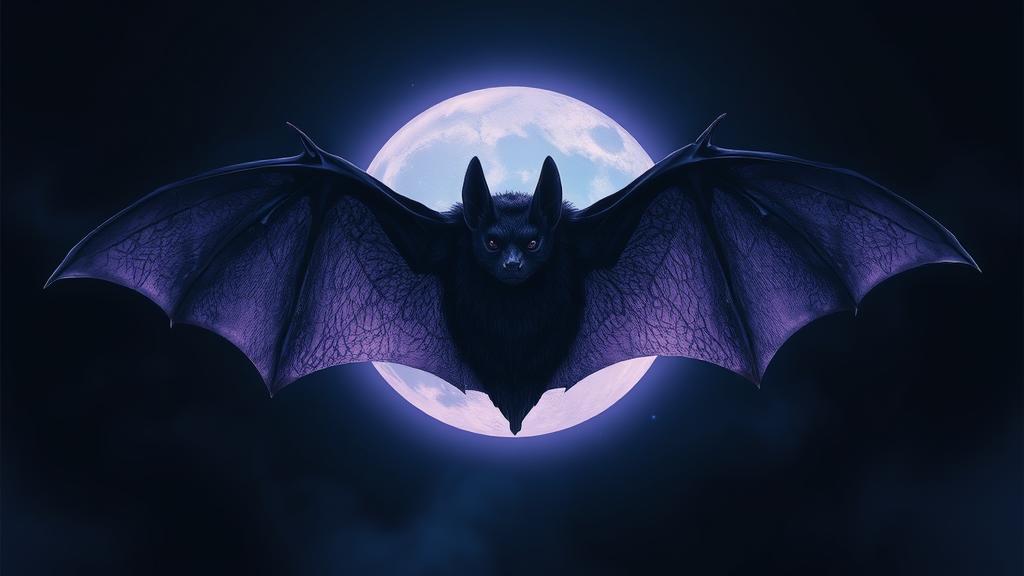
Dusk in August, and something crosses the window faster than your eye can follow. Not a bird. The wrong shape. The wings fold wrong. You stand there a second longer than you meant to, watching the space it left behind in the air. That’s the bat’s whole trick: it shows up at the threshold, when the light is going and your eyes haven’t adjusted to dark yet. Most people dismiss what they saw. A few keep watching.
If a bat flew through your sleep last night, you’re probably somewhere in your life that feels like that threshold. Not lost. Not found. That between-place where the rules of daytime haven’t quite let go.
A bat in a dream tends to signal navigation through uncertainty, something known in your gut before your conscious mind caught up. Whether it frightens you or fascinates you in the dream tells you almost everything.
The creature that sees without looking
Bats don’t use light the way we do. They’ve built a different system entirely: send a signal into the dark, listen for what bounces back, move accordingly. You already know this fact, but your dreaming brain takes it personally. The animal becomes an image of a kind of knowing that doesn’t require proof, the hunch that holds up, the instinct you talked yourself out of and later regretted. A Jungian reading would call the bat a shadow creature immediately, something that operates in the part of the psyche that works while you’re busy being rational. I find that reading almost too neat, but it keeps earning itself.
The fear response, when it’s there, is worth looking at directly. A bat swooping toward you can wake you with your heart going. That’s not necessarily a sign the dream is negative. Revonsuo’s threat simulation theory argues the nervous system rehearses possible dangers during sleep, and a creature coming at your face in the dark is exactly the kind of scenario it would want you to practice surviving. What matters is what happened after: did you freeze, duck, cover your face, or did you hold still and watch it pass? Your instinct in the dream tends to mirror your instinct in waking life when something unfamiliar flies at you.
What the bat was doing matters more than the bat
You’re turning something over repeatedly. The bat isn’t escaping because you haven’t opened the window yet. What are you still containing?
An instinct or piece of information is pushing to get your attention. The dive is urgent, not hostile. Something needs to land.
Rest in an unfamiliar posture. The world looks different inverted. This version is often about perspective more than threat.
The most straightforwardly hopeful version. Navigating beautifully in the dark is the whole point. You’re managing something you can’t fully see.
Intuition has crossed the threshold into the personal. Whatever this creature represents has moved past the outer edges of your life and into somewhere intimate.
Shape-shifting in bat dreams tends to point at something that’s been two things at once. A situation that looked like one thing and became another.
Artemidorus, working in the second century and already cataloguing what ordinary people dreamed, held that the same dream means different things for different dreamers depending on age, status and occupation. That logic applies to bats: the creature your sleeping mind chose says something about what concerns you. Bats aren’t random. Your brain picked this particular animal over all the others available to it.
Across cultures, the bat rarely reads as evil
In Chinese tradition, bats are symbols of good luck, five bats together representing the five blessings: wealth, health, love of virtue, old age, and natural death. The word for bat and the word for luck sound similar in Mandarin, and that’s not a coincidence the culture let slide. Mesoamerican traditions built entire mythologies around bat deities who governed the night underworld, not as punishments but as necessary counterparts to daylight. The Western Gothic tradition of the vampire bat is, historically, the weird outlier. Many cultures looked at this animal and thought: guidance, luck, the capacity to find your way when you can’t see.
That cross-cultural spread is worth holding onto when the dream feels ominous. If you grew up inside a tradition that loaded bats with malevolence, that’s the visual language your sleeping mind uses, but it may be drawing on a much older set of meanings underneath. The Gothic side of the image has its own page in dreaming of a vampire. For another creature that finds its way in the dark, dreaming of an owl reads a night bird as knowing without proof, and since bats roost in caves, dreaming of a cave looks at the dark place itself and what it knows about you.
Back at the window
The threshold idea is worth returning to. Bats are almost exclusively crepuscular or nocturnal, and they live in the margins: caves, attics, the space between walls. They don’t occupy the center of things. Dreams set at dusk, or featuring creatures of dusk, tend to arrive when you’re in the middle of a change that hasn’t resolved. Not crisis. Transition. The light is going but night isn’t here yet, and something is moving through that uncertainty with complete confidence because it was built for exactly this.
A bat dream can also leave something like relief, against all gothic conditioning. Like the animal was showing that it is possible to be useful and functional in conditions of uncertainty. That reading can’t be proven, but it is a reasonable one to hold alongside the others.
- Did the bat frighten me, or did I watch it with something closer to fascination?
- Was it trapped inside something, or moving freely?
- Is there something I’ve been navigating by instinct lately, something I haven’t been able to fully see?
- What time of day was the dream set in? The light in the dream is part of the message.
Quick answers
What does it mean to dream of a bat?
It usually points to navigating uncertainty using instinct rather than clear vision. The bat is built for darkness and still finds its way perfectly. Whether the dream feels threatening or oddly reassuring tends to be the more useful signal than the animal itself.
Is dreaming of a bat a bad omen?
In most cultural traditions outside Gothic Western imagery, no. Chinese, Mesoamerican, and many indigenous traditions read bats as signs of luck, guidance, and the ability to operate in difficult conditions. The bat in your dream is more likely about a skill you have than a threat approaching.
What does it mean when a bat flies at you in a dream?
Something is trying to get your attention forcefully. It’s usually an instinct or piece of information you’ve been sidestepping. The dive isn’t aggression so much as urgency. Check what you’ve been ignoring.
What does a bat in the house mean in a dream?
Whatever the bat represents has moved past the outer edges of your life and into something personal and intimate. Your intuition about a home situation, a close relationship, or something private has crossed a threshold you’d been keeping it out of.
Sources for this reading
- Revonsuo, A. (2000). The reinterpretation of dreams: An evolutionary hypothesis of the function of dreaming. Behavioral and Brain Sciences, 23(6), 877-901.DOI
- Artemidorus of Daldis (2nd century CE). Oneirocritica. English edition: Harris-McCoy, D. E. (2012). Artemidorus’ Oneirocritica: Text, Translation, and Commentary. Oxford University Press.
Full bibliography on Sources and method. Found a mistake? Tell us and see the corrections log.