- Tradition
- Psychological readingAnimal dreams
- Also read in
- The BibleSame symbol, other tradition
- Draws on
- Revonsuo, Artemidorus
- Reviewed
- 5 min read
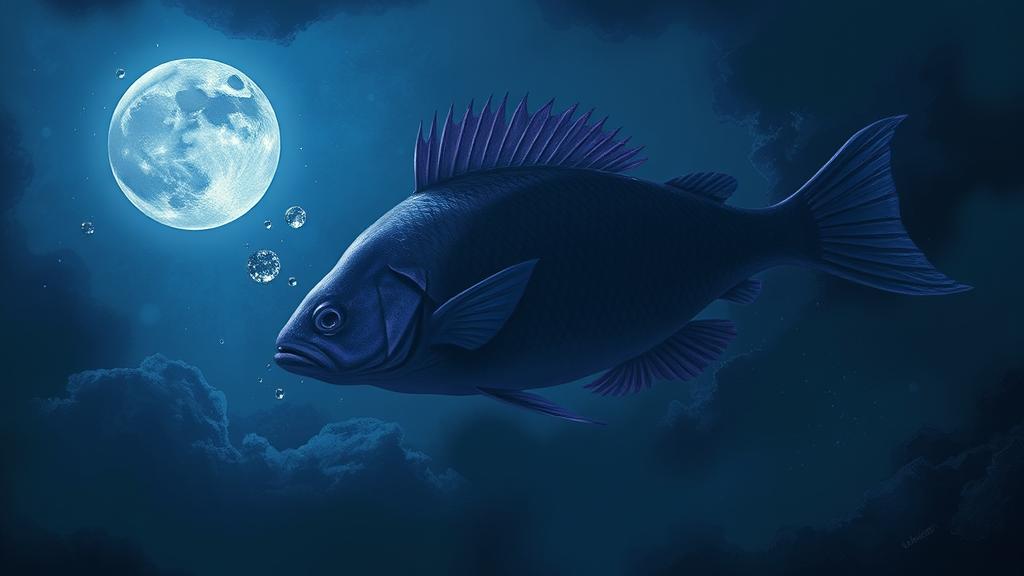
The Chester Beatty papyrus, a dream book from about 1200 BC, sorts dreams into good omens and bad. A fish floating belly up at the surface of still water would have been easy to file, and it is not hard now either: you know immediately what it means and you just stand there looking at it. What has changed is the question. We no longer ask what the dream forecasts, only what has quietly stopped.
The image carries something real into the waking hours. Not terror. Nothing that sharp. More like the specific weight of discovering that something small and quiet in your care has stopped. Maybe you forgot to feed it. Maybe there was nothing you could have done. The difference matters enormously and the dream rarely tells you which one it was.
I think the dead fish dream lands so persistently because it has a quality that most death-in-dreams doesn’t: it’s undramatic. Nobody ran, nobody wept, there was no transformation. Something was alive and now it isn’t, and the container, the tank, the pond, the clear still water, looks exactly the same as it did before.
What’s ended without announcement
The single most consistent thing about this dream is that it’s hard to pin down what, exactly, it’s about. That difficulty is information. The dead fish dream tends to surface during periods when something has ended so quietly that you haven’t fully registered it yet. Not a dramatic loss. A slow one. A thing that ran out rather than broke.
A Jungian reading takes water as the unconscious: fish living in that water represent contents of the unconscious that are, ideally, alive and moving. A dead fish in that reading is a thought, an impulse, a creative thread that has gone silent. I’m not fully convinced by that interpretation, partly because it can feel too smooth, too ready. But there’s a version of it I keep finding useful: the dead fish as a dream’s way of marking something that hasn’t been tended.
When something ends without announcement in waking life, when it simply stops being alive, the feeling is the one the image holds: standing at the glass, looking in, understanding.
- Notice the containerWhere is the fish? A tank you own, a wild river, a pond, an unknown body of water? Your relationship to the space tells you your relationship to whatever has ended. Your tank means your responsibility. A wild river means something larger is involved.
- Register the feeling, not the factThe dead fish is a fact. Your reaction to it is the dream’s actual content. Are you guilty, resigned, relieved, numb, or, strangely, fine? Each of those points in a different direction about what this ending means to you.
- Ask what it was swimming towardA fish lives in movement. The stopped version prompts the question: what momentum has gone out of something in your waking life? It doesn’t have to be a project. It can be an emotion, a connection, a version of yourself that used to move through your days.
- Consider what the water looks likeClear or murky water around the fish carries different weight. Clear water, an unclouded loss, something you can see plainly. Murky water, something you can’t fully make out, an ending you haven’t gotten a clear look at yet.
- Sit with the undramatic qualityThe dream didn’t make this death dramatic. It may be telling you that the ending doesn’t need to be either. Some things can be grieved quietly, acknowledged, and released without ceremony. Not every loss needs a scene.
What the traditions say, briefly
Artemidorus held that the same dream means different things for different dreamers, depending on age, status and occupation. A dead fish reads differently for someone who fishes for a living than for someone who keeps a tank: for the first it points toward disrupted livelihood, for the second toward something in their care that has stopped.
The Chester Beatty papyrus, one of the oldest collections of dream interpretations we have, would have filed a dead fish on the bad side, as a loss of nourishment. But the image can also be read as something surfacing from below, becoming visible, even in its ended state.
That second reading is the one I find more useful, honestly: the dead fish as revelation. Something that was invisible while alive has now surfaced where you can finally see it. An ending that makes a thing visible that wasn’t before.
If there were many dead fish
The scale changes the reading the way it changes every animal dream. One dead fish is one quiet ending. Many is a mass extinction event, a part of your life where multiple things have stopped or been allowed to die without notice.
This version often reads as the product of prolonged neglect, not dramatic destruction, but the slow attrition of things that needed tending and weren’t tended. A creative life. A relationship that faded through inattention rather than conflict. A body of work that accumulated and then just stopped.
The dead fish belongs to the wider category covered in dreaming of a dead animal, but it has a different texture: smaller in scale, quieter in emotional weight, more about the slow leak than the sudden cut. And dreaming of a stork offers a counterpoint, a water bird that folklore ties to arrivals and new beginnings, the opposite end of an ending.
The thing about the water being still
What I keep returning to is the container. Not the fish. The water, still undisturbed, continues after the death it holds.
Antti Revonsuo’s threat simulation work doesn’t have much to say about this dream, because there’s no threat to simulate. There’s just a small extinction in a container that keeps existing. I think that might be why the dream stays with people: it’s not warning you of danger. It’s showing you a fact you’ve already half-known. The water is still there. The fish isn’t.
I don’t think the dream is asking you to mourn. I think it’s asking you to notice. There’s a difference, and it’s worth sitting with.
- What small thing in my life has been running out rather than breaking, and have I acknowledged that?
- Was the fish in water I was responsible for, or water that belonged to something larger than me?
- What was my first feeling when it came into view? That feeling is the reading.
- Is there something I’ve been not-quite-neglecting, tending less than I know it needs?
One symbol, two traditions
The disagreement is honest: one school sees dead fish as self-communication, the other as an image to be discerned against Scripture. They can inform each other, but they do not merge.
Usually it points to something that has ended quietly, a creative thread, a connection, a momentum, that ran out rather than broke dramatically. The container the fish is in and your feeling on waking tell you more than the fish…
You are reading this oneFish in the Bible are strongly associated with provision, mission, and miraculous abundance (Luke 5, John 6, John 21). Dead fish don’t appear as a direct biblical symbol, but the opposite of the miraculous catch, emptiness after…
Read the biblical meaning →Quick answers
What does it mean to dream of a dead fish?
Usually it points to something that has ended quietly, a creative thread, a connection, a momentum, that ran out rather than broke dramatically. The container the fish is in and your feeling on waking tell you more than the fish itself.
Is a dead fish in a dream a bad sign?
Not automatically. Some traditions read a dead fish as something hidden surfacing into view, an ending that makes something visible that was previously submerged. The quality of the ending matters: a fish that died through neglect points in a different direction than one that simply reached the end of its natural course.
What does it mean when there are many dead fish in a dream?
Multiple dead fish tend to signal a period of accumulated neglect, where several things that needed tending weren’t tended. It’s less about dramatic loss and more about the slow attrition of things in your life that have been allowed to quietly run out.
Why does the dead fish dream feel so persistent?
Because it doesn’t resolve itself. Unlike a dream with action or fear, the dead fish just floats there. Nothing happens next. That suspended quality tends to linger in the body because the dream hasn’t given you anything to do in response to it. Which is part of its point: sometimes the right response to a quiet ending is just to see it clearly.
Sources for this reading
- Revonsuo, A. (2000). The reinterpretation of dreams: An evolutionary hypothesis of the function of dreaming. Behavioral and Brain Sciences, 23(6), 877-901.DOI
- Artemidorus of Daldis (2nd century CE). Oneirocritica. English edition: Harris-McCoy, D. E. (2012). Artemidorus’ Oneirocritica: Text, Translation, and Commentary. Oxford University Press.
Full bibliography on Sources and method. Found a mistake? Tell us and see the corrections log.