- Tradition
- Psychological readingBody dreams
- How common
- 18.8%of people have had itNielsen et al., 2003
- Also read in
- The BibleSame symbol, other tradition
- Draws on
- Domhoff, Hartmann, Artemidorus
- Reviewed
- 5 min read
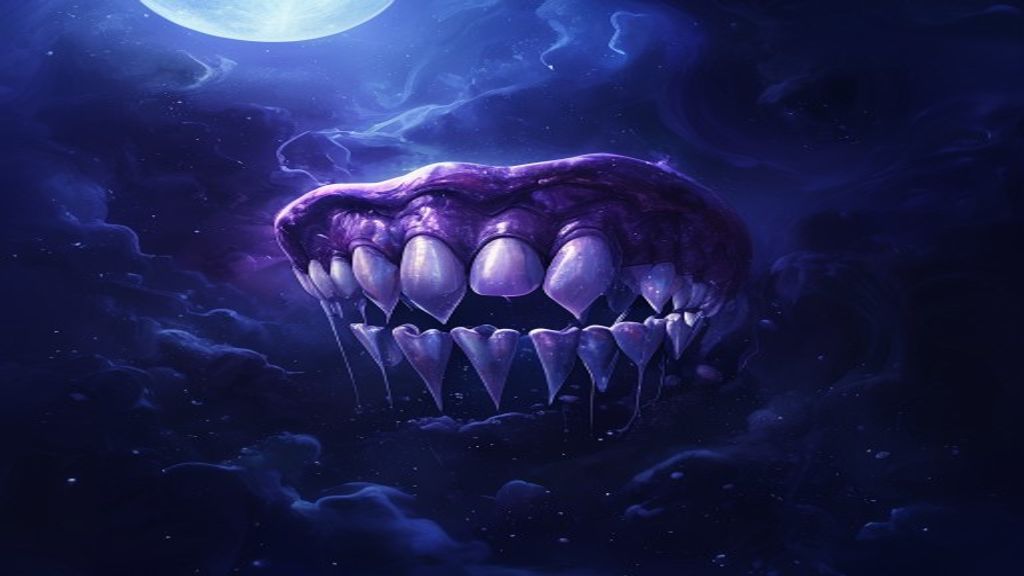
Teeth growing is easy to misread as the falling-out dream run backwards: loss reversed, so it must be good news. That fails because the feeling in the dream often isn’t relief. Teeth that move, multiply or come in where they weren’t before are uncomfortable even when the change is welcome, and that discomfort is the whole point. Something is arriving that you didn’t consciously authorize, and the dream is registering the strangeness of it before you have decided how you feel.
It’s the feeling of a mouth that feels wrong when you can’t say why, given form. Not falling out, not loose, but moving, multiplying, coming in somewhere they weren’t before. It’s less discussed than the classic falling-out version, which might be why it tends to leave people more unsettled when they have it. There’s no ready script for it. You search, you find falling-out articles, you come away more confused.
What you’re actually being handed
Growth in a dream isn’t automatically positive and it isn’t automatically frightening. It depends almost entirely on how the growth felt to you while it was happening. This is where it helps to resist the urge to look for a label before you’ve sat with the sensation.
A tooth growing in feels different from teeth multiplying. Both feel different from a full new set coming in. And all of those feel different depending on whether you were alone or being watched, whether you were alarmed or fascinated. The imagery is just the starting point.
Artemidorus already had opinions
The second-century dream interpreter Artemidorus built his Oneirocritica on a simple principle: the same dream means different things for different dreamers, depending on age, status and occupation. Apply that to teeth and nothing is generic. A dreamer who heads a household and a dreamer who is just starting out would not read new teeth the same way, and a household-minded reading would take them as new arrivals, new obligations, new dependents.
That reading is more useful than it sounds. If you’re about to take on a new responsibility, move into a role that requires you to lead or provide in a way you haven’t before, the image of new teeth appearing in your own mouth is almost uncomfortably apt. Something has come in that wasn’t there before. You’re not sure it fits yet. Give it a few weeks.
The version nobody expects to feel ambivalent about
Back to the mouth that feels wrong for no reason you can name. What that feeling names, and what the teeth-growing dream often names, is the specific discomfort of something happening inside you that you didn’t consciously authorize. You didn’t ask for the new tooth. You didn’t ask for the promotion, or the move, or the relationship taking that particular turn. It arrived. Now your mouth feels wrong and you don’t know why.
Domhoff’s continuity research would place this squarely in the category of waking concerns showing up in dream form without distortion. You’re not symbolizing anything exotic. You’re dreaming the shape of a real transition you’re in the middle of. The teeth are just what your sleeping mind handed you to work with.
If the growth felt animal or threatening, dreaming of having claws is the close relative: both put a sharp, animal tool on the body, and both ask what instinct you have been keeping out of sight.
The version that keeps coming back
Recurring versions of this dream almost always sit at the edge of a transition you haven’t committed to yet. A decision being put off. A change you can see coming and are still finding reasons to postpone. If dreams extend waking concerns, as Domhoff’s continuity hypothesis holds, a body-change dream should sit near the transition it echoes, often in the weeks or months before the change fully lands rather than at the moment of it.
The dream keeps coming back because the question it’s asking hasn’t been answered. What are you doing with this new capacity? What are you doing with what’s grown in?
If you found yourself touching the new teeth, dreaming of hands is about capacity and what you can do with it, the practical side of the same new capacity. And if you watched yourself from outside, as if the growth were happening to someone you were observing, dreaming of seeing yourself from outside deals with that same split between living a change and watching it.
- Did the growth feel natural or wrong? That single feeling contains the reading.
- Was I alone or being watched while it happened?
- What in my waking life has arrived, or is arriving, that I didn’t consciously choose?
- Have I been putting off acknowledging a change that’s already underway?
One symbol, two traditions
A psychologist asks what teeth growing felt like and what it echoes in your week. The biblical reader asks a different question entirely: what does Scripture say when this image appears, and what does it stay silent about?
It usually marks a period of transition or new capacity coming in. The emotional texture matters more than the image: growth that felt right points toward readiness, growth that felt wrong or crowded points toward an anxiety…
You are reading this oneNot explicitly in the way most dream sites claim. The biblical use of teeth is more varied: they appear as an instrument of suffering (gnashing in Matthew), of abundance (white teeth in Genesis 49), and of testing (vinegar to…
Read the biblical meaning →Quick answers
What does it mean to dream of teeth growing?
It usually marks a period of transition or new capacity coming in. The emotional texture matters more than the image: growth that felt right points toward readiness, growth that felt wrong or crowded points toward an anxiety about change moving faster than you can process.
Is dreaming of teeth growing good or bad?
Neither, automatically. It depends on the feeling. Many people who have this dream during a genuine positive transition, a new job, a relationship deepening, a new skill emerging, describe it as disconcerting anyway. Growth can feel strange even when it’s what you wanted.
Why do I dream of extra teeth coming in?
Extra or multiplying teeth in a dream often connect to feeling like new demands or responsibilities are being added to your life, whether you asked for them or not.
What if the teeth feel animal-like or sharp?
That version tends to surface instinctual qualities you don’t usually let yourself claim: assertiveness, aggression, appetite. The dream isn’t telling you to act on them. It’s showing you they exist. Worth thinking about what you’ve been suppressing rather than what you’re about to become.
Sources for this reading
- Domhoff, G. W. (2003). The Scientific Study of Dreams: Neural Networks, Cognitive Development, and Content Analysis. American Psychological Association.
- Domhoff, G. W. (1996). Finding Meaning in Dreams: A Quantitative Approach. Plenum Press.
- Hartmann, E. (1998). Dreams and Nightmares: The New Theory on the Origin and Meaning of Dreams. Plenum Trade.
- Artemidorus of Daldis (2nd century CE). Oneirocritica. English edition: Harris-McCoy, D. E. (2012). Artemidorus’ Oneirocritica: Text, Translation, and Commentary. Oxford University Press.
- Nielsen, T. A., Zadra, A. L., Simard, V., Saucier, S., Stenstrom, P., Smith, C., & Kuiken, D. (2003). The typical dreams of Canadian university students. Dreaming, 13(4), 211-235.DOI
Full bibliography on Sources and method. Found a mistake? Tell us and see the corrections log.