- Tradition
- Psychological readingBody dreams
- How common
- 18.8%of people have had itNielsen et al., 2003
- Also read in
- The BibleSame symbol, other tradition
- Draws on
- Domhoff, Nielsen, Artemidorus
- Reviewed
- 5 min read
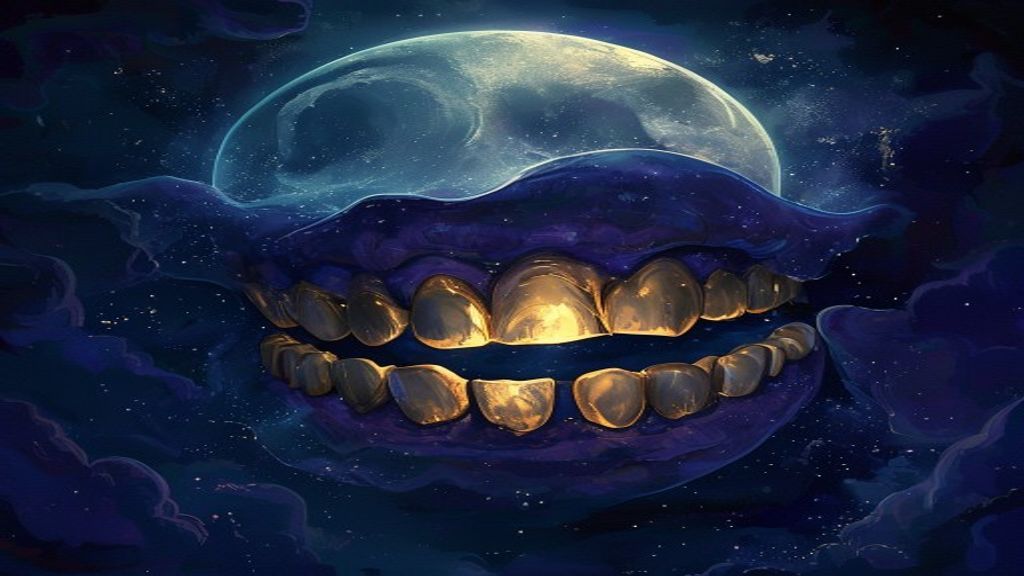
The easy reading of golden teeth is wealth: money, show, a dream of status. That reading skips over where the gold is. Gold in the mouth, a crown on a back molar say, isn’t a ring or a coat. You put it in, it becomes part of you, and years later someone else is the one who notices it. The dream is less about what you own than about what shows.
Which is, I think, exactly why dreams go there. The mouth is already one of the stranger body parts to dream about because it’s both private and public, soft and sharp, the seat of speech and silence. Swap the teeth for gold and you’ve added a whole second layer: wealth, show, permanence. But also something a little uncomfortable. Gold in a mouth is conspicuous. You didn’t choose it on a whim.
Golden teeth most often appear when something about your value, your public face, or your confidence is in motion. The dream isn’t predicting good fortune or bad. It’s asking which version of yourself you’re putting on display right now.
What a tooth dream is really doing
Teeth dreams as a category are relentless. Many people have had one, and most find them unsettling even when nothing dramatic happens. In the 2003 survey by Tore Nielsen and colleagues, 18.8% of 1,181 Canadian university students had dreamed of teeth falling out. Something about teeth clearly pulls on a deep wire.
The usual reading connects teeth to confidence: how you present, how you’re perceived, how firmly you feel anchored in social situations. When they fall out in a dream it’s rarely about dental anxiety. It tends to fit periods when people feel their grip slipping, their credibility questioned, or their self-image quietly wobbling. The mouth is your first visible instrument of selfhood. Of course your brain goes there.
Gold shifts the register. You’re not dreaming of broken teeth, or missing teeth, or teeth that won’t stay in. These ones are gold. They’re intact. They might even be beautiful. That’s a very different dream, and it’s easy to feel guilty about it, like it’s nakedly vain to wake up and realize your sleeping self was handing you a mouthful of wealth. It isn’t.
The gold question
Here’s where the interpretation splits, and I don’t think there’s one universal answer. Gold means different things depending on how the dream felt. Waking up pleased from a golden-teeth dream and waking up disturbed by one are two completely separate experiences. The image is the same. The dream isn’t.
The dream may be reflecting genuine confidence, or ambition you haven’t fully admitted to. You want to be noticed. That’s not a flaw; it’s information about where you are right now.
You’re performing a version of yourself that doesn’t quite fit. The gold stands for something you’ve adopted to look more valuable to others. Worth asking whose approval you’re chasing.
A transformation in process. Something you considered ordinary about yourself is being revalued. You’re seeing yourself differently, or someone else is.
A single thing stands out. The dream’s being specific. One quality, one role, one decision is being distinguished from the rest. What’s the thing that’s been put in a different category lately?
What Artemidorus thought, and why it still half-holds
Artemidorus was writing in the second century, and he’s annoyingly hard to dismiss even when you want to. His insistence that the same dream means different things for different dreamers, depending on age, status and occupation, is a good fit for golden teeth: a gold tooth means one thing in the mouth of a merchant and another in the mouth of someone who has just been promoted. He wasn’t wrong that gold in a dream almost always has a social dimension.
What I’d add is that the social dimension isn’t just about money. It’s about legitimacy. The dream of golden teeth is often the dream of being taken seriously. Not liked, not loved. Taken seriously. There’s a difference, and your body knows it.
Other body-part dreams ask neighboring questions. Dreaming of eyes is about seeing and being seen, the visibility side of golden teeth in its plainest form, and dreaming of having claws is what happens when a body-dream turns toward power rather than presentation. Both come back to the same underlying question: what does this body of mine mean right now?
The short version of why your waking self cares
G. William Domhoff’s continuity hypothesis says dreams don’t generally give us coded messages about things we haven’t thought about. They recombine and amplify what’s already present in waking concerns. So a golden-teeth dream is almost certainly related to something alive in your current life: a job you’re trying to land, a relationship where you’re still proving yourself, a project you’ve put a lot of shine into.
That doesn’t make the dream less interesting. It makes it more useful. Because if you can locate the waking concern, you’ve already done most of the work.
Dreaming of seeing yourself from outside is a close relative, because the golden-teeth dream is sometimes exactly that: a moment of watching yourself as others do. And if the dream had a pregnant quality, a sense of something ripening, dreaming of a pregnancy body is about embodied transformation, the body changing in ways other people can see.
Back to the gold crown
A golden-teeth dream tends to belong to a particular type of moment: somewhere between two versions of yourself, not yet one thing and no longer the other. The gold doesn’t feel like success in those dreams. It feels like the price of the change. Like something was melted down and cast into a new shape, and you’re still deciding if you like how it looks.
A gold crown on a molar is practical. It goes in because a tooth has broken, and it can outlast the person who wore it by years. The things we put in our mouths to keep them working.
- Did the gold feel like something earned, or something performed?
- Whose eyes were you seeing your teeth through?
- Is there a part of your life where you’re currently trying to look more solid than you feel?
- What’s the thing you’ve been polishing for someone else’s approval?
One symbol, two traditions
A psychologist asks what golden teeth felt like and what it echoes in your week. The biblical reader asks a different question entirely: what does Scripture say when this image appears, and what does it stay silent about?
Golden teeth most often appear when something about your value, your public face, or your confidence is in motion. The dream isn’t predicting good fortune or bad. It’s asking which version of yourself you’re putting on display…
You are reading this oneScripture never describes teeth turning to gold in any dream or vision. It has a great deal to say about gold as value and purity, and about the mouth and tongue as the site of life-giving or destructive speech. A biblical…
Read the biblical meaning →Quick answers
What does it mean to dream of having golden teeth?
Golden teeth in a dream usually point to questions of value and visibility: how you present yourself, whether you feel taken seriously, or whether something you consider ordinary about yourself is being reappraised. The emotional tone of the dream matters more than the image itself.
Is dreaming of golden teeth a good omen?
Psychologically, the dream is neither a promise nor a warning. It tends to surface during transitions when your sense of worth or public identity is shifting.
Why did my teeth turn gold in a dream?
A transformation dream. Your sleeping mind may be processing a change in how you see yourself, or how others see you. Something you’ve taken for granted is being assigned a new value. It’s worth asking what’s changed recently in your professional or social landscape.
Do teeth dreams always mean anxiety?
No, though anxiety is one common driver. Falling or crumbling teeth tend to connect with vulnerability and lost confidence. Golden teeth are a quieter, more ambivalent image, often appearing in periods of ambition or change rather than pure fear.
Sources for this reading
- Domhoff, G. W. (2003). The Scientific Study of Dreams: Neural Networks, Cognitive Development, and Content Analysis. American Psychological Association.
- Domhoff, G. W. (1996). Finding Meaning in Dreams: A Quantitative Approach. Plenum Press.
- Nielsen, T. A., Zadra, A. L., Simard, V., Saucier, S., Stenstrom, P., Smith, C., & Kuiken, D. (2003). The typical dreams of Canadian university students. Dreaming, 13(4), 211-235.DOI
- Artemidorus of Daldis (2nd century CE). Oneirocritica. English edition: Harris-McCoy, D. E. (2012). Artemidorus’ Oneirocritica: Text, Translation, and Commentary. Oxford University Press.
Full bibliography on Sources and method. Found a mistake? Tell us and see the corrections log.