- Tradition
- Psychological readingAnimal dreams
- Draws on
- Revonsuo, Jung, Artemidorus
- Reviewed
- 4 min read
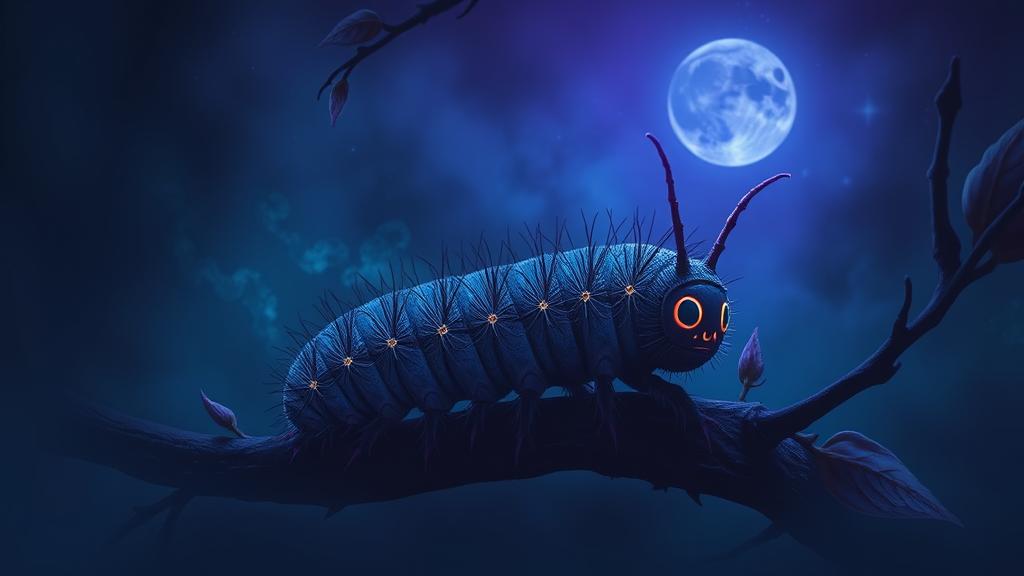
Why would a dream bother showing you a caterpillar doing nothing? Because doing nothing is exactly what unfinished work looks like from the outside. A fat green caterpillar sits in the center of a blank page, going nowhere, and the dream has the nerve to feel important. You wake irritated and convinced you’ve missed something. What you were shown is a process that isn’t finished yet, and the discomfort of watching it is part of the image.
A caterpillar in a dream is almost always about a process that isn’t finished yet. Not failure. Not stalling. The work of becoming, which looks identical to doing nothing from the outside. The discomfort you feel watching it is usually the point.
What the caterpillar is actually doing
The outside view
From outside, the caterpillar looks passive. It eats. It moves slowly. It resists the eye’s desire for drama. The people around you can see the same thing about you right now, whatever you’re in the middle of. They’re not wrong, exactly. They just can’t see inside the process.
The inside reality
Inside the chrysalis, which hasn’t arrived yet in the caterpillar stage, nearly everything dissolves. The transformation isn’t a tidy upgrade. It’s closer to a controlled dismantling. The caterpillar dream often arrives when you’re in your own version of that: halfway undone, not yet reassembled.
A Jungian reading would see the tension between what we present and what is forming underneath, and a caterpillar on a white page is almost embarrassingly on-the-nose as an image for that gap. I’m cautious about reaching for Jung at the first opportunity, but this is one of those symbols where the archetypal reading and the personal one arrive at the same address.
The color of the caterpillar matters more than you’d think
Green caterpillars in dreams tend to carry a sense of organic process, something growing from the inside out rather than built. Brown or dark ones shade toward camouflage, toward something you’re keeping hidden, possibly from yourself. A bright or implausible color, orange, electric blue, means your dreaming mind has flagged this creature as symbolic rather than literal. It wants you to notice it. You can find a similar logic at work in dreaming of a red snake, where vivid color tends to amplify rather than change the core meaning.
What it was eating, and why that matters
Artemidorus’s principle that the same dream means different things for different dreamers applies here: the creature matters less than the circumstances around it. A slow, harmless creature on a plant reads differently from a stinging one on your arm. So ask what it was sitting on, and whether it was eating your food. Which is actually not a bad question for the dream you had.
A caterpillar that’s feeding in a dream is doing its actual job. That’s not a negative image. But if what it’s eating is something you value, a book, a garden you’ve built, your clothes, that detail pulls the reading toward something in your waking life that’s being consumed by a slow process you haven’t quite named. Not a sudden crisis. A gradual erosion. A caterpillar quietly eating your clothes is the small domestic cousin of the animal in dreaming of a tamed wild animal: both are about something you assumed was harmless and under control.
When the caterpillar is the wrong size
Dreams scale creatures without logic and without apology. A caterpillar the size of a small dog carries a different emotional charge than the one on the white page. Size in dreams is usually about the weight you’re assigning something in your waking life. A tiny caterpillar you can barely see means you’ve almost missed something. An enormous one means you’ve been watching a slow process and it’s gotten bigger than you realized. Revonsuo’s threat simulation framework helps here, not because a caterpillar is threatening, but because the dream mind is running calibration: am I taking this seriously enough? Do I have the right scale for what’s happening to me?
Once the creature has finished its change, as in dreaming of a butterfly, the question flips from whether you are taking the slow process seriously to what actually came out of it.
The feeling when it’s gone
A caterpillar that disappears mid-dream, that you were watching and then it’s simply not there, carries a specific kind of unease. Not the sharpness of something taken. More the low-grade worry of something you were keeping track of and lost sight of. It’s the dream equivalent of putting your keys down in a room and not being able to remember which room. The process you were monitoring is still happening. You’ve just lost the thread of it.
That is the feeling the vanishing caterpillar leaves. The page is white again, and you don’t remember seeing the creature go. What stays is that particular quality of attention a dream leaves on you when it’s been trying to say something in a language you almost speak.
- What was the caterpillar sitting on? That surface is the subject it was marking.
- Was it moving toward something or just still? Stillness and slow movement read differently.
- Did you feel impatient watching it? That impatience is probably about something else.
- Is there a process in your waking life that looks like nothing from the outside?
Quick answers
What does dreaming of a caterpillar mean?
It usually points to a process of change that’s underway but not visible yet. The discomfort many people feel in these dreams often mirrors their own impatience with something that’s transforming slowly. The caterpillar isn’t stuck. It’s working.
Is a caterpillar in a dream a good or bad sign?
Generally neutral to positive. The caterpillar is associated with becoming, not with failure or threat. The reading shifts toward difficulty only when the caterpillar is eating something you value or when it disappears, which tends to suggest a process you’ve lost track of.
What does a giant caterpillar in a dream mean?
Scale in dreams reflects emotional weight, not literal size. A very large caterpillar suggests you’ve been watching something grow slowly and it’s now bigger than you expected. Not necessarily threatening, but worth looking at with the same enlarged attention the dream gave it.
What does it mean if a caterpillar transforms into a butterfly in your dream?
That’s the complete arc, and it’s rare. When it happens, it tends to feel conclusive rather than hopeful, more like witnessing something finished than anticipating something beginning. The process the dream was tracking has resolved. You probably already know what it was.
Sources for this reading
- Revonsuo, A. (2000). The reinterpretation of dreams: An evolutionary hypothesis of the function of dreaming. Behavioral and Brain Sciences, 23(6), 877-901.DOI
- Jung, C. G. (Ed.). (1964). Man and His Symbols. Doubleday.
- Artemidorus of Daldis (2nd century CE). Oneirocritica. English edition: Harris-McCoy, D. E. (2012). Artemidorus’ Oneirocritica: Text, Translation, and Commentary. Oxford University Press.
Full bibliography on Sources and method. Found a mistake? Tell us and see the corrections log.