- Tradition
- Psychological readingAnimal dreams
- Draws on
- Revonsuo, Artemidorus
- Reviewed
- 5 min read
A garden in August, early morning, and you turn over a flat stone. Underneath: pale, glistening, four or five of them clumped together. You didn’t scream but you made a sound. Something between disgust and a kind of awful recognition, like the garden had a secret it didn’t mean to show you. That image, the thing under the stone, is almost the exact shape of what slug dreams do.
Slugs are quieter than more dramatic dream animals, and the dream is easy to wave away, as if mentioning it gives it more weight than it deserves. But it tends to bother in ways that are hard to explain. The slug on the kitchen counter. The slug inside the house. The slug on your hand that you can’t get off. That last one is worth taking seriously.
What the slug is that the snail isn’t
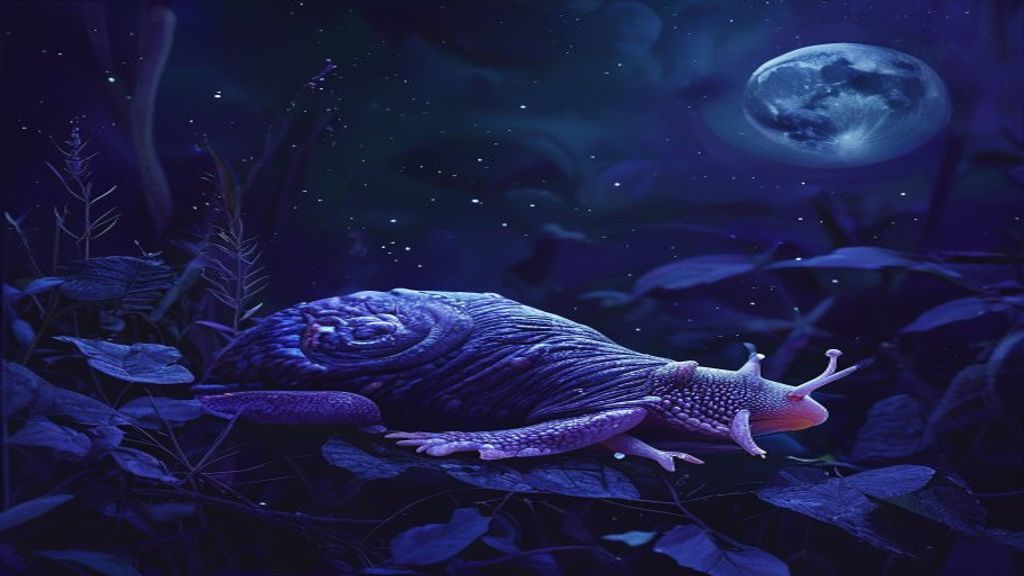
The structural difference is obvious, but it matters enormously in dream terms: the slug has no shell. It’s the same soft, slow creature, but completely exposed. If the snail in a dream suggests a self that’s protecting its pace, the slug is that same self stripped of its armor. Moving anyway. Leaving a trail anyway. Doing the whole slow, deliberate thing with nowhere to retreat.
That’s not automatically a bad thing. Vulnerability can be chosen. But dreams about slugs almost always carry a texture of wrongness, an ick-factor that isn’t arbitrary. The revulsion is signal. Something that should have protective covering has lost it, or never had it, and is now fully visible in a context where visibility feels risky.
| Tradition | How it reads the symbol |
|---|---|
| European folk tradition | Slugs crossing a threshold were read as omens of rot or hidden decay in the household. They belonged outside; finding one inside meant something had already gone wrong. |
| Artemidorus (2nd c.) | Soft, limbless creatures in dreams were generally read as signs of something formless and unresolved. Not monstrous, but without shape enough to be dealt with directly. |
| Jungian shadow work | Creatures that trigger instinctive disgust are often worth examining as shadow material: the parts of yourself you find repulsive or low, exactly because that reaction is disproportionate to the actual threat. |
| West African and Caribbean traditions | Slow-moving creatures in dreams are sometimes read as ancestors moving through the world at a different pace, not lost, just on a longer timeline. The disgust framework doesn’t apply; the slowness is dignified. |
The disgust response and what it’s actually tracking
Threat simulation theory, Revonsuo’s 2000 proposal that dreaming rehearses responses to danger, would say the disgust in a slug dream is doing exactly what it evolved to do: flagging contamination risk, boundary violation, something that shouldn’t be where it is. I think that’s right as far as it goes. But the dream isn’t a pathogen alert. The disgust is pointing at something psychological that has the same shape: a part of your life, yourself, a dynamic in a relationship, that you find viscerally hard to look at, and that keeps showing up in places it shouldn’t.
The question isn’t whether to get rid of the slug. It’s what the slug represents that you’ve been turning a stone over and hoping wasn’t there.
A Jungian reading would push harder and ask what quality you project onto the slug, what you find most intolerable about it. Slow? Slimy? Formless? Leaving a trail you can’t erase? Those adjectives are worth applying to whatever’s unresolved in your waking life right now. Not as insults. As clues. I find the shadow-work reading genuinely useful here, though I’d be careful not to turn it into a moral exercise. You don’t have to love the slug. You just have to figure out what it’s doing in your house.
Location changes everything
A slug outdoors in a garden, even an unsettling one, is a different dream from a slug in a bedroom or on food. In the garden, it’s in its proper ecosystem; the unease might be mild. The moment it crosses a threshold, kitchen, bed, body, the contamination reading activates fully. That’s your psyche’s way of saying the boundary between inside and outside has been breached, that something you kept exterior is now interior, or vice versa.
If the slug was on your skin in the dream, that’s the most intimate version, and also the one people most often describe as recurring. A recurring slug dream usually means the thing it represents hasn’t been named. Not fixed, necessarily. Just named. The naming alone tends to change something.
Salt
Dreams in which you pour salt on a slug are worth a separate sentence. Salt dissolves the boundary. The slug doesn’t just die; it dissolves. That’s aggressive symbolic energy, and it tends to show up when you’ve decided something, when you’re done tolerating a slow-moving intrusion and have reached for the one thing that will end it definitively. Sometimes that’s the healthiest dream in this whole cluster.
The flat stone you turned over
Slug dreams often arrive when something that was hidden has recently become visible. A secret surfacing. A dynamic in a relationship you could previously explain away. A habit you’ve been keeping outside the house, in the garden, under a stone, that’s started appearing on the counter. You didn’t put it there. It moved on its own.
If the texture of your dream was more about dread than disgust, or if the slug was part of a larger landscape of things underground and unseen, it might share something with dreaming of lice, which carries a similar sense of infestation and unacknowledged intrusion. And dreaming of earthworms shares the stone image itself: soft creatures that surface when the ground is disturbed, the hidden coming up into view.
Lifting the same stone over and over, knowing what you’ll find, is a compulsion that feels related to what slug dreams do: you know the thing is there, and the dream keeps lifting the stone, almost as if seeing it will eventually make it less horrible. Sometimes it does. The slug doesn’t get less slimy, but you stop making the sound.
- Where was the slug in the dream? Inside or outside a boundary matters enormously.
- What quality bothered me most about it: the slowness, the exposure, the trail, the texture?
- Is there something in my waking life I keep finding where it shouldn’t be?
- What’s been living under the flat stone that I already know about but haven’t named yet?
Quick answers
What does it mean to dream about a slug?
A slug in a dream typically points to something exposed and unprotected, a part of yourself or a situation that’s moving slowly without its usual defenses. The disgust response, if you felt it, isn’t random: it’s pointing at something in your waking life that you find difficult to look at directly.
Why are slug dreams so disturbing?
The revulsion is doing real work. It’s flagging something that feels like a contamination or a boundary violation, not a physical one but a psychological one: something that belongs outside is inside, or something you’ve been keeping hidden has started appearing where you can’t ignore it.
What does it mean to dream of a slug on your body?
That’s the most intimate version of the dream and tends to be the most recurring. Something you find repulsive or shameful has come close enough to touch. It’s worth asking what quality the slug carries that you’d most hate applied to yourself, and whether that quality is actually present somewhere in your current life.
Is dreaming of a slug a bad omen?
In folk traditions it often was, associated with decay or things going wrong in the household. Psychologically, it’s more useful to see it as a prompt rather than a prediction: something slow-moving and unpleasant has your mind’s attention, and the dream is asking you to look at it rather than keep flipping stones.
Sources for this reading
- Revonsuo, A. (2000). The reinterpretation of dreams: An evolutionary hypothesis of the function of dreaming. Behavioral and Brain Sciences, 23(6), 877-901.DOI
- Artemidorus of Daldis (2nd century CE). Oneirocritica. English edition: Harris-McCoy, D. E. (2012). Artemidorus’ Oneirocritica: Text, Translation, and Commentary. Oxford University Press.
Full bibliography on Sources and method. Found a mistake? Tell us and see the corrections log.