- Tradition
- Psychological readingBody dreams
- How common
- 48.3%of people have had itNielsen et al., 2003
- Draws on
- Domhoff, Nielsen, Artemidorus
- Reviewed
- 6 min read
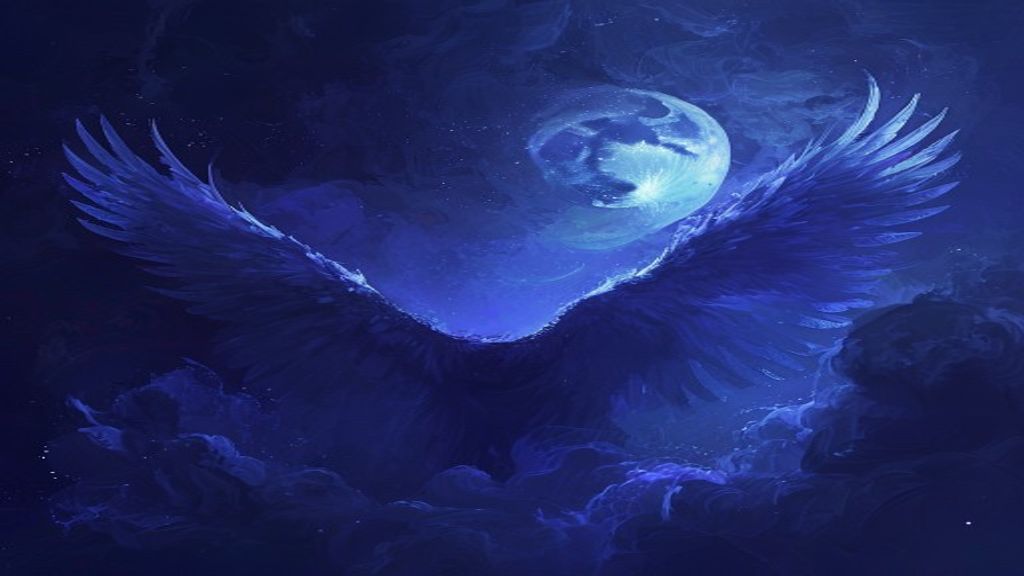
You feel them before you see them: a weight settling between the shoulder blades, a pull in the muscle like a sail taking wind. Then you are rising, or trying to, the feathers enormous, and below you a crowd goes on with its day without looking up. That last detail is the one that stays after waking, because it turns a flying dream into something else.
The wings dream isn’t always exhilarating. Sometimes it’s the saddest possible version: you’ve found something extraordinary about yourself, and the people around you are too busy to glance skyward.
The physical sensation deserves its own note. The feeling of wings, the weight of them on your back before you rise, that specific membrane-pull at the shoulder blades, it’s one of the most viscerally convincing experiences the sleeping mind produces. The fact that it feels so real is half the information.
Wings in a dream almost always represent freedom, capacity, or aspiration, but which depends on whether you used them, whether they worked, and who was watching. A dream where flight felt easy reads very differently from one where you couldn’t get off the ground.
What the wings were actually doing
There’s a trampoline quality to some of these dreams, and I mean this precisely. On a trampoline, just before you’re about to come down, there’s a half-second of suspension where your body doesn’t know which way gravity points. The wings dream before you’ve actually taken flight exists in that half-second. All the potential, none of the direction yet. If your dream stayed in that moment, hovering near the ground, testing what the wings could do, the dream is about possibility you haven’t committed to. You have the capacity. You’re still deciding whether to use it.
If you flew and it worked, that’s one of the genuinely joyful dreams. Not escapism, or not only: Nielsen’s survey of typical dreams found that 48.3% of the university students asked had dreamed of flying, so this is far from a rare experience. The body in the dream wasn’t fleeing. It was doing what it was built to do.
If the wings wouldn’t work, the dream turns pointed. Too heavy, too small, molting at the wrong moment. That’s the dream of capacity you believe you have but can’t access in this period of your life. Not a judgment. More like a report.
The shape that keeps appearing through history
- Ancient Egypt
Winged figures weren’t aspirational; they were divine. The soul’s capacity to fly was a statement about what the soul was. The Chester Beatty papyrus (about 1200 BC) sorts dreams into good and bad omens, which is the frame a winged dream would have been read in.
- Ancient Greece
Artemidorus argued that the same dream means different things for different dreamers, depending on age, status and occupation. On that logic wings were never neutral: a merchant might read them as profitable travel, a slave as escape and risk. They were always about what’s constraining you.
- Medieval Islamic tradition
Classical Islamic dream manuals tend to tie flight to ambition, rank and standing with those in authority. Read in that spirit, wings that function well suggest legitimate aspiration, and wings that belong to the wrong creature, a bat instead of a bird, suggest ambition misapplied.
- 20th century psychology
A Jungian reading would take the winged self as the psyche’s attempt to rise above a conflict rather than resolve it at its own level. That framing overstates the elegance a bit, I think, but it captures something real about why this dream appears at crossroads.
- Contemporary research
Domhoff’s continuity hypothesis, that dreams extend waking concerns, fits flying dreams well: you dream of wings when waking life has been pressing you down or when something you’ve been working toward is finally within range. In REM sleep the muscles are switched off, so the wings feel real partly because the body is already strangely still.
The wings no one looks at
I want to come back to the version from the opening, the wings no one would look at. I think it is more specific than “I want to be recognized.” The dream is staging something the dreamer already knows: they’ve developed something real, and they’re in a context where that thing isn’t visible to the people whose opinion they care about most.
The wings dream with an indifferent audience is a wings dream where the gift has outgrown the room. That’s uncomfortable to say out loud. It might be more uncomfortable to not say it. The dream doesn’t give the wings as compensation. It gives them as a statement of fact, and leaves the social problem right in the frame where the dreamer had been carefully not looking at it.
Domhoff’s continuity hypothesis would say the dream is tracking the waking situation with uncomfortable accuracy, and that seems right to me. It’s not offering comfort. It’s offering clarity.
If the wings are the whole point for you, the plain version of the dream is covered in dreaming of flying, where there are no wings at all and the body simply lifts. The sensation is the same, but without the feathers the dream has to be about the flying itself, and that comparison shows how much of this dream is carried by the wings.
What kind of wings, and what that might mean
Wings of feathers, large and warm, are almost always about aspiration with emotional weight. They feel like they belong to you. Mechanical wings, iron or glass, tend to come with an undertone of effort and construction: you built this, and now you have to trust the build. Bat wings carry a different atmosphere entirely, not evil in any useful interpretive sense, but liminal, nocturnal, suggesting a capacity that functions only in the dark or at the edge of things. And the wings that don’t belong to an animal you can name, the strange membrane-sail ones, those tend to appear when the dreamer is in genuinely new territory, a version of themselves without a precedent.
If the wings stayed barely off the ground, dreaming of flying very low describes that almost-but-not-quite height, which is the same in-between hovering that the trampoline image above points to. The self is trying on a new shape and has not yet trusted it.
The trampoline moment. That’s what I would point to as the center of these dreams. Not the soaring, though the soaring is real. The suspended instant before it, when the body is entirely committed to going up and doesn’t yet know if the wings will hold. That’s the dream’s center of gravity. Everything else is what happens next.
- Did the wings actually work, and how easily, and what does that ratio feel like in your current life?
- Were you trying to show someone, and if so, who was in the audience that wouldn’t look up?
- What kind of wings were they, and did they feel like yours or like something borrowed?
- What in your waking life has been keeping you close to the ground lately?
Quick answers
What does it mean to dream of having wings?
Wings nearly always represent freedom, capacity, or some aspiration you’re carrying. The meaning sharpens when you notice whether you actually flew, whether the wings worked, and how other people in the dream responded. The sensation itself is one of the most convincing the sleeping mind produces, which is worth noting.
Is a dream of flying with wings a good sign?
Usually yes, especially if the flight felt free and the wings held. It tends to arrive when something you’ve been working toward is coming within range. The difficult version is when the wings won’t work, which is more like a honest report on feeling constrained than a bad omen.
Why did no one notice I had wings in my dream?
That version of the dream is about capacity that’s real but unrecognized in your current context. The gift has outgrown the room, or the people in the dream represent an audience that can’t see what you’ve become. It’s less a rejection dream and more a mismatch dream. Worth thinking about where you’re directing your wingspan.
What do different types of wings mean?
Feathered wings tend to carry warmth and aspiration. Mechanical wings suggest effort and construction, something you built rather than were given. Bat wings are liminal rather than sinister, they work in the dark and at edges. Wings that don’t belong to any familiar creature usually appear when you’re in genuinely new territory as a person.
Sources for this reading
- Domhoff, G. W. (2003). The Scientific Study of Dreams: Neural Networks, Cognitive Development, and Content Analysis. American Psychological Association.
- Domhoff, G. W. (1996). Finding Meaning in Dreams: A Quantitative Approach. Plenum Press.
- Nielsen, T. A., Zadra, A. L., Simard, V., Saucier, S., Stenstrom, P., Smith, C., & Kuiken, D. (2003). The typical dreams of Canadian university students. Dreaming, 13(4), 211-235.DOI
- Artemidorus of Daldis (2nd century CE). Oneirocritica. English edition: Harris-McCoy, D. E. (2012). Artemidorus’ Oneirocritica: Text, Translation, and Commentary. Oxford University Press.
Full bibliography on Sources and method. Found a mistake? Tell us and see the corrections log.