- Tradition
- Psychological readingBody dreams
- Draws on
- Domhoff, Jung, Freud
- Reviewed
- 5 min read
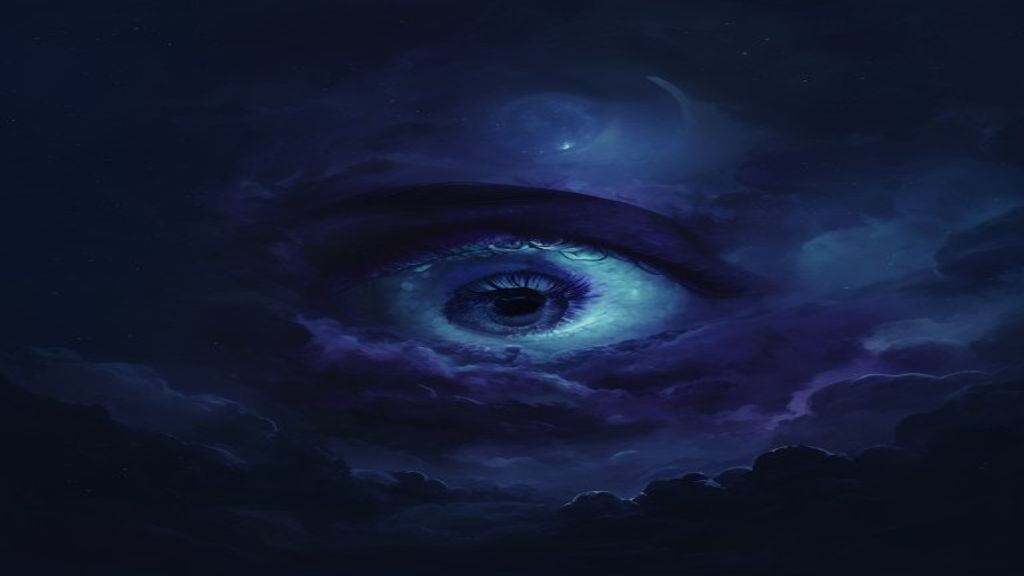
Is the third eye in a dream a gift of sight? Usually it is something plainer. You dream that you have one, right between the other two, and it is open. You don’t look through it. You just feel that it is open, and that it can see things your other eyes keep diplomatically failing to notice. What it shows is what you already knew, with your defenses down.
The knowing that precedes the looking
The third eye in dreams almost never functions the way people expect. There’s no beam of mystical light, no sudden revelation downloaded from somewhere outside. In the dream itself it’s subtler and stranger: a sense of expanded field, of peripheral awareness that doesn’t have a location, of noticing without quite deciding to look. Less a spotlight than a widened window. And the thing it tends to see is usually something the dreamer already knew. Not new information. Old information that’s been sitting in a drawer. The third eye isn’t showing you the future. It’s showing you the present with your defenses down. A dream of expelling something makes a coherent partner for this one: the body dreams of releasing something, and the mind dreams of seeing more clearly. Whether they arrive a night apart or never together, they point at the same movement, getting rid of whatever blurs.
- 2nd century CE
Artemidorus, in the Oneirocritica, held that the same dream means different things for different dreamers, depending on age, status and occupation. An eye in an odd place on the body is easy to imagine read that way: a gift of foresight for one dreamer, a sense of being watched for another.
- Hindu and Buddhist traditions (ancient, ongoing)
The ajna chakra, or third eye, located at the forehead, represents intuition, inner sight, and the capacity to see beyond the surface of things.
- Across dream traditions
Eyes and sight are rich symbols in many dream traditions, and an additional eye is easy to read as clarity, the uncovering of truth, or spiritual perception.
- 19th-20th century psychology
Freud read dream images through wish fulfilment, manifest and latent content. Jung, with his archetypes, left more room for an image like this: an eye that watches the rest of the self. A Jungian reading would treat a third eye as the observing function operating beyond the ordinary limits of conscious attention.
- Contemporary dream research
Domhoff’s continuity hypothesis holds that dreams extend waking concerns. A third eye is a specific version of the broader category of body-transformation dreams, which tend to feel uncanny but rarely frightening.
What it’s seeing that you’re not
Here’s my honest read, the one I hold with some confidence: the third eye in a dream is a perception dream, not a power dream. The dreamer isn’t being given something. They’re being told they’ve been withholding something from themselves. I’m usually cautious about making sweeping claims about dream symbols. But in this case the recurrence of the image across traditions is hard to dismiss. In many of them, the image of an additional eye resolves to the same thing: seeing what’s actually there, past what you’ve been willing to acknowledge. The perception isn’t external. It’s the permission to use what you’ve already got. Domhoff would frame this less dramatically, and he’d be largely right: if someone is in a period of suppressed knowing, if they’re maintaining a convenient blindness about their job, their relationship, their health, their direction, then a dream of enhanced perception is exactly what continuity would predict. The third eye is the mind’s way of noting that it’s been holding information it hasn’t passed upstairs yet.
When it opens versus when it’s always been there
Two versions of this dream, and they’re reading differently. The first: you discover the eye. It’s there on your forehead, and you didn’t know. You feel it open, or you see it in a mirror, or someone else notices it. This version tends to arrive at threshold moments, at the beginning or end of something, when something you’ve been constructing or denying is becoming impossible to maintain. The second: in the dream, the eye has always been there. You’ve always had it. And the dream’s question isn’t about discovery but about use: why haven’t you been looking through it? This is a quieter dream, and it implicates the dreamer a little. It’s asking what you’ve chosen not to see. If dreaming of blood has been part of the same stretch of nights, the pair suggests your perception and your emotional life are both in motion simultaneously. That’s not unusual, but it’s worth tracking.
The version that resists a clean reading
There’s a version of this dream that resists a clean reading. The third eye is there. It’s open. And it’s looking at you, not outward. The other two eyes look outward. This one looks inward. It’s the sensation of being observed by yourself, watched from inside, and it’s the strangest of these dreams to sit with. Dreaming of seeing yourself from outside shares the self-observation, and there’s something shared there about dissociation too. But the third eye version isn’t dissociation. It’s the opposite. It’s the intensely present sensation of being known to yourself more completely than usual. That one is compelling in a way that’s hard to justify entirely. The image of an eye that sees inward is a metaphor that earns its keep.
What you knew before you looked
Ask what the third eye changed, and the honest answer might be “nothing, I had already decided.” The dream didn’t cause the decision. It just stopped letting the decision go unadmitted. That is exactly what the third eye dream is saying. You already knew. The eye was open. What you lacked wasn’t information. You lacked permission to act on what you could already see. There’s something about the image of an eye opening in a dream the night before a person finally looks clearly at their own life that I’m not sure I want to turn into theory just yet.
- Was the eye looking outward or inward, and does that direction tell you something?
- Did it feel like a gift or an exposure?
- What’s the one thing you’ve been seeing imprecisely that this dream might be sharpening?
- If you already knew what the third eye showed you, when did you stop trusting that knowing?
Quick answers
What does it mean to dream of having a third eye?
It’s most often about perception you’ve been suppressing or not fully trusting. The third eye in dreams isn’t showing you something supernatural. It’s showing you something you already know but haven’t quite let yourself see clearly yet.
Is dreaming of a third eye spiritual?
The image is ancient and appears in Hindu, Buddhist, Islamic, and many other traditions, all reading it as heightened inner sight. Whether you take that as spiritual or psychological, the functional meaning is similar: a permission to perceive what you’ve been partially avoiding.
What’s the difference between dreaming the eye opens versus finding it already there?
The opening version usually arrives at a threshold, a beginning or ending. The always-there version is asking why you haven’t been using it. That second one tends to implicate the dreamer a little more directly in what they’ve been choosing not to see.
Why does the third eye feel so unsettling even when nothing frightening happens?
Because being seen clearly, especially by yourself, is unsettling. The dream isn’t threatening you. It’s just removing the comfortable blur. That’s worth tolerating, even if it doesn’t feel comfortable right away.
Sources for this reading
- Domhoff, G. W. (2003). The Scientific Study of Dreams: Neural Networks, Cognitive Development, and Content Analysis. American Psychological Association.
- Domhoff, G. W. (1996). Finding Meaning in Dreams: A Quantitative Approach. Plenum Press.
- Jung, C. G. (Ed.). (1964). Man and His Symbols. Doubleday.
- Freud, S. (1900). The Interpretation of Dreams (Die Traumdeutung; first published November 1899). English translation by James Strachey, Basic Books.
- Artemidorus of Daldis (2nd century CE). Oneirocritica. English edition: Harris-McCoy, D. E. (2012). Artemidorus’ Oneirocritica: Text, Translation, and Commentary. Oxford University Press.
Full bibliography on Sources and method. Found a mistake? Tell us and see the corrections log.