- Tradition
- Psychological readingObject dreams
- Also read in
- The BibleSame symbol, other tradition
- Draws on
- Domhoff, Hartmann, Hobson
- Reviewed
- 6 min read
A single lit candle on a windowsill. You know the image. You’ve probably seen it in a film and felt something you couldn’t immediately explain, a small tightening in the chest, the sense that someone is waiting for someone who may not come back. The candle in a window is one of the oldest pieces of human visual grammar: it says vigil, it says hope, it says I’m still here even after dark.
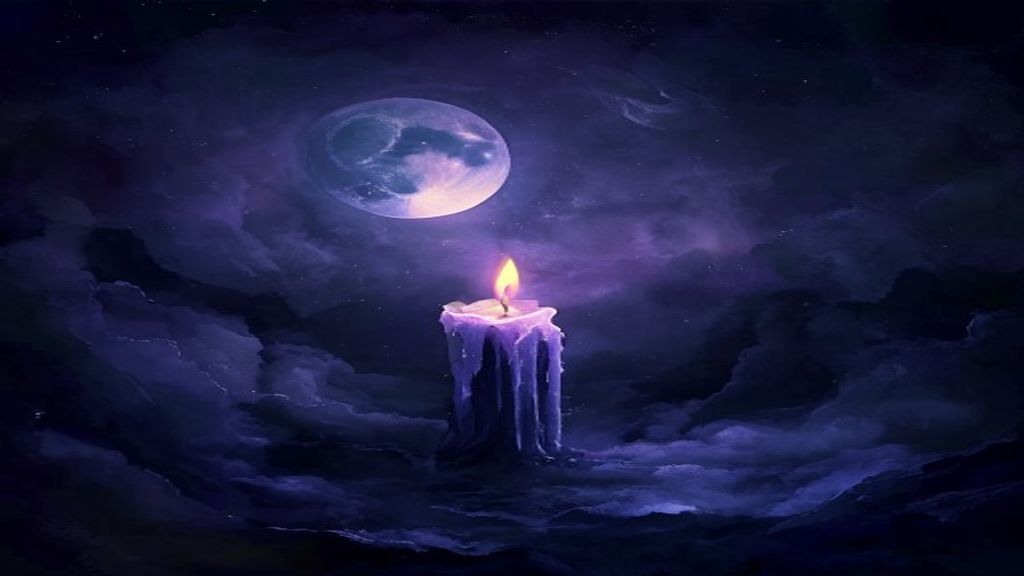
In dreams, a candle almost never appears as furniture. It appears as attention. Something in your sleeping mind decided that this particular small flame deserved to be in the scene, and that decision is the beginning of the reading.
What the flame is doing when you find it
A candle burning steadily in a dream is almost always a symbol of something being maintained: a hope, a relationship, a commitment, a vigil you’re keeping, maybe without fully admitting to yourself that you’re keeping it. The steadiness of the flame is the steadiness you’re sustaining. The draft in the room is whatever is threatening that steadiness.
What the dream lingers on, though, is rarely the steady burn. It lingers on the moment just before, or just after. The candle about to go out. The still-warm wax with no flame left in it. The wick you’re trying to relight and the match that keeps dying. Those edge-moments are where the dream’s real question is hiding.
One recognizable version starts with a room that should be bright and isn’t. It’s a space you know, and a single candle is doing all the work that a lamp should do. The light is beautiful and insufficient. You wake with the sense of having squinted through the whole dream, compensating. That can be a very precise description of what is happening in waking life during certain periods: compensating, making something small do the work of something large.
The moment it goes out
A candle being extinguished in a dream is probably the variant that brings people to this page the most. It frightens them. They want to know if it means death, and the answer is almost always no.
What a snuffed flame tends to signal is an ending of sustained effort. Not of life. Of the particular quality of attention you’ve been giving something. You’ve been tending a flame, and either it’s gone out naturally because the thing it was illuminating is done, or a wind came and you’re deciding whether to relight it. Both possibilities are in the image. The distinction lives in how you felt watching it go: relieved, bereft, or something guiltier, the feeling of not having stopped it.
A candle blown out by your own breath is different again. That’s a conscious ending. The dream is confirming that you’re the agent here, that this was a choice even if it felt like surrender.
A flame is attention wearing a material form
Hartmann’s idea that emotions become central images in dreams is a framework I find useful here, more useful than for most objects. A candle is essentially a metaphor that already exists in the physical world: sustained, effortful light from a finite material. Its dream appearance is almost already translated. The candle flame is what you’re giving. The wax is what you have left to give.
Hobson would be skeptical. He’d point out that candles carry centuries of emotional association and that the dreaming brain, activating stray networks, will naturally reach for high-valence images with complex cultural coding. The meaning, he’d say, is something the waking mind projects backwards. I’m honestly not sure he’s wrong. But I also don’t think it matters for the practical question of what to do with this dream, because whether the meaning is constructed or conveyed, the question it points at is the same.
| Tradition | How it reads the symbol |
|---|---|
| Ancient Egypt (Chester Beatty papyrus) | The papyrus sorts dreams into good and bad omens, and a flame that burns well or fails would naturally fall on one side of that sort |
| Artemidorus (2nd c. Oneirocritica) | He held that the same dream means different things for different dreamers, so who lit the candle and who is dreaming decide the reading: a stranger’s flame and your own are different dreams |
| Christian tradition | Vigil candles held before icons or altars carried associations of prayer and sustained hope; the candle in dreams inherited that weight |
| Domestic light traditions (general) | Light in a home has long been read as the condition of the household, so a bright candle suggests well-being and one going out suggests a warning |
| Contemporary secular reading | The candle functions as a symbol of intentional, small-scale illumination: comfort, focus, or the choice to stay present in the dark |
What you’re watching over
Domhoff’s continuity work would predict that a candle dream clusters around the concerns you carry into sleep. The candle in the dream tends to correspond to something in waking life that requires tending: a person, a creative project, a slowly healing wound, a thread of hope about something uncertain.
The specifics matter less than the texture of the tending. Is the candle yours, or did you find it? Are you responsible for keeping it lit, or are you just watching? Did someone else light it? These details sketch the relational geography of the symbol. A candle that isn’t yours but that you feel responsible for is the dream image of something you’ve taken on that wasn’t originally your vigil to keep.
A candle and a jewel are both precious, finite things you’re trying to hold onto, and dreaming of a lost jewel is the version where the holding has failed. A room growing darker is partly a seeing problem, which is why dreaming of glasses belongs beside it: sight, effort, and what it costs to keep seeing clearly.
Religious and ceremonial candles in the dream
When the candle in the dream is explicitly ceremonial, a church candle, a Shabbat candle, a votive at a shrine, the reading tilts toward something more formal: a vow, a ritual, a commitment that carries weight beyond the personal. These dreams often follow moments when a formal aspect of your life is being tested. The ceremony is doing symbolic work on something that’s changed or is changing. That’s worth sitting with separately from the usual candle reading.
A ceremonial candle can sit near authority and obligation, and dreaming of a crown extends that, particularly if the ceremony in your dream feels like an obligation rather than a choice.
Back to the windowsill candle, the one in the film that always makes the chest tighten. Take a recurring version: a kitchen you don’t quite recognize, a very small flame, no certainty about who lit it. The dreamer wakes unsure whether they are the person keeping the vigil or the person the candle is burning for. That uncertainty might be the whole point. The dream keeps coming back because the question hasn’t been answered yet.
- Was the flame steady, struggling, or already out? That state is the state of whatever you’re tending.
- Who lit the candle? You, a stranger, someone you know? The lighter is the origin of the vigil.
- Did I feel responsible for keeping it burning, or just a witness to it?
- What in my waking life is running on the last of its light right now?
One symbol, two traditions
The disagreement is honest: one school sees candle as self-communication, the other as an image to be discerned against Scripture. They can inform each other, but they do not merge.
A candle in a dream almost always represents sustained attention or hope: something you’re keeping lit through effort. The state of the flame, steady, guttering, or already out, describes the state of that sustained effort in…
You are reading this oneScripture doesn’t give us a specific rule for this, but the gesture has resonance. In Matthew 5, light is something passed along through witness and life. If someone in your dream hands you a candle, it might be worth asking who…
Read the biblical meaning →Quick answers
What does dreaming of a candle mean?
A candle in a dream almost always represents sustained attention or hope: something you’re keeping lit through effort. The state of the flame, steady, guttering, or already out, describes the state of that sustained effort in your waking life.
Is a candle going out in a dream a bad omen?
Not usually. A candle going out in a dream tends to mark an ending of effort rather than a death or disaster. It often signals that something you’ve been tending has either run its course or needs a conscious decision about whether to relight it.
What does it mean to light a candle in a dream?
Lighting a candle yourself is almost always a positive image: you’re initiating something, choosing to illuminate something, or beginning a period of sustained focus. The question the dream leaves behind is what you chose to light.
Why do I keep dreaming about candles?
Recurring candle dreams tend to orbit something you’re tending in your waking life without fully acknowledging how much attention it’s requiring. The dream surfaces when the cost of tending is outrunning the acknowledgment. Naming what you’re watching over, and deciding whether to keep watching, tends to settle the recurrence.
Sources for this reading
- Domhoff, G. W. (2003). The Scientific Study of Dreams: Neural Networks, Cognitive Development, and Content Analysis. American Psychological Association.
- Domhoff, G. W. (1996). Finding Meaning in Dreams: A Quantitative Approach. Plenum Press.
- Hartmann, E. (1998). Dreams and Nightmares: The New Theory on the Origin and Meaning of Dreams. Plenum Trade.
- Hobson, J. A., & McCarley, R. W. (1977). The brain as a dream state generator: An activation-synthesis hypothesis of the dream process. American Journal of Psychiatry, 134(12), 1335-1348.DOI
- Artemidorus of Daldis (2nd century CE). Oneirocritica. English edition: Harris-McCoy, D. E. (2012). Artemidorus’ Oneirocritica: Text, Translation, and Commentary. Oxford University Press.
Full bibliography on Sources and method. Found a mistake? Tell us and see the corrections log.