- Tradition
- Psychological readingObject dreams
- Draws on
- Domhoff, Jung, Hobson
- Reviewed
- 5 min read
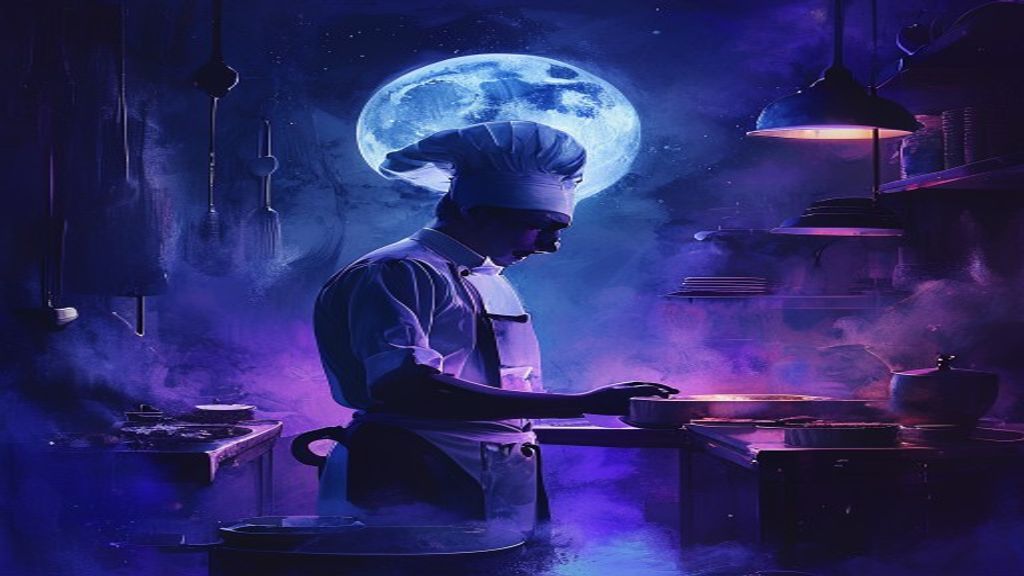
A kitchen at full pressure smells like concentration. Hot fat, something sweet about to catch, the sharp edge of something acidic cutting through steam. If you’ve ever worked near a professional kitchen or even cooked for twenty people at once, your body knows that smell as a kind of emergency held just under control. That specific edge, creation and disaster living in the same pot, is what chef dreams run on.
I want to stay with the kitchen smell for a second because it comes back. The dream version of cooking isn’t always pleasant. People describe arriving at a service with no mise en place, ingredients they’ve never seen, a ticket rail going on forever. Or they’re plating something beautiful and someone keeps changing the order. The chaos is almost always there, underneath the white coat.
Dreaming of being a chef usually isn’t about food itself. It’s about the act of producing something for others under pressure: whether what you make will be good enough, whether you’re in control of your own creative process, and what it costs to feed people who are waiting.
What the kitchen actually represents
The kitchen is a space of transformation. Raw to cooked, separate ingredients to a unified dish, effort to nourishment. Carl Jung would call it a fairly obvious alchemical image and move on, but I think the more interesting question is: who is the food for? Chef dreams almost always have someone waiting to eat. That waiting presence, barely visible, is usually the most important element in the dream.
If you’re cooking for a crowd and terrified of disappointing them, the dream is mapping some form of caretaking pressure in your actual life. A project that feeds people’s expectations. A family role that requires you to produce. A creative output someone is waiting for. The kitchen, in this reading, is anywhere you’re expected to transform effort into something sustaining, and the fear is that you might serve something inadequate.
Domhoff’s continuity work would predict exactly this: that the dream amplifies an emotional pattern already running in your waking life, without inventing new material. Chef dreams behave true to that. They tend to cluster around deadline periods, new responsibilities, and the specific exhaustion of being someone others depend on. They’re not prophetic. They’re a faithful portrait.
| Tradition | How it reads the symbol |
|---|---|
| Ancient Egypt | Preparing food in temple dream records was linked to readiness for offering, what you had to give, and whether it was worthy of the divine recipient |
| Chinese tradition | Cooking dreams were often read as signs of domestic harmony or its absence; the fire under the pot was the family’s vitality |
| West African traditions | The act of feeding in dreams carries strong ancestral resonance, as if preparing a meal for the unseen dead who still require nourishment from the living |
| Contemporary West | Chef culture now carries strong professional ego weight, so modern chef dreams often fold in themes of creative reputation and public judgment that older traditions simply didn’t have |
When the dish burns
The burning dream is its own category. You’re watching something you made ruin itself, and you can’t stop it in time. This version tends to arrive when you’ve overcommitted, or when you’re taking on creative or emotional work that’s outpacing what you can sustain. Hobson would call the kitchen-fire imagery just random activation finding a coherent narrative frame, and maybe structurally he’s not wrong, but functionally the burned dish lands with meaning and the dreamer knows it.
The flip side is worth naming: the dream where everything works. The dish comes together exactly as it should, the flavors are right, the presentation is clean, and whoever is waiting receives it. That dream comes in, more often than people expect, during periods of creative flow, not always when things are going well publicly, but when the internal process feels honest. The kitchen is quiet and competent. That’s a different kind of information.
If you’ve been dreaming about other professional roles recently, there’s an interesting comparison available in what it means to be dreaming of being an artist: the creative-pressure undercurrent is closely related, but the chef dream adds the element of producing for others’ consumption in a way the artist dream doesn’t always carry.
The smell that comes back
Back to that kitchen smell: hot fat, something sweet about to catch. The dream that starts with that smell and ends well is usually telling you that the pressure you’re under is manageable, that you know what you’re doing even when it doesn’t feel like it. The dream that starts with that smell and ends with smoke billowing and the ticket rail still full is asking a harder question: what are you trying to produce right now, and for whom, and is the heat under it the right amount?
Recurring chef dreams, the ones that keep returning you to the same overwhelmed kitchen, usually stop when the waking-life pressure either resolves or gets acknowledged. The dreams don’t need you to become a better cook. They need you to look at what you’re trying to serve, and whether the people waiting for it actually need what you’re making. It’s possible you’ve been producing for an audience that shifted, or a hunger that was never yours to fill. Related pressure patterns show up clearly in dreaming of being a police officer, where the weight of responsibility for others takes a different but adjacent shape.
The journalist who dreamed of a ruined soufflé the week before her first book launch told me it was the most honest thing her sleeping brain had ever said to her. I don’t know how the book did. I know she laughed when she woke up and recognized it. Some dreams are simply that direct. And sometimes the recognition is enough.
- Who was I cooking for, and what did they need from me?
- Did the dish turn out, and what did that feel like?
- What in my waking life requires me to transform effort into something others consume?
- Is the pressure in my kitchen self-imposed, or is someone else setting the temperature?
Quick answers
What does it mean to dream of being a chef?
It usually reflects the part of your life where you’re producing something for others under pressure: creative work, care-giving, professional output. The kitchen is a stage for transformation, and the dream is asking whether what you’re making will be enough and whether the process is sustainable.
What does it mean when food burns in a dream?
A burning dish tends to show up when you’ve taken on more than you can sustain, or when something you’ve been carefully tending has tipped past the point of recovery. It’s less a warning and more a recognition of something you already suspect.
Is dreaming of being a chef good or bad?
Neither, really. A chef dream where things go well often follows periods of genuine creative competence. A chaotic kitchen dream tends to surface around overcommitment or caretaking exhaustion. The feeling on waking is more diagnostic than the dream’s events.
Why do I dream about cooking for a crowd?
Cooking for a crowd maps the part of your life where your output feeds multiple people’s expectations. It can be a job, a family dynamic, a creative project with an audience. The crowd’s size in the dream often corresponds to how many people you feel responsible to, not how many are literally in your waking life.
Sources for this reading
- Domhoff, G. W. (2003). The Scientific Study of Dreams: Neural Networks, Cognitive Development, and Content Analysis. American Psychological Association.
- Domhoff, G. W. (1996). Finding Meaning in Dreams: A Quantitative Approach. Plenum Press.
- Jung, C. G. (Ed.). (1964). Man and His Symbols. Doubleday.
- Hobson, J. A., & McCarley, R. W. (1977). The brain as a dream state generator: An activation-synthesis hypothesis of the dream process. American Journal of Psychiatry, 134(12), 1335-1348.DOI
Full bibliography on Sources and method. Found a mistake? Tell us and see the corrections log.