- Tradition
- Psychological readingPlace dreams
- Draws on
- Domhoff, Freud, Artemidorus
- Reviewed
- 6 min read
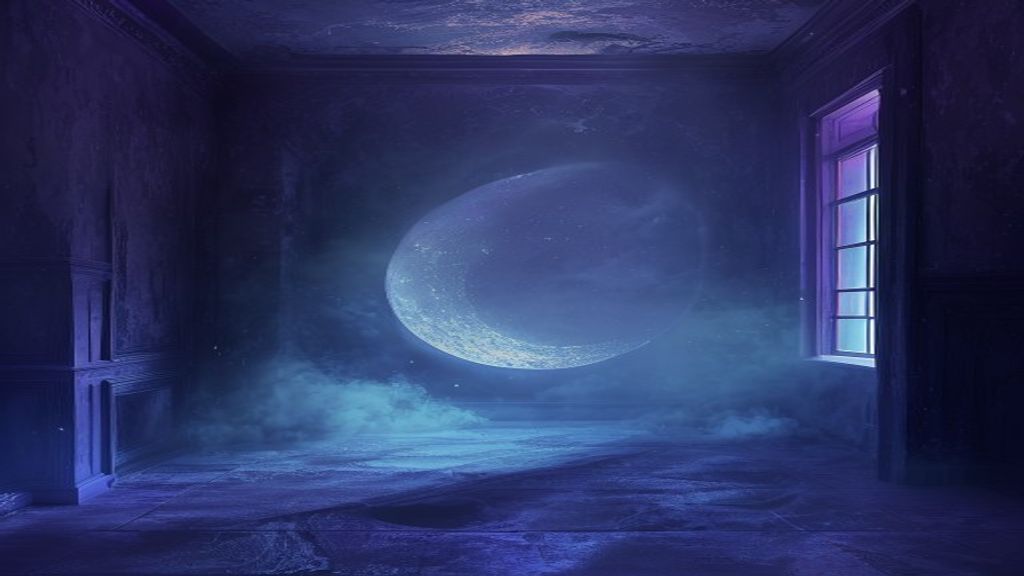
Popular dream guides often read a hidden room as a secret kept: something locked away, suppressed, waiting to leak out, and Freud’s framework pulls in the same direction, toward concealment. The dream itself usually feels like the opposite. You find a door behind a bookcase, or a passage, or a staircase that shouldn’t be there, and behind it is a room that was somehow always there in the house you thought you knew completely.
The feeling that comes first is excitement. Not terror, not disorientation, but something genuinely excited that lingers. It isn’t dread. It’s something more like: oh. There’s more.
Why this one feels different from other house dreams
Most house dreams work by subtraction: the house is empty, the house is cold, the house is falling, the house has something wrong with it. The secret room dream works by addition. The house was fine. The house was yours. And then you pushed something, or opened a door that looked like a wall, and the house turned out to be bigger than you’d been living in.
The Jungian reading of the house as a map of the psyche gives this dream its most satisfying frame. If the house is the self, then a room you didn’t know existed is a part of yourself you haven’t accessed yet. A capacity, an interest, a room of ability or feeling that’s been there the whole time, waiting, with no particular urgency, for you to find the handle. I’m usually a little skeptical when Jungian readings feel too neat, but this one earns its neatness. It fits the phenomenology of the dream too precisely to dismiss.
The contents of the room matter, though they often shift or stay vague. Some people find it full of light and unfamiliar furniture. Some find it empty and beautiful. Some find it containing something specific: an object, a piano, a garden, a window looking out onto a landscape that doesn’t match the geography of the house. These aren’t random. Whatever was in your secret room is the dream’s more specific answer to the question of what exactly you’ve been carrying without knowing it.
- Ancient Near East
The Chester Beatty papyrus (about 1200 BC) sorts dreams into good omens and bad ones. That sorting is still the first question to put to this dream: is what you found a blessing or a threat? The feeling of the finding settles it.
- Classical antiquity
Artemidorus, writing in the second century, held that the same dream means different things for different dreamers, depending on age, status and occupation. A secret room reads one way for someone starting a new venture and another for someone in mourning. Who is doing the discovering matters as much as what is discovered.
- 19th and early 20th century
Freud’s framework, in The Interpretation of Dreams (published 1899, dated 1900), separates manifest content from latent content, so a hidden room invites the question of what is concealed behind it. The room became a place where something was locked away.
- Jungian reversal
Jungian psychology shifts the secret room’s valence from threat to resource. In that architecture of the psyche, unexplored rooms aren’t traps; they are unlived life. The room you didn’t know you had is the part of yourself you haven’t yet inhabited.
- Contemporary dreamwork
Researchers working in the continuity tradition would push back gently on the symbolic framework and ask: where in your current waking life have you recently discovered capacity you didn’t know you had? The dream, in that reading, isn’t prophetic. It’s a delayed mirror of something that’s already happening.
The door behind the bookcase
Here’s what I think this dream is actually about: it arrives when you’re on the edge of something. Not when you’ve done it, not when you’ve decided to, but when the possibility has just entered the room. The secret room dream is the dreaming mind running slightly ahead, the way you might turn a corner and suddenly see more of a building than you expected from the street.
The anchor for this dream is a specific kind of moment: the one where you pick up something new, a language, an instrument, a craft, a discipline, something you’d never tried, and you’re bad at it, and then three weeks later you’re less bad, and something in you realizes this is a room you apparently already had. Not talent you were owed. Just a door that was there and you didn’t know to open it. That moment of discovery is what secret room dreams seem to be made of, compressed into an image.
G. William Domhoff’s continuity hypothesis asks what’s been happening in your waking life in the weeks before the dream started arriving. It suggests that secret room dreams cluster around real expansions: a new role, a new relationship, a period of learning or change that’s showing you more capacity than you thought you had. The dream isn’t giving you the room. It’s acknowledging one that’s already been found.
Dreaming of your house is the plain version of the premise: if the house is the self, the secret room is an extension built onto it overnight. And an attic is another unvisited part of the same house, though what waits up there is stored rather than newly discovered.
When the room is frightening
Not all secret rooms are welcoming. A minority of these dreams carry dread rather than excitement, and it’s worth distinguishing the two carefully. If you found the room and didn’t want to enter it, or if what was inside felt threatening rather than inviting, that’s a different version of the same architecture. A secret room that terrifies you is still an unexplored part of self, but one the dreaming mind is flagging as charged, unprocessed, or difficult.
In this version, the room may be holding something you’ve been keeping separate from your everyday life, not a suppressed desire in the old Freudian sense, but something more ordinary: a grief you haven’t entered, an anger you’ve never given space to, a version of yourself you’ve been keeping locked in a room and pretending the room doesn’t exist. The dream finding it doesn’t mean you have to go in immediately. But it does mean you know where the door is now.
A locked door and a mysterious basement carry the frightening version of this architecture: the door you can’t or won’t open, the space below the floor that you know is there.
What the room was doing while you weren’t looking
Different room every time, same house. Once the secret room dream establishes itself as a recurring visitor, it can feel less like discovery and more like a series of dispatches from a part of yourself that’s been very patient and is starting to have opinions about the timeline.
When this dream stops recurring, it’s plausibly not because the dreamer ran out of rooms. It’s because they started actually walking through some of the doors.
- What was in the room? Even vague details, a quality of light, an object, an atmosphere, carry information.
- Did you feel excited, afraid, or something more complicated than either?
- Is there something in your waking life right now that you’ve been treating as a wall when it might be a door?
- If you went back to that room tonight, what do you think you’d do in it?
Quick answers
What does it mean to dream of a secret room?
Almost always it’s the hopeful version of a house dream: a part of yourself you haven’t accessed yet, a capacity, an interest, or an area of feeling that’s been there without your knowing it. The room’s contents, and especially the feeling when you find it, excited or frightening, refines the interpretation considerably.
Why does the secret room dream feel exciting rather than scary?
Because the dream is offering something rather than taking it. Most unsettling house dreams work by subtraction, something is missing, wrong, failing. The secret room works by addition: there’s more than you thought. The excitement is a real signal from the dreaming mind that something has been found.
Is dreaming of a secret room a sign of hidden potential?
Jung would say yes, fairly directly, and his framework fits the phenomenology of the dream unusually well. Contemporary researchers would phrase it more cautiously: the dream often arrives during or just after real periods of expansion, new learning, new roles, new relationships that are showing you capacity you didn’t know you had.
What does it mean if the secret room is frightening?
A room you found but didn’t want to enter is pointing at something kept separate on purpose: a grief, an anger, a version of yourself you’ve been compartmentalizing. The dream isn’t demanding you go in. It’s showing you where the door is. What you do with that information is genuinely yours to decide.
Sources for this reading
- Domhoff, G. W. (2003). The Scientific Study of Dreams: Neural Networks, Cognitive Development, and Content Analysis. American Psychological Association.
- Domhoff, G. W. (1996). Finding Meaning in Dreams: A Quantitative Approach. Plenum Press.
- Freud, S. (1900). The Interpretation of Dreams (Die Traumdeutung; first published November 1899). English translation by James Strachey, Basic Books.
- Artemidorus of Daldis (2nd century CE). Oneirocritica. English edition: Harris-McCoy, D. E. (2012). Artemidorus’ Oneirocritica: Text, Translation, and Commentary. Oxford University Press.
Full bibliography on Sources and method. Found a mistake? Tell us and see the corrections log.