- Tradition
- Psychological readingNature dreams
- Also read in
- The BibleSame symbol, other tradition
- Draws on
- Domhoff, Jung, Cartwright
- Reviewed
- 7 min read
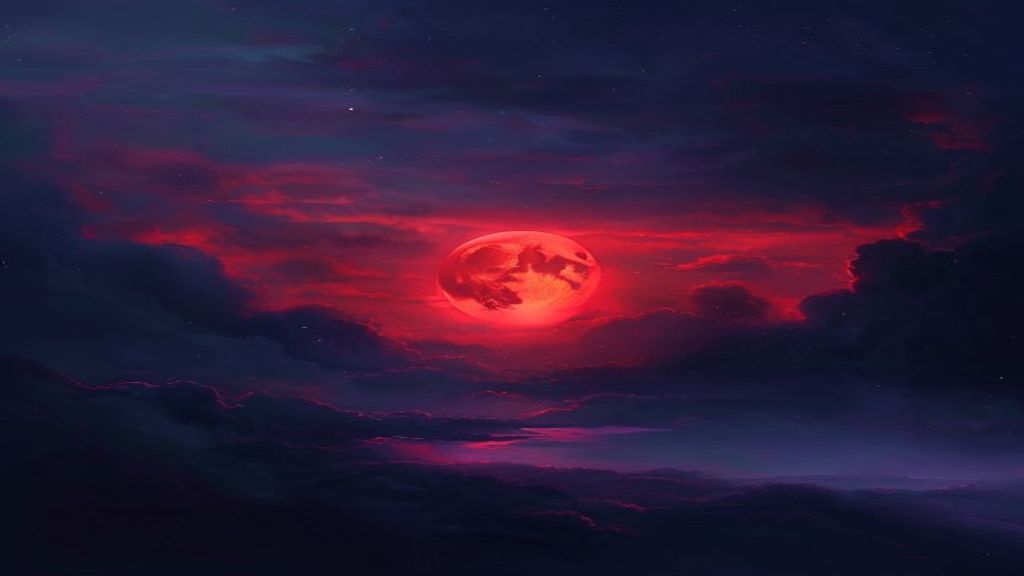
A red sky looks like a warning, a sky on fire and a bad omen written across the horizon. That misses what the dream actually feels like. You’re standing somewhere, watching the horizon go crimson and violet and orange, and some part of you can’t decide whether to stay or run. The light is gorgeous. The light is also too much of something. It’s the particular vertigo of a sky that is beautiful and wrong at the same time, and an ending, not a threat, is what it tends to mark.
A red sunset in a dream usually holds two things at once: something ending that is also, in its ending, spectacular. It’s the mind reaching for the most dramatic metaphor it knows for a closing. Whether that closing belongs to grief, change, or relief depends on where you were standing and whether you wanted to turn away.
The moment before the lights go out
Start with the kind of light that has nothing to do with dreams. Late November, the sun low enough to go sideways through a window and turn a whole room the color of old copper. Nothing is ending. And yet there is something about that light that feels like it is accounting for itself, announcing its departure before it goes. That’s the light a red-sunset dream brings into the room with it when you wake up. Not darkness. The thing that happens just before darkness.
That feeling of something accounting for itself is the emotional core of this dream. A white sky wouldn’t carry it. A grey sky wouldn’t either. It has to be red, specifically, because red is the color that doesn’t let you be neutral. You have a physiological response to it whether you want one or not. Your dreaming mind knows this. It chose red on purpose.
Two ways to stand in that light
Watching from stillness
You’re standing somewhere fixed, maybe a shore, a rooftop, a field, and the sky is doing everything. This is the more contemplative version. You’re witnessing an ending that isn’t yours to control. The feeling is often bittersweet: a relationship that ran its course, a chapter you knew was closing, a version of yourself you’ve been carrying past its useful life. Something is done, and the sky is dramatizing what you haven’t let yourself feel yet.
Moving through it
You’re driving into it, walking toward it, or the sunset is moving with you. This version feels more urgent. The horizon is both destination and limit. It tends to show up when you’re in the middle of a transition, not at its end: a new city, a career change, a commitment that’s been made but not yet tested. The red light is ahead of you, not behind. That’s different. You haven’t gotten there yet.
The distinction matters because the same sky means opposite things depending on your position in it. Most red-sunset dreams belong to the still-watcher type, with the dreamer standing somewhere solid while the world does something enormous above them. But if you were moving, if the road was taking you into that red, this is much more a dream of threshold than of ending.
What the color is doing that the image can’t do alone
Red in dreams is a strange case, because it doesn’t have a single stable meaning. It’s too loaded, too contested. Cultures that treat it as luck and cultures that treat it as danger are both right about it, because it’s a color that insists on being noticed. In the context of a sunset, though, I think the red is doing something more specific than generic intensity. It’s making the ending unmissable. A pale sunset you could almost miss. This one you can’t.
Jung’s idea of archetypes, symbols too large and too old for purely personal meaning, is one I find compelling when it comes to sunsets specifically, because the ending of light is one of the few events that every human being across every era has watched together. There’s something in a red sunset that feels inherited, not just dreamed. Like you’re feeling something people have always felt at that particular moment of the day, and your dreaming mind reached into that archive.
Artemidorus, writing in the second century, insisted that the same dream means different things for different dreamers, depending on who they are and what occupies them. That suits a saturated sky. Read it as intensity in whatever life matter you are most preoccupied with. Not good or bad, specifically. Just concentrated. Amplified. The dream’s intensity is a signal about intensity in waking life. What’s loud in your life right now?
The witness problem
Here’s what stands out in most red-sunset dreams: the dreamer is watching. Rarely doing. Rarely talking to anyone. Just standing there in that impossible light, absorbing it. I don’t think that’s incidental. The dream is asking you to be a witness to something you might otherwise be avoiding. Not to fix it. Not to explain it. Just to see it.
G. W. Domhoff’s research into dream content suggests that our dream imagery tends to track our preoccupations closely, not symbolically in any cryptic way, but emotionally, thematically. A red-sunset dream fits that framework better than most nature-image dreams. You’re not solving anything, you’re contemplating. And the thing you’re contemplating is finishing. This is the continuity hypothesis at work, the dream holding up the emotional weather of your waking life so you can see it properly. Sometimes that’s all you need.
Thunder and wind do the same job from different angles. Both are natural forces that arrive from outside you, and the dreaming mind uses them to measure something internal, as it does with the sky here. See dreaming of thunder and dreaming of wind for how that plays out when the intensity is sound and movement rather than color.
If someone else was watching with you
This version is worth naming separately. You’re standing at a sunset, and there’s someone beside you, and sometimes you don’t know who they are. Or you do know, and their presence is the whole weight of the dream. The sky in this case is almost backdrop. What the dream is really examining is the company. Ending-light and someone beside you: that’s a dream about relationship to closure, about who you’re with when things end, about whether you’re facing your transitions alone or alongside someone.
If the person was someone you’ve lost, I’d direct you toward Rosalind Cartwright’s work on dreaming and mood regulation, because a dream that places a lost person in beautiful, fading light is doing something quite particular. It’s not haunting you. It’s making a frame for them.
And if the person was a stranger, that’s the most interesting version. The unknown companion at the end of the day. I have no clean theory for them. Just the feeling that the dream put them there so you’d notice you weren’t alone in the watching.
There’s one more version of this dream to mention before closing: the one where the sunset won’t end. The sky stays red and burning and refuses to go dark, and you’re waiting for the night that doesn’t come. That one’s different. That’s not an ending being witnessed. That’s an ending that’s been suspended, a transition that you’re caught in, the perpetual threshold. A bud that hasn’t opened yet holds the same breath, something at the edge of change that hasn’t tipped either way, which is why dreaming of a flower makes a useful contrast: the same threshold, read as opening rather than closing.
That copper light, the room going the color of old metal as the angle drops. That’s the quality to carry out of the dream, the beautiful accounting. You don’t have to do anything with it. I’m not sure you’re supposed to.
- Was I moving toward the sunset or standing still watching it?
- Did the sky feel like a warning, a farewell, or something else entirely?
- Was there someone beside me, and if so, who was it, and what did that mean?
- What’s ending in my waking life right now that I haven’t fully let myself look at?
One symbol, two traditions
A psychologist asks what red sunset felt like and what it echoes in your week. The biblical reader asks a different question entirely: what does Scripture say when this image appears, and what does it stay silent about?
A red sunset in a dream usually holds two things at once: something ending that is also, in its ending, spectacular. It’s the mind reaching for the most dramatic metaphor it knows for a closing. Whether that closing belongs to…
You are reading this oneRed in Scripture carries multiple registers: protective covenant (Passover blood in Exodus 12, Rahab’s cord in Joshua 2), weather reading (Matthew 16:2-3), and in prophetic/apocalyptic texts, warning and upheaval (the red dragon…
Read the biblical meaning →Quick answers
What does dreaming of a red sunset mean?
It usually means you’re processing something that’s ending or closing. The red light is your mind making that ending dramatic enough to hold your attention. Whether it feels like grief, relief, or beauty depends on how you felt standing in it.
Is a red sunset dream a bad omen?
It’s not. The dream is amplifying something real in your life. The color is doing the emotional heavy lifting, not delivering a verdict.
Why was someone standing beside me in my red sunset dream?
When there’s a companion in a sunset dream, the dream is often about relationship to endings rather than the ending itself. The sky becomes context. The company becomes the subject.
What if the red sunset in my dream never ended?
A sunset that refuses to turn to night tends to reflect a transition that’s been suspended. Something is ending or changing in your life, but the process hasn’t completed. You’re caught in the threshold, which can feel frustrating or strangely beautiful depending on your situation.
Sources for this reading
- Domhoff, G. W. (2003). The Scientific Study of Dreams: Neural Networks, Cognitive Development, and Content Analysis. American Psychological Association.
- Domhoff, G. W. (1996). Finding Meaning in Dreams: A Quantitative Approach. Plenum Press.
- Jung, C. G. (Ed.). (1964). Man and His Symbols. Doubleday.
- Cartwright, R. D. (2010). The Twenty-four Hour Mind: The Role of Sleep and Dreaming in Our Emotional Lives. Oxford University Press.
- Artemidorus of Daldis (2nd century CE). Oneirocritica. English edition: Harris-McCoy, D. E. (2012). Artemidorus’ Oneirocritica: Text, Translation, and Commentary. Oxford University Press.
Full bibliography on Sources and method. Found a mistake? Tell us and see the corrections log.