- Tradition
- Psychological readingAnimal dreams
- Draws on
- Revonsuo, Artemidorus
- Reviewed
- 4 min read
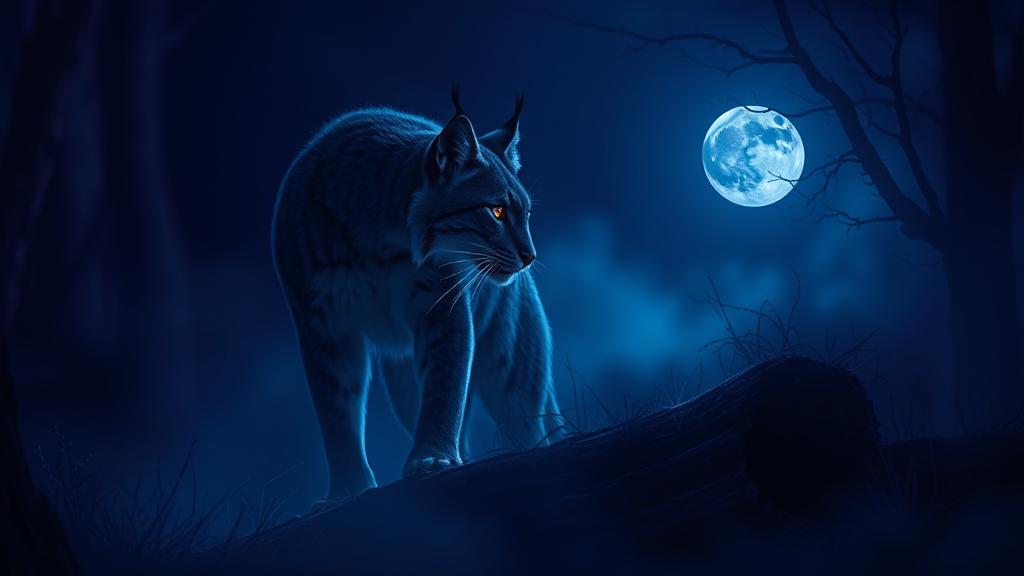
Lynx dreams tend to share one quiet quality: the sense of being watched by something that sees much better than you do. It doesn’t charge. It sits still and looks, and you find yourself standing still too, a cup forgotten in your hand, waiting to see who looks away first. Not terror. Not magic. Just that specific alertness of being seen.
Why a lynx and not any other cat
The lynx is the animal of tufted ears and pale eyes that pick up motion in darkness. It’s a hunter, but a particular kind: it tracks by observation, often waiting long after another predator would have moved. It’s almost never seen in the wild. These qualities are not incidental when your sleeping mind selects this specific cat. It didn’t choose a lion or a house cat. It chose the one that watches, waits, and sees what you can’t.
If you’re wondering whether the meaning differs from, say, dreaming of a hyena, it does, substantially. The hyena carries social connotations, threat-from-below, chaos on the edges of the camp. The lynx is solitary, precise, and it brings something the hyena never does: the uncomfortable sense that it already knows something about you.
The seeing problem
The quality that stands out in the animal’s gaze is that it’s not aggressive, it’s simply direct. Seeing without flinching. A Jungian reading treats animals in dreams as images of instinctual life, the parts of the psyche that haven’t been domesticated. A seeing animal, specifically one famous for sight in darkness, has a fairly clear psychological address: it represents the part of you that already knows the thing you’re working hard not to know.
This is where Revonsuo’s threat simulation framework gets complicated. The lynx rarely feels like a threat in these dreams, even when it’s close. There’s no running, often no fear. Revonsuo would say any predator appearing in a dream is practicing the biology of alertness. But I think something else is happening too, something older. The lynx is the kind of threat that sees you before you see it, and by the time it’s in your dream, it’s already decided you’re worth watching.
How to read which version you had
What the old interpreters made of watching animals
Artemidorus’s principle, that the same dream means different things for different dreamers, makes the condition of being watched worth thinking about. Older dream traditions treat being observed by a powerful animal as a sign of scrutiny in waking life, sometimes divine, sometimes social, sometimes the dreamer’s own conscience wearing an exterior shape. The direction of the gaze matters. An animal looking directly at you versus one glancing sideways carries entirely different weight.
That distinction holds up better than most ancient framework. A dream in the “full gaze” category, where the lynx locks eyes and doesn’t look away, carries a much heavier charge than one where it’s simply nearby. Full gaze is usually about something you can’t pretend you haven’t seen.
Being looked at, really looked at
Nothing prophetic is going on. But being looked at, really looked at, by a creature that doesn’t pretend and doesn’t explain itself, tends to make you notice things you’d been successfully not-noticing. Your lynx dream is probably doing that work. If it’s recurrent, the question it’s asking hasn’t been answered yet.
And if what you dreamed felt less like a watcher and more like a dead animal, a stillness rather than a gaze, dreaming of a dead bird is about the other end of perception: instinct gone quiet. The living lynx and the dead bird are almost opposites, but they’re both, in the end, about a particular kind of perception that’s either awake or it isn’t.
- Did the lynx look directly at me? What does it already know that I’m pretending not to know?
- Was I watching it or was it watching me? The direction of that attention matters.
- Is there something in my life right now that sees more clearly than I’m willing to let myself?
- What would I do differently if I trusted that level of clear-eyed attention in myself?
Quick answers
What does dreaming of a lynx mean?
A lynx in a dream most often points to sharp, unsentimental perception, yours or something else’s. The lynx is the animal that sees in darkness and waits without moving. Dreaming of one usually means something in your waking life already knows something you haven’t quite admitted to yourself.
Is a lynx dream a warning?
It’s closer to a mirror than a warning. The lynx doesn’t attack; it watches. The dream is pointing toward a clarity you’re resisting, not a danger to avoid.
Why does the lynx in my dream just stare at me?
That direct, unblinking quality is the whole message. Whatever the lynx represents in your psychology, it’s not posturing. It has no interest in frightening you. It’s interested in whether you’ll hold the gaze or look away. The dream is asking whether you’ll do the same in your waking life.
What does it mean to dream of a lynx running away or disappearing?
This version, where the animal vanishes just as you see it, tends to recur. It usually means you’re touching a truth and then immediately letting it escape. The dream keeps setting up the moment. The question is whether you’ll hold onto it next time.
Sources for this reading
- Revonsuo, A. (2000). The reinterpretation of dreams: An evolutionary hypothesis of the function of dreaming. Behavioral and Brain Sciences, 23(6), 877-901.DOI
- Artemidorus of Daldis (2nd century CE). Oneirocritica. English edition: Harris-McCoy, D. E. (2012). Artemidorus’ Oneirocritica: Text, Translation, and Commentary. Oxford University Press.
Full bibliography on Sources and method. Found a mistake? Tell us and see the corrections log.