- Tradition
- Psychological readingPlace dreams
- Also read in
- The BibleSame symbol, other tradition
- Draws on
- Domhoff, Jung
- Reviewed
- 5 min read
“You’re next.” The voice in the dream was entirely ordinary, the kind a nurse uses when she’s said it two hundred times that shift. You weren’t frightened. You didn’t know what you were waiting for. You just joined the queue.
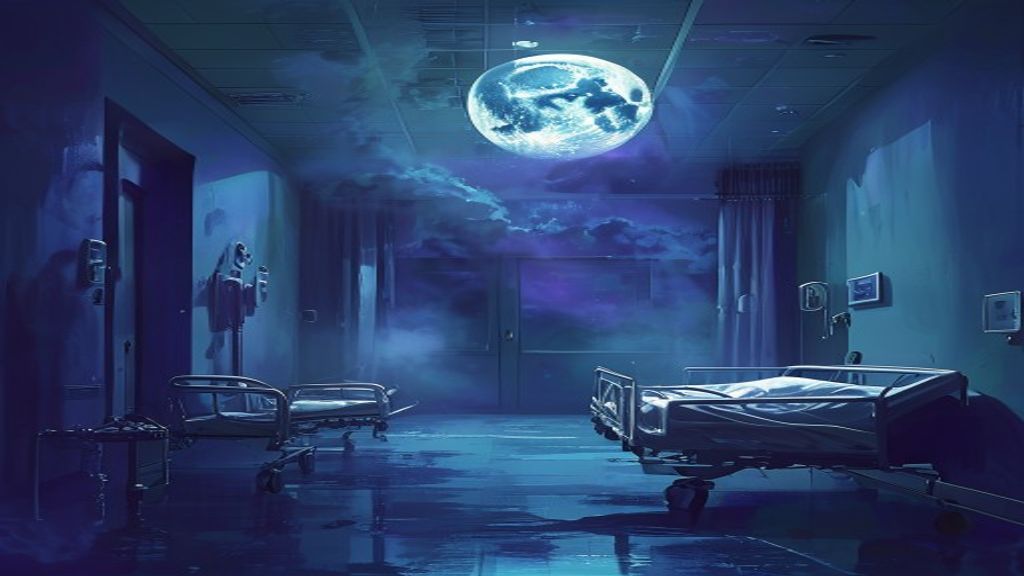
Hospital dreams have a particular texture that is hard to describe. Not nightmare-dark, not comfortable either. More like the actual experience of being in a hospital: fluorescent-lit, rule-governed, suffused with a kind of suspended time. You’re there because something needs to be attended to. You just don’t always know what.
And that, it turns out, is usually the whole message.
The waiting room as the dream’s real subject
Most hospital dreams don’t take place in an operating room or a recovery ward. They take place in the waiting area. You’re holding a number, or waiting for your name, or looking for a room you can’t find, or being told to sit back down. The waiting room is one of the most efficient images your sleeping mind has ever chosen for a specific waking feeling: the condition of knowing that something needs to happen, not yet knowing when or if it will.
Domhoff’s continuity hypothesis is useful for reading hospital dreams because it predicts that they will track specific waking circumstances. Unresolved health concerns, yes, but also career waiting periods, relationship stalemates, creative projects stuck at the threshold of something, and the particular limbo of caring for an ill family member while your own life goes on hold. The hospital isn’t saying you’re sick. It’s saying something is suspended.
Jung would add that the hospital, as an institutional space dedicated to repair, can represent the psyche’s own healing process: something underway that isn’t finished, attended to by forces larger than your conscious will. I’m honestly uncertain how far to take that reading, but it fits certain dreams well. The ones where the atmosphere is clinical but somehow benign, where you’re a patient who isn’t frightened. Those lean into it.
What your role in the dream is doing
The role you occupy inside a hospital dream changes the interpretation more sharply than almost any other variable. Patient, visitor, medical staff, and lost wanderer are genuinely different dreams wearing the same building.
- You’re the patientSomething in your life is asking for care and isn’t getting it. This isn’t always about your body. It can be an emotional wound you’ve been managing rather than treating, a part of yourself that’s been running at a deficit for a long time. The dream is pointing at it.
- You’re visiting someoneYour attention is on another person’s condition more than your own. This version often arrives when you’re in a caregiver role in waking life, or when someone close to you is going through something difficult. It can also represent a part of yourself, a quality or relationship, that you’re tending from the outside.
- You’re medical staffYou’re in control of the process, responsible for others’ recovery. This reads well if the dream felt competent and purposeful, and more anxiously if you were overwhelmed, understaffed, or unable to help. The competence-to-overwhelm ratio is the message.
- You’re lost in the corridorsThe hospital maze dream is about institutional systems in your waking life that you can’t navigate: bureaucracy, medical processes, organizational structures that all look the same and lead nowhere. It’s worth writing down where you’re trying to get to, because that destination is the real subject.
The ancient precedent worth citing here
The ancient precedent for hospital dreams is less a person than a practice. The temples of Asclepius, the ancient Greek god of medicine, functioned as a kind of proto-hospital where the sick would sleep inside and wait for a healing dream. The dream itself was the treatment. Certain spaces carry the weight of their real-world function, and if you sleep inside a healing place, your mind is doing something with the concept of healing.
The modern hospital carries that same conceptual weight, whether or not you find it comforting. It’s the place where the body’s most serious problems go to be attended to. Your sleeping mind chose that building for a reason.
Reading what’s unresolved
Hospital dreams that recur are almost always pointing at something that hasn’t been brought in for treatment. Not literally: not a medical problem necessarily, though if you’ve been putting something off, the dream is worth taking as a practical nudge too. More often the recurring hospital dream attaches to an emotional pattern that keeps being managed rather than addressed. The distinction between managing something and actually attending to it is one your sleeping mind understands better than your waking self usually wants to.
If your hospital dreams keep leading you toward a specific room or department, the location is often more meaningful than the building itself. A dream that keeps landing you in pediatrics is doing something different from one that deposits you repeatedly outside the cardiology wing. Your dreaming mind is a remarkably specific location scout. The department you keep ending up in is worth sitting with.
If the hospital in your dream felt cold, institutional, and hostile rather than merely clinical, a library is the softer version of an institutional space: also hushed and rule-governed, but organized around keeping knowledge rather than repairing bodies. And if your dream moved between the hospital and your childhood home, your childhood home adds the oldest layer of care you know, the place where you were first looked after. A hospital corridor that turns into a crossing, a threshold between one state and another, is close to a bridge dream: both are about being in between.
The urge in these dreams is to check the ceiling of the corridor, look for the room number, figure out where the voice is coming from. The good ones end before you find out. You’re next, and then you wake up, and you sit with the question of what needed to be seen to.
- Was I the patient, a visitor, staff, or someone lost? That role holds most of the meaning.
- Was I waiting, or was something actually happening to me?
- What part of my waking life is currently in a state of suspension, not yet resolved?
- Is there something I’ve been managing rather than actually attending to?
One symbol, two traditions
Psychology keeps hospital inside your own story, a symbol your mind built from your days. The biblical tradition looks outward instead, and asks whether Scripture gives the image any voice at all.
Hospital dreams rarely predict illness. They most often point to something in your life that needs care but isn’t getting it, or to a period of suspension where you’re waiting for something to resolve. The role you play inside…
You are reading this oneScripture doesn’t support reading hospital dreams as medical forecasts. The biblical dream accounts in Genesis and Daniel are symbolic rather than literal, and even those are interpreted by gifted individuals through prayer and…
Read the biblical meaning →Quick answers
What does dreaming of a hospital mean?
Hospital dreams rarely predict illness. They most often point to something in your life that needs care but isn’t getting it, or to a period of suspension where you’re waiting for something to resolve. The role you play inside the dream, patient, visitor, staff, lost wanderer, shapes the reading significantly.
Is dreaming of a hospital a bad sign?
Not usually. It’s more of a directional sign than a warning. The building stands for care, repair, and attention. If the dream felt hostile or confusing, it’s more likely pointing at a waking system you can’t navigate than predicting something medical.
What does it mean to dream of being lost in a hospital?
The maze version of this dream tends to accompany experiences of institutional or bureaucratic confusion in waking life: navigating complex systems, medical processes, organizations that feel identical at every level and lead nowhere useful. The destination you couldn’t find in the dream is worth naming.
Why do I keep dreaming about hospitals?
Recurrence usually means something is still waiting in the waiting room. Something in your life needs genuine attention rather than just ongoing management. The dream keeps returning because the intake form hasn’t been completed: the problem is acknowledged but not yet addressed.
Sources for this reading
- Domhoff, G. W. (2003). The Scientific Study of Dreams: Neural Networks, Cognitive Development, and Content Analysis. American Psychological Association.
- Domhoff, G. W. (1996). Finding Meaning in Dreams: A Quantitative Approach. Plenum Press.
- Jung, C. G. (Ed.). (1964). Man and His Symbols. Doubleday.
Full bibliography on Sources and method. Found a mistake? Tell us and see the corrections log.