- Tradition
- Psychological readingPlace dreams
- Also read in
- The BibleSame symbol, other tradition
- Draws on
- Domhoff, Artemidorus
- Reviewed
- 5 min read
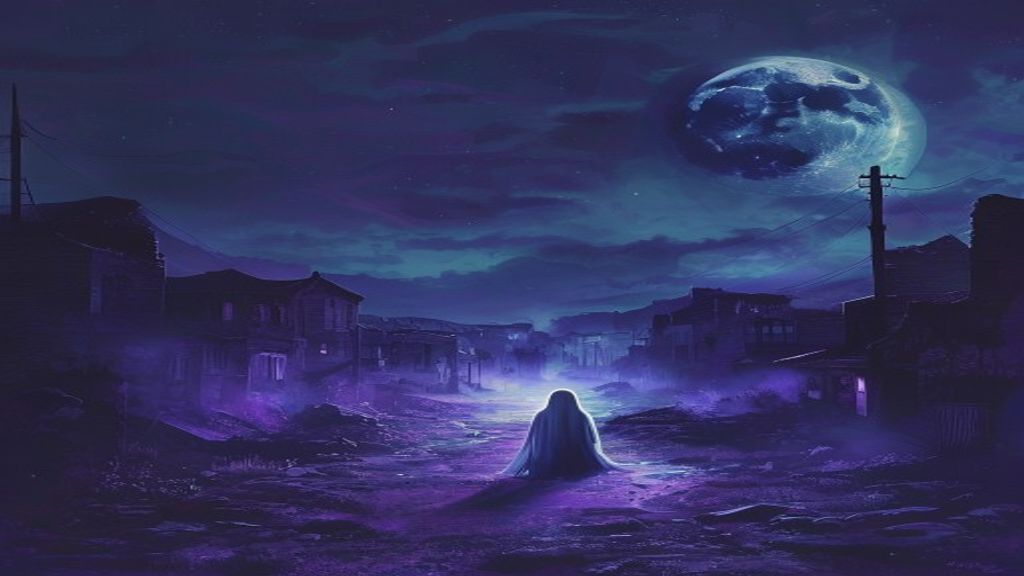
A gas station sign still lit at noon, no cars, no sound, the hum of the fluorescent tube the only proof the grid still works. That image, which you didn’t invent consciously, is what the dream handed you. A ghost town isn’t a ruin. It’s a place with all its infrastructure intact and all its people gone. That’s a very specific horror, or a very specific peace, depending on which version you got. The difference between those two versions is where the interpretation lives.
Most dream dictionaries will tell you this is about abandonment, endings, death. That’s not wrong, exactly, but it’s lazy. Because the ghost town dream almost never feels like death. It feels like aftermath. Like the moment after the last person left, and you’re there to see what’s still standing.
A ghost town in a dream usually represents a part of your life that was once active and is now quiet: a relationship you’ve moved past, a version of yourself you’ve left behind, or a phase that’s over but not yet grieved. The feeling, eerie or peaceful, is the entire reading.
What ghost towns are actually made of
The detail that matters most is the state of the objects. Curtains still in the windows. A coat hung by a door. Dishes on a table as if someone stepped out. The dream preserves the ordinary residue of a life. And that residue is the point. A Jungian reading of the built environment treats the house as the self, the rooms as different aspects of the psyche. A whole town scaled up from that: it’s a community of selves, an entire social world, and when the dream empties it, the dream is asking what has left your social world. Who has moved out of the picture. What community, what era of your life, is now populated only by its objects.
This is a dream that fits grief, relocation, and the quiet aftermath of a group disbanding: the band that broke up, the team that scattered, the friendship group that drifted without anyone deciding to. Not a fight, just an attrition. Ghost towns without villains. The buildings still stand. The sign still hums.
How the world has read this
| Tradition | How it reads this symbol |
|---|---|
| Western antiquity (Artemidorus, 2nd c.) | Artemidorus held that the same dream means different things for different dreamers, depending on age, status and occupation. By that rule an abandoned settlement could mean solitude for one dreamer and welcome independence for another, depending on whether the dreamer wanders it in distress or at ease. |
| Jungian tradition | The empty town is the shadow’s territory, a landscape of unlived life or repressed aspects. The buildings are the structures you built around yourself that no longer have inhabitants. The question is whether you’re ready to demolish them or move back in. |
| Ibn Sirin tradition (Islamic oneirology) | This tradition reads dreams in light of the dreamer’s circumstances, so an empty town could be a warning of community rupture for one dreamer and an invitation to let go of worldly attachments for another. Ambivalent, as the best readings usually are. |
| Contemporary psychology | Domhoff’s continuity hypothesis predicts exactly this: the ghost town arrives after real dispersal events. It’s not prophetic. It’s documentary, a dream’s record of what’s already happened to your social landscape. |
The version where you built it
One variant is easy to overlook: the ghost town you recognize as a place you used to inhabit, but the version in the dream is what you left behind. Not a town someone else abandoned. The town you left. You’re the ghost.
This one tends to arrive when you’ve done a lot of outgrowing in a short period. Changed jobs, changed cities, changed friend groups, changed who you are. And the dream shows you the earlier version of your life still standing there, waiting. Still lit. No one home. If that’s the version you got, the useful question isn’t why did I leave. It’s whether you’ve actually said goodbye, or whether you just stopped showing up and called it moving on.
A secret room keeps a single space preserved and unclaimed, and a museum preserves a whole past on purpose. A ghost town is the version nobody curated: everything left as it was, with no one to explain it.
When the quiet is the point
Not every ghost town dream is about loss. Some carry something close to relief. The city is finally still. Nobody needs anything from them. The streets are wide open. In that version, the dream isn’t about abandonment. It’s about permission to stop performing for an audience. The ghost town is an introvert’s dream, almost literally, a world that finally stopped demanding your participation.
What to do with the sign that’s still lit
The gas station sign keeps humming. That detail, or something like it, is worth staying with: a piece of infrastructure still running for an audience of zero. What in your life is still running on the old fuel, still maintaining the old signal, for a community or a context that has long since moved on? It might be a habit. It might be a self-presentation. It might be a loyalty to a version of yourself that nobody around you is looking for anymore.
The dream doesn’t tell you to shut the sign off. It just makes you notice it’s still on. A tunnel works in the other direction, toward what’s ahead rather than what’s still lit from before, so dreaming of a tunnel is where to look if you’re trying to move from documentation to momentum.
I don’t have a clean ending for this one. Ghost town dreams don’t resolve neatly, and I’m not sure they should. Some of what they’re pointing at isn’t meant to be resolved so much as acknowledged. You were there. It mattered. It’s quiet now.
- Did I recognize the town, or was it somewhere I’d never been? Recognition changes everything.
- Was I frightened by the emptiness, or oddly comfortable in it?
- What era of my life would that town represent if it had a name?
- Is there something still running in my life that no longer has an audience?
One symbol, two traditions
Psychology keeps ghost town inside your own story, a symbol your mind built from your days. The biblical tradition looks outward instead, and asks whether Scripture gives the image any voice at all.
A ghost town in a dream usually represents a part of your life that was once active and is now quiet: a relationship you’ve moved past, a version of yourself you’ve left behind, or a phase that’s over but not yet grieved. The…
You are reading this oneScripture doesn’t work that way, and it would be dishonest to suggest it does. The Bible’s record of predictive dreams, Joseph’s, Pharaoh’s, Nebuchadnezzar’s, involves interpretation given by God himself through a human…
Read the biblical meaning →Quick answers
What does dreaming of a ghost town mean?
Usually it points to a part of your life that was once active and is now quiet. A relationship, a social group, a version of yourself. The mood of the dream, eerie versus peaceful, tells you how you actually feel about that quieting.
Is a ghost town dream a bad omen?
Not in any literal sense. It shows up most often after real dispersal events: moves, breakups, group endings. It’s the dream documenting what’s changed in your social landscape, not warning you about what’s coming.
Why do I feel peaceful in a ghost town dream?
That peaceful version is more common than people admit. It tends to arrive for people who’ve been over-extended socially and are, somewhere below the surface, longing for permission to stop performing. The empty town gives them that, at least for the night.
What does it mean if I’m the only person in the ghost town?
That’s the standard version. But ask yourself whether you felt like a visitor discovering it, or like someone who belongs there. If it felt like your town, you might be the one who left, and the dream might be inviting you to actually grieve the leaving rather than just continuing to move.
Sources for this reading
- Domhoff, G. W. (2003). The Scientific Study of Dreams: Neural Networks, Cognitive Development, and Content Analysis. American Psychological Association.
- Domhoff, G. W. (1996). Finding Meaning in Dreams: A Quantitative Approach. Plenum Press.
- Artemidorus of Daldis (2nd century CE). Oneirocritica. English edition: Harris-McCoy, D. E. (2012). Artemidorus’ Oneirocritica: Text, Translation, and Commentary. Oxford University Press.
Full bibliography on Sources and method. Found a mistake? Tell us and see the corrections log.