- Tradition
- Psychological readingNature dreams
- Draws on
- Domhoff, Jung
- Reviewed
- 4 min read
Jung’s idea of compensation, that dreams supply what waking life leaves out, points to one reason a loud life might produce a winter dream. The season isn’t arriving through the window. Snow can turn up in the dreams of someone who has never seen it settle properly, and frozen ground in the dreams of someone in the tropics. What the dream is reaching for is stillness, a landscape where the noise of ordinary life has been muffled under several inches of something white and patient.
What winter actually does in a dream
The dominant quality of winter in a dream isn’t cold. It’s still. Winter dreams are rarely about being frozen or suffering; they’re about a landscape that has stopped moving. I think that stillness is the real symbol, not the season.
Which means the first question to ask isn’t: what does winter mean? It’s: what has gone quiet in your life, and is that a relief or a deprivation? Those two readings of the same snow cover are almost perfectly opposite, and dreams of winter split exactly along that line.
- Ancient Egypt (~1200 BC)
The Chester Beatty papyrus dream book sorts dreams into good and bad omens. That two-sided sorting is the heart of a winter dream too: the same snow cover is either relief or deprivation.
- Classical Greece
At the temples of Asclepius, patients slept in designated chambers seeking healing dreams. Sleeping there was an act of deliberate stillness offered to a god, which is close to what a winter dream feels like from the inside.
- Islamic tradition
Islamic dream interpretation reads a symbol against the dreamer’s own condition, so a winter dream can be taken as preparation or as hardship depending on the person: the frozen earth is the self not yet ready to produce, which is different from the self that cannot.
- Jung (early 20th century)
Carl Jung’s compensation idea, that dreams supply what waking life leaves out, gives winter a role: for a life that is too loud, the dormant landscape is a compensating stillness. It isn’t dead; it’s conserving, the self turning inward before a new period of outward growth.
- Contemporary dream research
Domhoff’s continuity hypothesis would read a winter dream as a reflection of the dreamer’s current emotional temperature. Flat, cold, still: a waking life that has contracted or is in a waiting period. The reading is less poetic than Jung’s and harder to argue with.
The bare tree that isn’t dead
One winter image is worth a closer look: a single tree in an open field, no leaves, branches against white sky. It sounds bleak. It doesn’t feel bleak. There’s something structural about a bare tree that a fully leafed tree doesn’t have; you can see exactly how it’s built, where each branch splits from the one below it. Summer hides that. Winter reveals it. And I think that’s the metaphor winter dreams are often making: stripping the ornamentation back until you can see the actual shape of something.
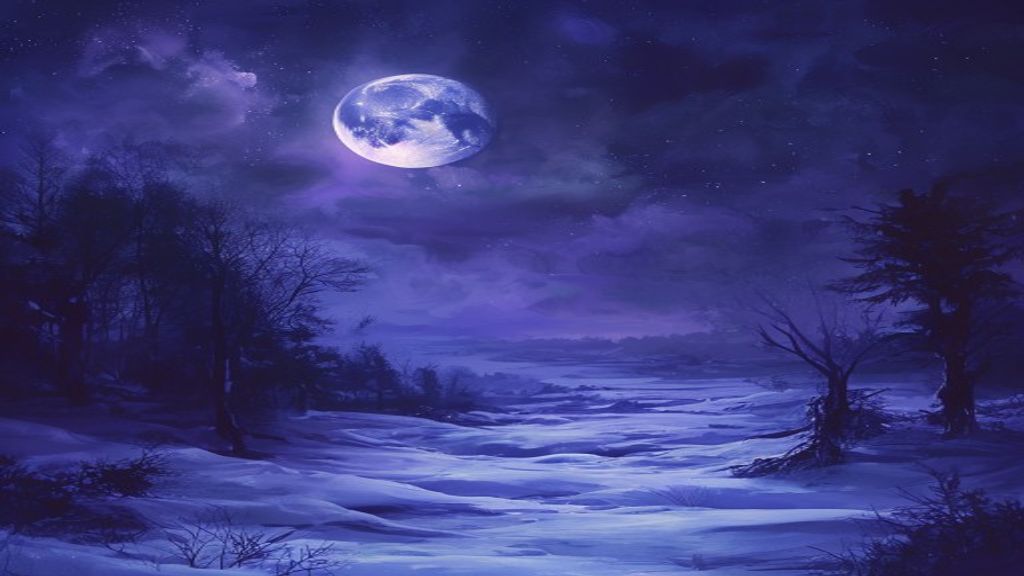
Dreams of a full moon over a winter landscape concentrate this effect; the light and the exposure working together. And if your winter dream involves being indoors watching snow fall outside, that’s a different structure from being in it, a distinction that matters about as much in dream reading as it does in waking life.
What dormancy looks like from the inside
The compensation reading, winter as the stillness a loud life lacks, is the one I return to most, not because I’m uncritical of it, but because I haven’t found a better account of a very specific kind of winter dream: the one that feels peaceful and completely empty at the same time. Not sad. Not frightened. Just… paused. Like something has been put away carefully and is waiting. Dormant, not dead.
Domhoff would say this is just the dreaming mind matching the emotional register of a waking life in a quiet period. He’d be uncharmed by the seasonal metaphor and he’d be right that the correlation is probably doing most of the work. But I think both readings are compatible. The waking life got quiet. The dream reached for winter because winter is how the mind has learned to picture quiet. The question is whether the quiet is depletion or conservation, and only you can answer that.
Spring is somewhere in it
I want to be careful not to make winter dreams into an inevitably hopeful symbol, because for some people they’re not. Depression has a winter texture. Grief that hasn’t moved has a winter texture. The stillness can be pathological, not just contemplative. If your winter dream is accompanied by a feeling of being genuinely stuck, genuinely cold all the way through, that’s worth taking seriously in the waking sense, not just the symbolic one.
But for a dreamer who has never walked in snow, a winter dream can be weirdly comforting. That winter is doing something different. It’s offering a version of stillness that a loud actual life doesn’t easily provide. A dream of a sunset in winter carries this double quality particularly well, the warmth and cold existing in the same moment, the end of the day and the end of the season overlapping. That compression is its own kind of message. I’m not sure I have a clean reading for it. I’m not sure it needs one.
- Was the stillness a relief or a deprivation?
- Were you inside the winter looking out, or outside in it?
- What in your life right now has gone quiet, and is that conservation or emptying?
- Did anything alive appear in the winter landscape, however small?
Quick answers
What does it mean to dream of winter?
Winter dreams usually reflect a period of stillness, inwardness, or dormancy. The key question is whether the cold and quiet feels like relief and conservation, or like depletion and being stuck, because those two readings point in opposite directions.
Is dreaming of snow a good sign?
Often yes, especially if the snow feels peaceful. Snow in a dream is the mind’s shorthand for things going quiet, for noise and complexity being muffled. Whether that’s welcome or oppressive depends entirely on your emotional response inside the dream.
Why do I dream of winter even though I live somewhere warm?
Winter as a dream symbol operates independently of your real-world climate. The mind reaches for it to capture a quality of stillness, dormancy, or inward quiet, regardless of whether you’ve experienced a genuine winter. The season is doing emotional work, not geographical work.
What does it mean to dream of a frozen landscape?
A frozen landscape in a dream often corresponds to a part of your life that has stopped moving. That can be a positive pause, something conserving itself for later, or it can signal something genuinely stuck. The feeling of the dream, oppressive or simply still, usually tells you which reading applies.
Sources for this reading
- Domhoff, G. W. (2003). The Scientific Study of Dreams: Neural Networks, Cognitive Development, and Content Analysis. American Psychological Association.
- Domhoff, G. W. (1996). Finding Meaning in Dreams: A Quantitative Approach. Plenum Press.
- Jung, C. G. (Ed.). (1964). Man and His Symbols. Doubleday.
Full bibliography on Sources and method. Found a mistake? Tell us and see the corrections log.