- Tradition
- Psychological readingSpiritual dreams
- Draws on
- Domhoff, Hartmann
- Reviewed
- 6 min read
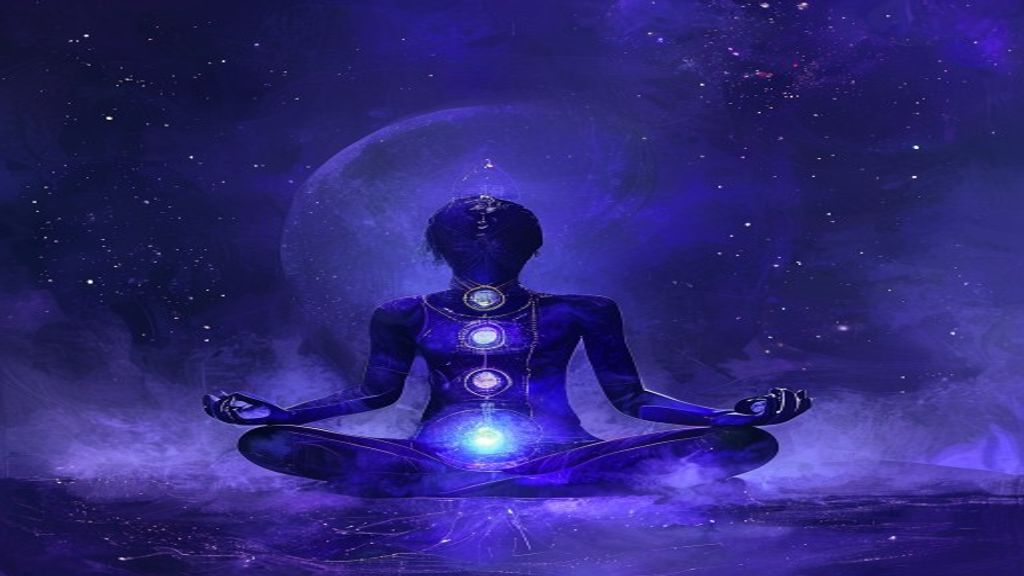
Ernest Hartmann argued, in Dreams and Nightmares (1998), that dreams put emotion into a central image. A disc of warm orange turning steadily in the center of your ribcage is exactly that kind of image, and you don’t need the word chakra to have it. Which is interesting, and worth thinking about carefully before we get anywhere near the spiritual interpretation.
That is the stance for the rest of this piece: start with the body and the feeling, and bring the framework in later if it earns its place.
Dreaming of chakras usually means the dreaming mind has turned a bodily or emotional experience into an interior diagram. Energy centers, spinning wheels, blocked or damaged points in the body, these images map onto states of vitality, expression, fear, or connection that have been building in waking life. You don’t need to practice energy work for this dream to carry meaning.
The body as geography
Take that image: a spinning thing in the chest. Because the chest is where we tend to localize grief, longing, love, and the specific kind of ache that has no name. The body knows this before the mind does. We put our hands there when we’re moved. We feel constriction there when we can’t say something we need to say. Chakra dreams, I think, are simply the dreaming mind finding a visual form for something the body has been registering all along.
The chakra system in Hindu and yogic tradition is ancient, sophisticated, and not mine to oversimplify. But its core move, mapping states of being and energy onto specific locations in the body, is a move the dreaming mind makes independently and repeatedly. Dreamers report lit or constricted areas in their bodies, wheels of sensation, passages blocked or suddenly open, whether or not they know the vocabulary. The image may be less a Western New Age invention than a recurring feature of dreaming, translated through whichever vocabulary the culture has available.
Working through what you saw
- Locate it firstBefore you look up what any color or center means, note where in the body the dream placed the focus. Throat, chest, belly, head? That location is more specific than any color code. It tells you which domain of your life is being addressed: expression and voice, love and grief, fear and gut instinct, or perception and clarity.
- Check its conditionWas the chakra spinning cleanly, erratically, blocked, dark, absent, painfully bright? A steady spinning tends to feel like health or resolution. A blocked or stuck center almost always corresponds to something that’s been suppressed or unaddressed. A painfully intense one might be overdoing it, giving everything to one area of life at the cost of others.
- Note the color with your own associationsYes, there are traditional color correspondences. But your mind assigned this color, and your associations run first. Red at the base of the spine means something different to someone who associates red with danger than to someone who associates it with warmth. Start with your own color-feeling, not the framework.
- Find the emotional echo in waking lifeThe location plus the condition plus the emotional tone of the dream almost always point to something specific: a relationship where you’ve been silent, a project you’ve been afraid to start, a part of your physical life you’ve been ignoring. Don’t look for a cosmic reading before you’ve tried the ordinary one.
- Let it stay unresolved if it needs toNot every chakra dream comes with a tidy prescription. Some of them are just the dreaming mind reporting: here is what’s going on with you right now. That’s enough. You don’t have to fix anything before breakfast.
Take someone going through a period of creative work they’ve been afraid to show anyone, who dreams of a warm orange disc turning in their chest. They may not know that in the common modern color scheme orange is associated with the sacral center, creativity, generation, the capacity to make things and offer them. If they’ve never read that anywhere, the overlap is striking. I’m not sure what to do with it, honestly. I hold it loosely.
When the chakra is damaged or missing
This version is harder. A dark center, a blocked wheel, a point in the body that’s absent or hollow, these dreams tend to land with a sense of wrongness that lingers. I’d take that seriously, not as a diagnosis, but as attention. If the throat center was closed or dark, and you’ve been swallowing things you needed to say for months, the dream is not informing you of something supernatural. It’s telling you what your body has already been tracking.
Ernest Hartmann’s argument that strong emotions generate central images in dreams works especially well here. The damaged or blocked chakra is the emotional texture of suppression made literal, a spinning thing that can’t spin. I find his framework useful without needing it to be the whole story. Some things in dreams feel older than psychology.
The dream that keeps returning
Recurring chakra dreams, on G. William Domhoff’s continuity hypothesis, are chasing an unresolved concern. The wheel keeps appearing because whatever it’s mapping hasn’t been attended to. That’s not a mystical claim, it’s a boringly accurate one. But the pattern holds regardless of the vocabulary: the dream returns until you look at the thing it’s marking.
Take someone who dreams of a constricted center, high in the chest, throat-adjacent, a pressure that won’t release, for most of one difficult year, during which they have been systematically not saying several true things to several important people. The dream might not stop until they start saying them. The dream wouldn’t have caused the change. But it was accurate about what needed to change, which is enough.
Chakra dreams can sit near other large-body dreams, the body as something vast, something monstrous, something outside ordinary human scale. If the body in your dream felt enormous, almost cosmically scaled, there may be some resonance with giant dreams, where the body’s size is itself the message about power or overwhelm. And sometimes these energy-body dreams arrive in darker company: a blocked center that feels contaminated, a spinning wheel that’s the wrong color in the wrong way, the body as a system under assault. That imagery can overlap with witchcraft dreams, where external forces seem to be interfering with something internal that should be your own. Those are usually about perceived violation of boundaries rather than actual metaphysics.
If the chakra dream arrived in a context of feeling freed from something heavy, a blockage suddenly cleared, a wheel beginning to turn after a long stillness, that release motif connects to what I’d call the lifted-curse dream: the felt experience of something that was constraining you finally letting go. Whatever the specific imagery, the felt sense of constraint releasing is among the more promising things a dream can offer. It usually means you already know, somewhere, what you need to do.
- Where in the body was the focus, and what domain of life does that location map onto for me?
- Was the center spinning freely, blocked, dark, or painfully bright? What’s the waking-life analog?
- Have I been ignoring something physical or emotional in that part of my life for a while now?
- If I had to name what that spinning thing was made of, what would I say, and does that name tell me anything?
Quick answers
What does it mean to dream about chakras?
It means the dreaming mind has found a visual language for something happening in your body or emotional life. Energy centers, spinning wheels, and blocked points in the body correspond to states, of vitality, of suppression, of expression, of fear, that have been building while you were awake. The framework matters less than the feeling.
Do you need to practice yoga or energy work to dream about chakras?
No. The image appears in people who’ve never encountered the concept, which is one of the more interesting things about it. The dreaming mind has its own reasons for rendering interior experience as body geography. The vocabulary of chakras is one interpretation of something the mind seems to do independently.
What does a blocked chakra in a dream mean?
Almost always something suppressed or unattended to in the domain that body location maps onto. A blocked throat center points toward things unsaid. A blocked heart center points toward grief or connection that’s been held at arm’s length. The blockage is a report, not a verdict.
Why do I keep having chakra dreams?
Recurring energy-body dreams usually track something unresolved in waking life. The same location keeps appearing because the same concern keeps going unaddressed. It tends to stop when you actually look at what it’s been marking.
Sources for this reading
- Domhoff, G. W. (2003). The Scientific Study of Dreams: Neural Networks, Cognitive Development, and Content Analysis. American Psychological Association.
- Domhoff, G. W. (1996). Finding Meaning in Dreams: A Quantitative Approach. Plenum Press.
- Hartmann, E. (1998). Dreams and Nightmares: The New Theory on the Origin and Meaning of Dreams. Plenum Trade.
Full bibliography on Sources and method. Found a mistake? Tell us and see the corrections log.