- Tradition
- Psychological readingNature dreams
- Also read in
- The BibleSame symbol, other tradition
- Draws on
- Domhoff, Jung, Hall and Van de Castle
- Reviewed
- 5 min read
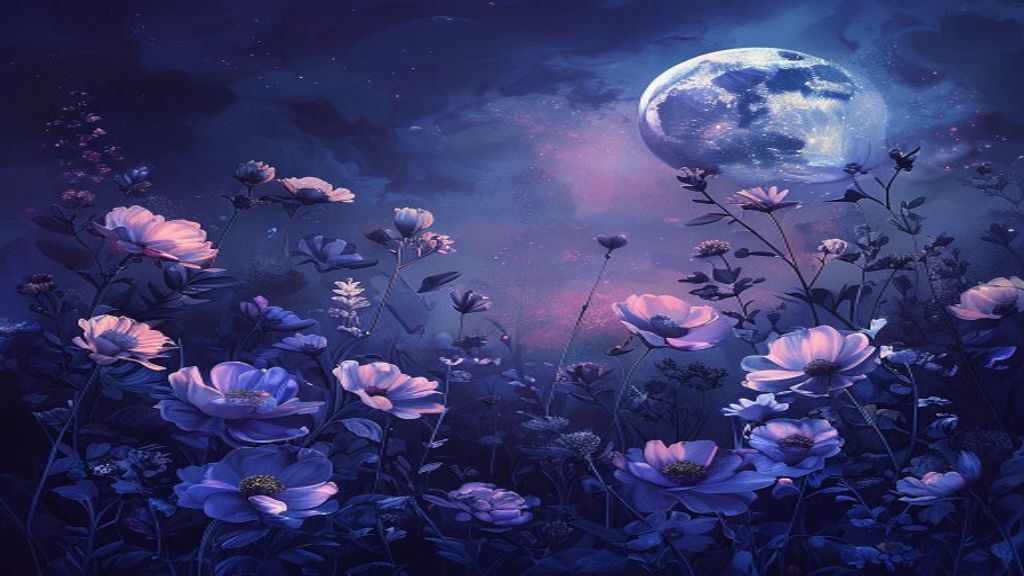
Blooming flowers read as straightforward good news, and the dream often is. But that reading skips what the dream holds alongside the brightness. Hold a flower at full bloom, cold water still on the petals, the smell filling your palm, and within two minutes you can feel the bloom already moving past its opening. That slight sense of something in the act of becoming and the act of passing at the same time is what a blooming flower dream actually carries, and it’s more interesting than pure joy.
The dreams that stay with you usually carry something else alongside the brightness: urgency, a kind of sweetness-with-pressure, the feeling of being at the exact right moment for something, and knowing it. That knowing is what the dream is usually about.
Blooming flowers in a dream almost always point to emotional readiness, creative opening, or a moment in your life that has fully arrived. The emotional texture is the key: pure joy suggests something genuinely coming into fullness, while awe mixed with urgency usually signals an awareness that this moment is precious and won’t last indefinitely.
How people have read flowers across time
- 2nd century
Artemidorus held that the same dream means different things for different dreamers, depending on age, status and occupation, so a blooming flower reads differently for a gardener, a lover and someone in mourning. The dreamer’s situation comes before any catalogue of meanings, a principle that holds up.
- 1900s onward
Jung’s archetypes point toward flowers as an image of something growing toward wholeness, the psyche making itself legible. Blooming is, on that reading, the self coming into view.
- 1966
Hall and Van de Castle published their coding system for dream content, the system Domhoff’s DreamBank is built on. It let researchers count what appears in dreams rather than guess, which is why a claim like “flowers mean new beginnings” can be checked against what dreamers were living through rather than only repeated.
- Contemporary
Domhoff’s continuity work would place blooming flower dreams simply: if something in your life is opening, your dreams give you the corresponding image. Nothing mystical in the timing. The dream is reading your situation accurately.
The moment of opening, which is what’s actually happening
The specific detail that the flowers are blooming, actively, in the process of opening rather than simply present and already open, is the more interesting part of this dream. You could dream of flowers already in full bloom. You could dream of them wilted. The act of opening is its own stage, and it tends to appear when something in your life is in the process of becoming rather than already arrived.
A Jungian reading treats the flower as the psyche’s way of showing what it looks like when inner life finds outward expression. A blooming flower dream that’s set in a garden usually points toward the cultivated self: something you’ve worked on and tended, which is the question dreaming of a garden asks about what your mind is growing. A blooming flower that appears wildly, unexpectedly, in a field or along a road, tends to carry the feeling of something natural and unplanned that you didn’t know was building.
What I find most useful, practically, is asking where the blooming is happening relative to you. Are you watching it from outside, or is it somehow happening around you, even in response to your presence? The distinction is almost always significant. Watching from a distance tends to point toward something you can see is possible but haven’t fully moved toward. Being in the midst of it, or even causing it, is the dream at its most embodied.
Color, and why it mostly doesn’t matter
Color is the obvious thing to ask about, and it matters less than the dream dictionaries suggest. Red doesn’t reliably mean passion, white doesn’t reliably mean purity, and yellow doesn’t reliably mean anything in particular about your life. Color in dreams tends to intensify mood rather than carry independent meaning. Vivid color means the emotional charge is high. Pale or faded color means something is subtle or at the edge of your awareness. That’s about as far as I’d take it without knowing the specific dreamer.
The exception might be when a specific color is strongly associated with something personal in your life. A specific flower in a specific color that you associate with a particular person or time: in that case, the color is doing biographical work, not symbolic work in the generic sense. Your associations override the dictionary.
When blooming arrives with grief
Blooming flowers can turn up in the weeks after a significant loss. I think this is the dream’s least-understood version, and it deserves its own attention. The flowers blooming in the immediate wake of a death or ending often function as the dream acknowledging something that’s still alive: a quality in you that the lost relationship cultivated, a capacity you developed during a hard period, a part of yourself that survived something. The blooming isn’t denying the loss. It’s telling you what the loss didn’t take.
This is a dream that works like something preserved in amber: it holds a moment of opening inside a larger context of closing, and both are true at once. If you got this version, I’d sit with both feelings rather than trying to resolve them into one.
That flower held in the palm is the whole dream. The sensation worth keeping is rightness-with-time-limit. The dream isn’t offering you a permanent state. It’s offering you a moment that is fully itself while it lasts. The question that follows is often whether the opening was real. I think it is. Whether it lasts is a different question, and maybe the wrong one.
The flower that has passed its bloom is the other half of the picture: dreaming of wilting flowers reads beauty past its peak with its own kind of honesty. And dreaming of a flowering tree puts the same moment of opening on a tree instead of a single flower.
- Were the flowers blooming around me, or was I watching from outside? The position tells you how close this opening is.
- Did the blooming feel joyful, urgent, or both at once? Both at once is the more interesting answer.
- Was there anything I recognized as mine in what was opening, a feeling, a project, a way of being?
- Is something in my waking life in the process of becoming rather than already arrived?
One symbol, two traditions
A psychologist asks what blooming flower felt like and what it echoes in your week. The biblical reader asks a different question entirely: what does Scripture say when this image appears, and what does it stay silent about?
Blooming flowers in a dream almost always point to emotional readiness, creative opening, or a moment in your life that has fully arrived. The emotional texture is the key: pure joy suggests something genuinely coming into…
You are reading this oneFlowers in Scripture hold multiple meanings that depend entirely on context: the transience of human glory (Isaiah 40, James 1), the extravagance of providential creation (Matthew 6), the language of love and seasonal arrival…
Read the biblical meaning →Quick answers
What does dreaming of blooming flowers mean?
It usually points to emotional readiness or creative opening, something in your life that’s actively becoming rather than already complete. The act of blooming, the process rather than the result, is what distinguishes this dream. It tends to arrive when a moment you’ve been moving toward is finally here.
Are blooming flowers in a dream a good sign?
Generally yes, though the mood matters. Pure joy suggests something genuinely coming into fullness. Awe mixed with urgency, which is actually the more common version, signals an awareness that this moment is particular and won’t wait. Neither is bad news; the second is just asking you to pay attention.
What does it mean to dream of blooming flowers after a loss?
This is the dream’s way of showing you what survived. When blooming appears in the wake of grief or an ending, it tends to point to a quality or capacity in you that the loss didn’t take, something that was cultivated by that relationship or period and is still alive in you. It’s the dream holding both things at once.
Does the color of the flowers matter?
Less than most guides suggest. Color in dreams tends to amplify emotional charge rather than carry fixed meaning. Vivid saturated color means the feeling is strong; pale or faded color means something subtle. The exception is a color with strong personal associations for you specifically, in which case your memory overrides any general symbolism.
Sources for this reading
- Domhoff, G. W. (2003). The Scientific Study of Dreams: Neural Networks, Cognitive Development, and Content Analysis. American Psychological Association.
- Domhoff, G. W. (1996). Finding Meaning in Dreams: A Quantitative Approach. Plenum Press.
- Jung, C. G. (Ed.). (1964). Man and His Symbols. Doubleday.
- Hall, C. S., & Van de Castle, R. L. (1966). The Content Analysis of Dreams. Appleton-Century-Crofts.
- Artemidorus of Daldis (2nd century CE). Oneirocritica. English edition: Harris-McCoy, D. E. (2012). Artemidorus’ Oneirocritica: Text, Translation, and Commentary. Oxford University Press.
Full bibliography on Sources and method. Found a mistake? Tell us and see the corrections log.