- Tradition
- Psychological readingSpiritual dreams
- Draws on
- Domhoff, Hartmann
- Reviewed
- 5 min read
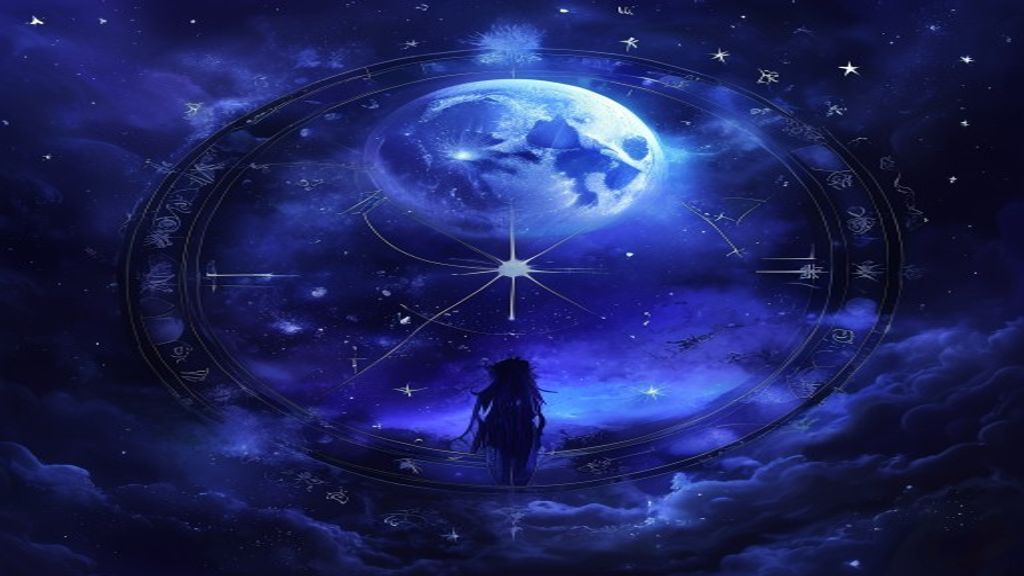
An astrology dream sounds like a message from the stars: a prediction, a warning, something about your sign. Look at what the dream actually contains and the message-from-the-stars idea stops fitting. There is no zodiac monster, no Jupiter crashing through a window. You are sitting at a table with a natal chart, the kind printed on A4 paper with criss-crossing blue lines and degree numbers you can never quite read, and you study it the way you study a map before a long drive. The map doesn’t explain anything.
Dreaming of astrology usually isn’t about whether the stars are real. It’s about the hunger to see your own life as a pattern with a shape, a story that was always going somewhere. The chart or the sign is the symbol. The search for meaning is the subject.
The chart you can’t quite read
There’s a specific quality to astrology in dreams that I think is worth naming first. It almost never arrives as information. Nobody in the dream tells you your rising sign or explains what a twelfth-house Saturn means. What arrives instead is the feeling of standing before a system that is supposed to explain you, and the mild vertigo of not quite being able to decode it. That vertigo is the whole point. The dream isn’t giving you a horoscope. It’s handing you the sensation of wanting one.
That distinction matters more than it sounds. When astrology appears in a dream, the question isn’t whether you believe in astrology. The question is what the image of a cosmic map is doing for you psychologically at this particular moment. And the answer is almost always some version of: you’re trying to find the shape of something. A relationship, a phase of your life, a decision you’ve been circling without landing.
The pattern hunger
You’re drawn to astrology in the dream as a system of meaning. You want your life to have a legible shape, a chart someone could hand you and say: here’s where you are, here’s why this stretch has been hard. This version tends to arrive during transitions, not crises. It’s the dream of someone who suspects things make sense and wants confirmation.
The self-study
You’re reading the chart but it’s a mirror. Astrology here stands for the entire category of self-knowledge tools: therapy, personality frameworks, journaling, any grid you use to understand your own wiring. The dream may not be about astrology at all. It may be about whether you’re willing to look.
What the old dream books would have said, and what I’d add
Ancient dream readers had a practical take on celestial dreams: stars overhead and in good order meant prosperity and clear plans; stars that seemed confused, falling, or unreadable meant trouble with one’s affairs. I like that this reading doesn’t bother with which sign or planet. The condition of the sky was the message. By that logic an unreadable natal chart suggests muddled intentions, which is often not wrong.
Ernest Hartmann’s work on how central images in dreams carry the emotional weight of whatever we’re actually processing is useful here, though in an indirect way. On Hartmann’s account the birth chart in the dream is the emotion of that dream made visible: the search itself, compressed into an object. The chart isn’t showing you your future. It’s showing you your need to understand. Whether you read the chart as real guidance or as symbol, the underlying reach toward meaning is worth taking seriously.
What the zodiac sign tells you (and what it doesn’t)
If your own sign appeared in the dream, that’s often the mind naming you to yourself. Not as prediction but as a kind of shorthand: here is a version of you that the culture around you already has a word for. Whether you find that version accurate is a separate question. If a different sign appeared, especially someone else’s, the image might be about that person or about a quality you associate with that sign, independent of any belief in astrology.
The planets have their own logic in dreams. Saturn appearing, even vaguely, tends to belong to dreams about duty, constraint, or long timelines. Venus to dreams that are also touching on attraction or value. I’m not saying the planets are real agents. I’m saying we’ve all absorbed these symbolic associations deeply enough that the mind can use them. Dreaming of robots works similarly: another symbol the mind borrows from shared culture when it needs shorthand for an emotional texture.
When the sky goes wrong
Not all astrology dreams are calm. Sometimes the chart is disturbing, the signs are wrong, the sky is somehow broken or reversed. Domhoff’s continuity hypothesis would simply note that these dreams track real anxiety: the felt sense that the order underlying your life isn’t reliable, that the structure you were counting on has become unreadable. If you dreamed the sky was disordered and woke uneasy, the question isn’t whether Mercury is actually in retrograde. The question is what felt stable last year that no longer does.
The feeling that the cosmic ledger is somehow against you is the core of dreaming of a curse, and it can attach to these disturbed-sky dreams. That’s worth noticing without necessarily believing. The dream isn’t a verdict. It’s a register of the feeling.
And sometimes the astrology dream is just a ghost of yesterday’s internet rabbit hole. You spent forty minutes on a birth chart website before bed and your sleeping brain filed it. The continuity hypothesis would call that mundane, and it would be right. Context matters. The question is whether it came charged with feeling, or flat.
That natal chart on the table may never explain itself. Maybe that’s the point. Dreaming of a familiar ghost shares one thing with this dream: a presence that should be legible but isn’t quite. Both leave you squinting.
- Was the chart or system readable, or just out of reach? The gap between those two matters.
- Were you looking for guidance, or looking at yourself?
- What part of your life right now most wants a shape, a framework, a story that makes it make sense?
- If the sky was disordered, what in waking life feels like it lost its structure recently?
Quick answers
What does dreaming of astrology mean?
It usually signals a hunger for pattern and meaning rather than any specific prediction. The chart or zodiac in the dream stands for your need to understand your own life as something that has shape, direction, and reason. The feeling beneath the dream matters more than any specific sign or planet.
Does dreaming of your zodiac sign mean something specific?
Often the sign is the dream’s shorthand for a version of you the culture already has a word for. It may be the mind naming you to yourself, or it may be about someone else you associate with that sign. Belief in astrology isn’t required for the symbolism to work.
What if the astrology in the dream felt disturbing or wrong?
Disordered charts or broken skies tend to track anxiety about the structures you rely on. Something that felt stable and predictable may feel less so. The dream isn’t a warning from the stars. It’s a report on how secure your sense of direction currently feels.
Is dreaming about a birth chart the same as dreaming about astrology generally?
The birth chart specifically tends to emphasize self-knowledge and identity, the attempt to map who you are. A more general astrology dream might be more about timing or the search for meaning in events. Both come back to the same need: wanting your life to be legible.
Sources for this reading
- Domhoff, G. W. (2003). The Scientific Study of Dreams: Neural Networks, Cognitive Development, and Content Analysis. American Psychological Association.
- Domhoff, G. W. (1996). Finding Meaning in Dreams: A Quantitative Approach. Plenum Press.
- Hartmann, E. (1998). Dreams and Nightmares: The New Theory on the Origin and Meaning of Dreams. Plenum Trade.
Full bibliography on Sources and method. Found a mistake? Tell us and see the corrections log.