- Tradition
- Psychological readingPlace dreams
- Draws on
- Domhoff
- Reviewed
- 5 min read
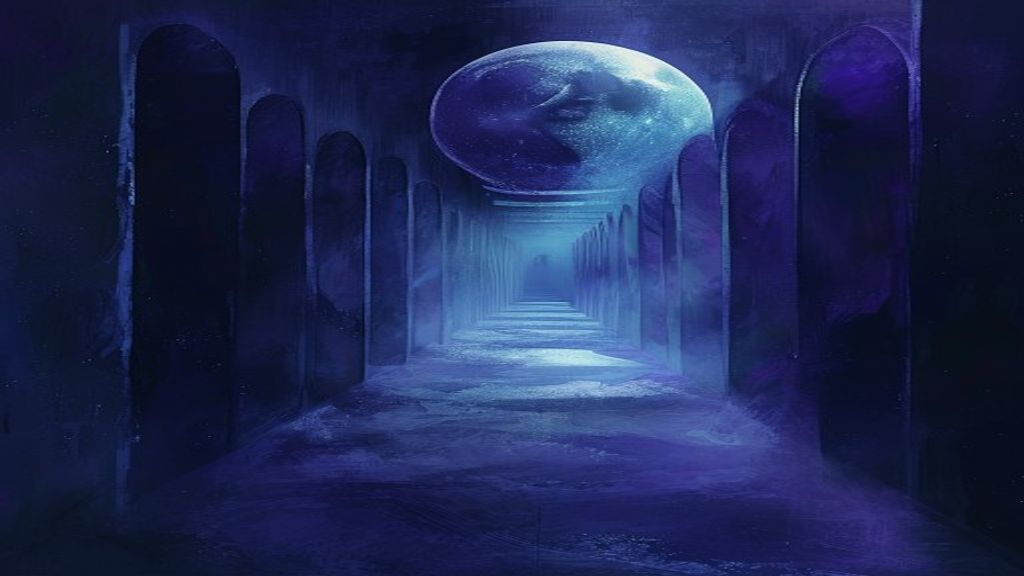
This dream is usually experienced as effort without arrival. Not the nightmare kind, not the chase: just a hallway that refuses to end, the door at the far end either staying exactly as far away or vanishing entirely once you get close. You walk faster and it makes no difference. You wake up tired in a way that sleep shouldn’t cause, and that tiredness is often the part that stays with you all day.
The corridor is an interesting symbol precisely because it’s not a destination. It’s transition made architectural. You’re in it because you’re supposed to be going somewhere. It’s not a room where you live; it’s the space between where you were and where you’re meant to be. An endless one, then, is a transition that has stopped transitioning.
An endless corridor in a dream typically reflects a waking-life situation where you’re in motion but not arriving: a process that keeps extending, a goal that retreats as you approach, or an in-between phase you can’t seem to exit. The details matter: whether you’re alone, what’s at the far end, and whether the corridor is familiar or strange.
The architecture of being stuck while moving
What makes the endless corridor different from simply being lost is that you know the direction. You’re not wandering. You’re walking a straight line toward something. The problem is the line won’t terminate. That specificity is important. This isn’t confusion; it’s effort without payoff. The dream is about trying.
Depth psychology would recognize this as the psyche mapping the in-between. The corridor, like the passage between rooms in a house, represents the threshold state, not where you were, not where you’re going. If the house is the self, the corridor is the self in negotiation, moving between one version of itself and another. An endless one means the negotiation isn’t completing. Something won’t release you into the next room.
Domhoff’s continuity hypothesis is almost too obvious here. If you’re living through something that feels like relentless forward motion with no arrival, a long job application process, a recovery that keeps plateauing, a relationship waiting on an answer from someone else, the corridor will come for you in sleep. It’s not symbolic in a mysterious way. It’s practically literal. The dream is just running the same software.
What’s at the far end
The door you can’t reach. The figure who doesn’t turn around. The light that doesn’t get brighter. Whatever the corridor is aimed at in your dream is where the real content lives, and most people, if they ask themselves gently, can name a waking-life equivalent without much trouble.
Older omen traditions might have read the corridor as a literal sign about a journey or a delayed outcome. I’m not dismissing that instinct entirely. There’s something to the idea that this image clusters around periods of waiting. Those frameworks were diagnostic in a very concrete sense: show me the obstacle in the dream and I’ll show you the obstacle in your life. For this one, that mapping tends to be accurate.
Which version are you in
The corridor that connects to other places
Endless corridors often sit among other dreams of towers and heights, of suspension bridges, of liminal places that exist to connect things rather than contain them. If your dream geography tends toward in-between spaces, that’s a pattern worth noticing. Dreaming of a suspension bridge carries a closely related feeling: crossing toward something, uncertain whether you’ll make it. Dreaming of a ghost town is the corridor’s cousin: a place meant to be moving through, now frozen.
In the flooded house dream, water cuts you off from your own rooms; in the corridor, distance does. Both leave the self separated from its own space. But the corridor is about the journey, not the contained space.
A transition that has stopped transitioning
Familiar corridors in these dreams are often hospitals or schools. Both are places where you are definitively in transit, not arriving, not departing, just getting to the next thing. The endless versions tend to arrive during the most in-between periods: changing direction professionally, ending something that hasn’t been named as ending yet, waiting on news that is slow in coming.
What the corridor doesn’t do is tell you to hurry. That is the surprising thing about this dream. The corridor doesn’t demand anything. It just continues. The lesson, if that’s the word, is less about urgency and more about whether you have been treating the in-between as though it were the problem, rather than the process.
I’m not sure that insight retires the dream. It may well come back occasionally. The corridor just feels less hostile once you stop fighting it, which might be its own kind of progress.
- What is at the far end of the corridor, and what does that thing represent in my waking life?
- Am I being followed, or walking in calm? What does that say about the pressure behind the in-between?
- Which area of my life has been in transit the longest without arriving?
- Am I trying to exit the in-between phase, or have I quietly settled into it?
Quick answers
What does an endless corridor mean in a dream?
It usually mirrors a real-life situation where you’re making effort but not arriving: a process that extends without resolving, a goal that stays just out of reach, or a transition you can’t seem to exit. The corridor is the in-between made visible.
Is the endless corridor dream a bad sign?
Not inherently. It’s most often a sign of a prolonged in-between period rather than a crisis. The emotional tone of the dream, anxious versus calm, matters more than the image itself.
What does it mean if I’m being followed in the corridor?
There’s pressure behind the stuckness. Something is pushing the transition forward even as arrival stays elusive. It’s worth asking what obligation or expectation in your waking life is tracking the process you can’t complete.
Why does the corridor keep repeating in my dreams?
Recurring corridors suggest the in-between situation in your waking life hasn’t resolved, and possibly hasn’t been acknowledged for what it is. Naming the transition, and especially identifying what’s at the far end, tends to reduce the frequency.
Sources for this reading
- Domhoff, G. W. (2003). The Scientific Study of Dreams: Neural Networks, Cognitive Development, and Content Analysis. American Psychological Association.
- Domhoff, G. W. (1996). Finding Meaning in Dreams: A Quantitative Approach. Plenum Press.
Full bibliography on Sources and method. Found a mistake? Tell us and see the corrections log.