- Tradition
- Psychological readingObject dreams
- Draws on
- Domhoff, Hobson, Artemidorus
- Reviewed
- 4 min read
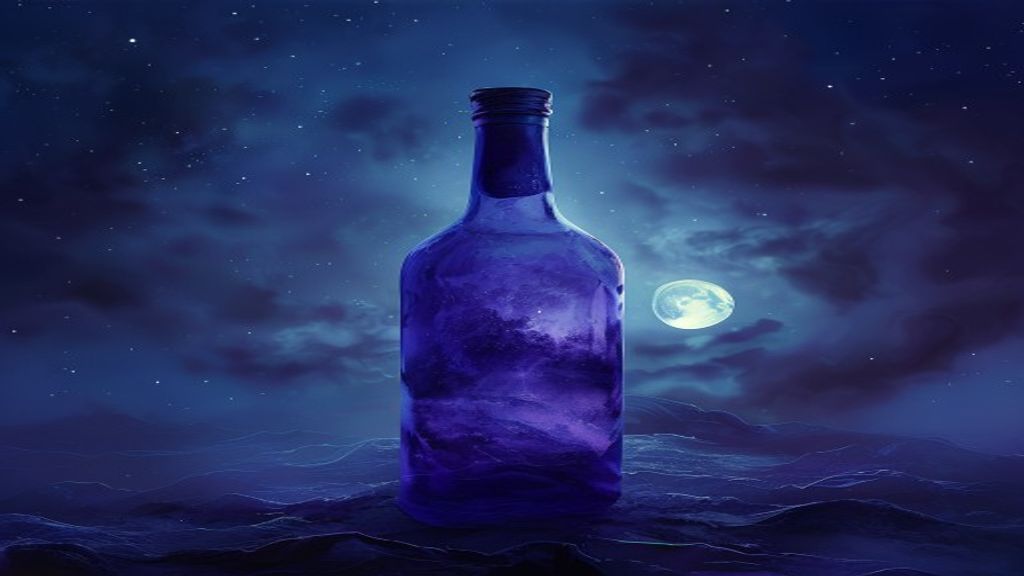
It’s easy to dismiss an empty-bottle dream as too on-the-nose to bother with: of course an empty bottle means something is used up. What the dream actually shows is subtler. The bottle is rarely empty because you drank it, and it is rarely yours. It is simply found that way, already hollow, already done, waiting on a counter or a table or in a field with no explanation.
That detail changes how the symbol reads. The question stops being what is used up and becomes what you do now that the container is left behind.
An empty bottle in a dream usually signals depletion, something finished, or a longing without an object. The bottle’s emptiness is rarely about literal consumption. It’s about arriving at the aftermath of something and having to decide what to do with the container now.
The container that outlived its contents
An empty bottle is one of those objects that can exist without a purpose. A full bottle is clearly for something. An empty one just persists. I think that’s the core of the dream: the structure of a thing remains after the thing inside is gone.
Artemidorus, writing in the second century, held that the same dream means different things for different dreamers, which fits a vessel well. An empty jar, an empty cup, an empty flask: all point to depletion of one kind or another, but the shape of the vessel matters, because the shape tells you what the contents were supposed to be. A medicine bottle that’s empty is different from an empty wine bottle. The lost thing matters.
G. William Domhoff would cut through all of that and ask what’s actually depleted in your waking life. His continuity hypothesis, which I find genuinely useful here, suggests the dream isn’t generating symbols so much as narrating a state you’re already in. The empty bottle is probably tracking something real: energy, a relationship, a period of your life that’s concluded.
How cultures have read it differently
| Tradition | How it reads the symbol |
|---|---|
| Ancient Greek | Empty vessels in temple incubation at Asclepius sanctuaries signaled exhaustion before healing. Being empty was a precondition, not an ending. |
| Ibn Sirin tradition | In classical Islamic dream interpretation, an empty container could mean a household depleted of provisions, or a person whose inner resources had been spent. The advice was to refill rather than mourn. |
| Jungian lens | The bottle as a bounded self: empty means the inner life has been used up on the world and needs solitude to restore. Less about loss, more about restoration being due. |
| Practical/contemporary | Most people who describe this dream link it to burnout, a relationship that’s ended, or a creative period that’s dried up. The feeling is almost always recognizable on waking. |
What you do with it in the dream
This is where the individual dream usually tells you the most. If you’re searching the bottle for a last drop, that’s a particular kind of not-ready-to-let-go. If you set it down and walk away, the dream is probably further along in the process than you consciously are. If you’re carrying it somewhere, the question is whether the destination matters.
Throwing it away is its own version. Dreams where you discard the empty bottle sometimes arrive when you’ve actually started to release something: the bottle being thrown out is the relationship, the habit, the old self-concept being acknowledged as finished. This tends to be one of the better-feeling empty-bottle dreams, which tracks.
Breaking it is different again. A bottle that shatters in a dream suggests the container itself has failed, not just what was in it. The structure didn’t hold. That version tends to cluster around endings that weren’t gentle.
The label you can read
I find the label versions quietly fascinating. When the bottle is empty but you can still read what it was for, your mind is showing you both the absence and the name for it at once. You know exactly what’s missing. That level of specificity in a dream is an essay prompt: write two sentences about that substance and what it meant in your life, and you’ve probably done most of the interpretation.
If the bottle in your dream connects to something you’ve been giving away to others, dreaming of a bow and arrows looks at the other end of the same act: what you’re aiming at, and what’s stopping you from letting go.
And if the emptiness is about a commitment or bond that’s hollowed out, look at dreaming of an engagement ring: an object whose meaning depends entirely on what’s being promised or withdrawn.
Hobson would probably remind me that a bottle, empty or full, is just the brain firing in ways that happen to resemble a bottle, and that I’m adding the meaning retroactively. He’s not wrong. But the meaning is what people wake up with, and meaning is what we’re working with here.
What I don’t have a clean answer to is whether the dream helps. It holds up the hollow thing, makes you look at it, and then you wake up. Whether you do anything with that looking seems to be genuinely up to you.
- What was this bottle supposed to contain, and do I know when it ran out?
- Did I find it empty, or did I watch it become empty?
- What did I do with the bottle in the dream? Did I hold it, throw it, break it?
- Is there something in my waking life I’m still carrying around even though it’s finished?
Quick answers
What does dreaming of an empty bottle mean?
It usually points to depletion, the end of something, or a longing without a current object. The bottle’s shape outlasting its contents is the core image: structure persisting after the substance is gone.
Is an empty bottle dream a bad omen?
Not in any predictive sense. It’s more diagnostic: something in your life is running low or has run out, and the dream is naming that. Many people describe these dreams arriving just as they begin to consciously recognize exhaustion or the end of a period.
What does it mean to break an empty bottle in a dream?
Breaking it tends to signal that the container itself failed, not just the contents. It often clusters around endings that were abrupt or unresolved rather than gradual.
Why do I dream of searching an empty bottle for more?
That version usually reflects a reluctance to accept something as finished. You know it’s empty; you’re checking anyway. The dream is probably showing you where you are in a process, not telling you what to do about it.
Sources for this reading
- Domhoff, G. W. (2003). The Scientific Study of Dreams: Neural Networks, Cognitive Development, and Content Analysis. American Psychological Association.
- Domhoff, G. W. (1996). Finding Meaning in Dreams: A Quantitative Approach. Plenum Press.
- Hobson, J. A., & McCarley, R. W. (1977). The brain as a dream state generator: An activation-synthesis hypothesis of the dream process. American Journal of Psychiatry, 134(12), 1335-1348.DOI
- Artemidorus of Daldis (2nd century CE). Oneirocritica. English edition: Harris-McCoy, D. E. (2012). Artemidorus’ Oneirocritica: Text, Translation, and Commentary. Oxford University Press.
Full bibliography on Sources and method. Found a mistake? Tell us and see the corrections log.