- Tradition
- Psychological readingObject dreams
- Draws on
- Domhoff, Hobson, Artemidorus
- Reviewed
- 5 min read
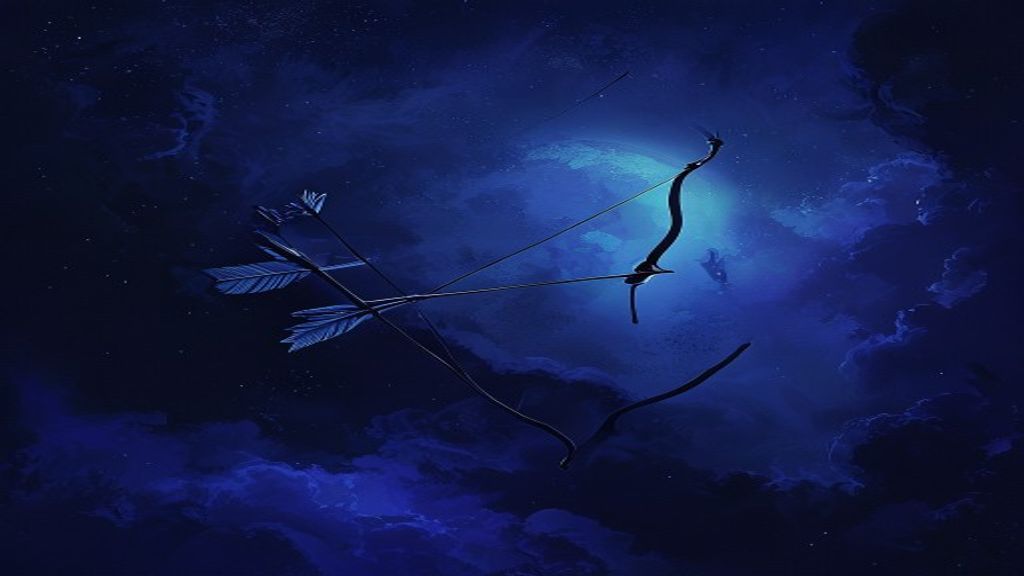
Aimed at what? That is the first question a bow and arrows dream raises. Usually intention held in suspension: something you are aiming at and haven’t yet committed to. The dream rarely shows the flight or the impact. It stays in the held breath, bow raised, elbow level, arrow nocked, target visible somewhere ahead, not releasing, just holding. That not-yet is the whole subject.
A bow and arrows in a dream are almost always about intention in suspension. The bow is your capacity, the arrow is your will, and the dream asks: what are you aiming at, and what’s stopping you from letting go?
The held breath
The most important thing about a bow is that its whole purpose is to store energy for release. You draw it back precisely so that you can let go. And yet the dream usually takes place in that suspended moment: arrow nocked, arm trembling slightly, target visible somewhere ahead. Not the flight of the arrow. Not the impact. The waiting. That’s where the dream lives, and that’s where your waking life probably is too right now. Something is loaded. You haven’t released it yet.
The feeling in the dream matters enormously here. Is the bow heavy, the draw difficult, your arm shaking with effort? Or does it feel light, natural, the tension almost pleasurable? Heavy and strained tends to point toward an obligation you’ve been carrying without getting to act on it. A decision made but not executed. A conversation you’ve been rehearsing for months. Light and ready is different: that’s the dream version of someone who knows exactly what they want and is simply waiting for the right moment. Both are doing the same motion. They feel completely unlike each other.
What the arrow is aimed at
Pay attention to the target, if there was one. A clear, specific target is the dream being unusually direct: you know what you want, and you know where it is. A vague or absent target is the more unsettling version, because you have the capacity and the tension but no direction for it. That’s how it feels when you’re ready to commit to something but haven’t figured out what yet. The bow’s drawn. The landscape is empty. You’re holding and waiting for a target to appear.
Some people dream that the arrow keeps going wide, that no matter how carefully they aim, it drifts. I’d call that a dream about doubt rather than incompetence. The aim itself is fine. It’s the hands that won’t stop second-guessing.
You’re prepared and committed in principle, but something is holding the release. A fear of the consequences, a last reservation, a timing question you haven’t answered.
Satisfaction, a sense of your own competence. Usually follows a decision made or a goal achieved. The bow dream arrives after the fact to confirm something you already did right.
Self-doubt more than incapacity. The mechanics are there. What’s wobbling is belief. This is worth taking seriously if it’s a recurring theme.
You’ve used what you had. Resources, patience, effort. Not necessarily bad: sometimes the quiver empties because you did the work. But it may be asking whether you’ve left anything in reserve.
A tool you counted on failing. Plans, strategies, the approach you had to a problem. The break is the dream doing you the favor of telling you before it happens in waking life.
Bow-as-protection reframes the whole symbol. Here it’s not about ambition but about a boundary you’re having to enforce, a line you’re drawing, something you don’t want to let any closer.
The oldest readings
Artemidorus, writing in the second century, would have asked first who was dreaming, since the same dream means different things for different dreamers, depending on age, status, and occupation. One older framework reads arrows as words or intentions sent toward a specific person, and the bow as the means of delivery. Hit the mark: the communication landed. Arrow falls short: the intention didn’t reach. It’s not a bad framework, honestly. A bow dream is often relational, about something aimed at someone rather than something abstract. An arrow in a dream often has a specific person in its path, someone the dreamer is trying to reach, persuade, confront, or escape.
Domhoff would say this is just continuity: you dream what your waking life is already full of. If you’re in a period of aim and preparation, your brain rehearses the bow. If you’re avoiding a confrontation, it hands you the weapon and puts you in front of the target anyway. He’d be right, and it takes something away from the romance of the image. What it gives back is the question of what you’re actually rehearsing.
When the bow is someone else’s
Short section, but it matters. If you’re the target in the dream, not the archer, everything flips. The symbol becomes about being aimed at: someone’s intention, someone’s focus, or someone’s potential hostility directed at you. Often this shows up during conflict that hasn’t been spoken yet. You feel the aim before the conversation happens. The arrow hasn’t left the bow. You know it’s coming.
Hobson would file the whole thing under pattern-matching: the sleeping brain grabbing an archery image from memory and threading it into a narrative. He’s probably partly right. But even if the image is random, the feeling the dream wraps around it isn’t. The held breath means something. The trembling arm means something. A lost key has the same texture: a capacity present, access delayed. The bow and the key are cousins in that respect. Both are tools whose whole identity is being poised before a use. A gun puts the same aim at a longer distance, which is the question of how far you stand from the thing you are aiming at, and a sword is about the cut you haven’t made yet.
That held posture is easy to carry for a long time. What the dream is about often isn’t archery at all. It is about not asking the thing you mean to ask before the time for asking runs out.
- Did I release the arrow, or was I still drawing back?
- Was there a clear target, or was the aim uncertain?
- What in my life right now has been prepared but not yet launched?
- Is the bow in my hands, or someone else’s?
Quick answers
What does it mean to dream of a bow and arrows?
It’s almost always about intention held in suspension: something you’re aiming at but haven’t committed to yet. The bow stores your readiness; the arrow is the decision. The dream tends to show up when a significant choice, action, or conversation is loaded but not yet released.
Is dreaming of a bow and arrows a bad sign?
Not at all. The symbol is neutral on its own. What matters is the feeling: a confident draw with a clear target is very different from a trembling arm and no target in sight. Many people wake from bow dreams with a useful clarity about something they’ve been stalling on.
What does it mean if the arrow misses in a dream?
Missing tends to be about self-doubt rather than real incapacity. The aim drifts when the hands won’t commit, not when the skill is absent. It’s worth asking what would change if you believed the shot would land.
What does it mean to be the target of an arrow in a dream?
Everything reverses. Now the symbol is about being aimed at, whether by someone’s focused attention, intention, or hostility. It often precedes a difficult conversation that hasn’t happened yet. The arrow being in flight is different from it still being drawn: the first is something arriving, the second is something still being decided.
Sources for this reading
- Domhoff, G. W. (2003). The Scientific Study of Dreams: Neural Networks, Cognitive Development, and Content Analysis. American Psychological Association.
- Domhoff, G. W. (1996). Finding Meaning in Dreams: A Quantitative Approach. Plenum Press.
- Hobson, J. A., & McCarley, R. W. (1977). The brain as a dream state generator: An activation-synthesis hypothesis of the dream process. American Journal of Psychiatry, 134(12), 1335-1348.DOI
- Artemidorus of Daldis (2nd century CE). Oneirocritica. English edition: Harris-McCoy, D. E. (2012). Artemidorus’ Oneirocritica: Text, Translation, and Commentary. Oxford University Press.
Full bibliography on Sources and method. Found a mistake? Tell us and see the corrections log.