- Tradition
- Psychological readingAnimal dreams
- Also read in
- The BibleSame symbol, other tradition
- Draws on
- Revonsuo, Jung, Artemidorus
- Reviewed
- 5 min read
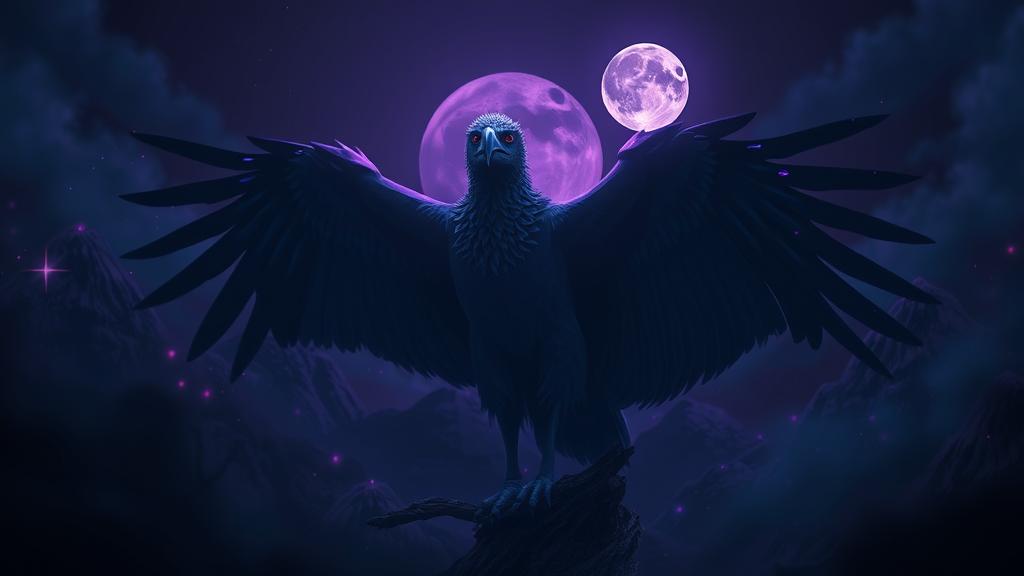
A vulture in a dream usually doesn’t look alarming close up. On a fence post, or on a dead tree at the edge of a field, absolutely still in full sun, it looks patient, as if it had decided something. That’s the unsettling part, actually: not aggression but the complete absence of hurry. It’s hard to say what it decided. But it had decided.
The dreamer tends to wake with a residue that’s hard to name. Not quite fear. Something more like recognition. The bird is circling something, or sitting above something, and in the dream you know it belongs there even if you wish it didn’t.
Why this bird is not what you think
The automatic reading is death or danger, and it’s not completely wrong, but it’s the laziest version. Vultures don’t kill. That’s the fact that reshapes everything. They arrive after, and they clean up, and because of them the landscape doesn’t become permanently contaminated by what died in it. Whatever they’re circling in your dream isn’t a threat on the way. It’s something that has already ended, or is ending, and the bird is there to do the work that follows.
That reframe changes the whole question. The dream isn’t warning you that something terrible is about to happen. It’s showing you that something has finished, and that there’s a process still ahead: clearing, composting, making space. The vulture doesn’t cause the ending. It manages it.
- Notice where the vulture isIs it on the ground, on something elevated, or circling in the air? On the ground usually means the ending has arrived and the process of clearing is already happening. Perched overhead suggests something in transition, still dying or recently finished. Circling at a distance points to awareness you have of something ending that you haven’t acknowledged yet.
- Notice what it’s watching or moving towardIf you can see what the vulture is attending to, that’s the center of the dream. It might be a person, an object, an animal, a version of yourself. The vulture’s attention is the dream pointing at something for you.
- Check how you feel about the birdRepulsion, relief, fascination, and grief all lead somewhere different. Feeling relieved watching the vulture is interesting and worth sitting with. It can suggest the part of you that’s ready for the clearing to happen. Feeling horrified might mean you haven’t fully accepted that something is actually done.
- Ask what needs compostingThis is the real question the dream is usually asking. What in your life has ended that you haven’t cleared away yet? A dynamic, a role you used to play, an idea about yourself that no longer fits? The vulture is patient. It’ll wait until you’re ready to deal with what it’s attending to.
The historical readings are genuinely stranger than the modern ones
Artemidorus, whose systematic dream manual from the second century remains one of the oldest surviving in the Western tradition, held that the same dream means different things for different dreamers: age, status and occupation change the reading. Applied to a vulture, that rule means a physician, a soldier and a merchant would each read the bird differently. The bird that lives from others’ misfortune could be a useful patron for those whose work involves transactions around death and ending. Not a curse. A kind of business partner.
Ancient Egypt did something even more interesting with it. The vulture was Nekhbet, one of the two protective goddesses of the pharaoh, a figure of guardianship rather than threat. She spread her wings over those she protected. That reading, the vulture as fierce protector, is a reminder that the modern death-omen is only one lens among many. I find I can’t just dismiss that lineage when it’s that old and that consistent.
What Jung would say, and what I’d add
Jungian readings treat animals in dreams as aspects of the psyche’s deeper, older layers, and a large bird that deals in death and transformation sits close to what Jung called the shadow: the parts of yourself that do the difficult necessary work that the conscious self prefers not to look at. The vulture in this reading isn’t outside you. It’s a part of you that processes endings, that handles the clearance work, that doesn’t flinch at what’s finished.
I think Jung’s lens is useful here but not quite sufficient on its own. The vulture’s particular quality is its patience. The shadow in Jungian terms tends to be urgent, pressing. The vulture waits. That waiting is part of the message: whatever this dream is pointing to, you don’t have to rush at it. The process has its own timing.
When the vulture is aggressive or attacking
This is the version that wakes people up. A vulture that’s no longer waiting but actively coming at you shifts the dream considerably. Revonsuo’s threat simulation theory, which argues that some dreams exist to rehearse responses to threat, feels relevant here in ways it doesn’t with the passive vulture. An attacking vulture dream may be rehearsing a confrontation with something you’ve been treating as if it’s patient when it actually isn’t. Something is pressing. The waiting period is over and you know it.
Or, less dramatically: the dream is working through some anxiety about a situation in your life where others are waiting for something from you. Where you are the thing being circled.
Go back to the bird in full sun that had decided something. What it decided, in the dream’s terms, was simply to be still until the right moment. Not to force anything. Not to chase. Just to wait with complete commitment. If you’re in a period where something is ending and you don’t quite know what to do with yourself during the interval, that bird is a better image for what’s being asked of you than any action plan I could offer.
Dreams of a white snake share the vulture’s stillness: an animal whose whole presence is waiting, though the snake’s waiting is the pre-strike kind and the vulture’s is the aftermath kind. And if the real subject of your dream was an ending you have not looked at yet, dreaming of an ostrich is the large-bird dream about treating something obvious as if it weren’t there.
- Was the vulture circling, perched, or on the ground? Its position tells you how far along the ending is.
- What was it attending to? That thing is the center of the dream, not the bird.
- Did I feel relieved watching it, or horrified? Both feelings tell you something different about your relationship to what’s ending.
- What in my waking life has finished but hasn’t been cleared away yet?
One symbol, two traditions
Read side by side, the two traditions pull in different directions: vulture as a signal from your own mind, or vulture as an image to test against the text. Knowing which question you are asking is half the interpretation.
A vulture in a dream most often points to something that has ended or is ending in your waking life, and to the clearing process that follows. It’s not a symbol of incoming death or disaster; vultures don’t kill. They arrive…
You are reading this oneJoel 2:28 says God can speak through dreams, and the prophetic texts use vulture imagery in connection with serious judgment. But Ecclesiastes 5:7 counsels against over-reading every dream as divine speech, and Jeremiah 23:25-28…
Read the biblical meaning →Quick answers
What does dreaming of a vulture mean?
A vulture in a dream most often points to something that has ended or is ending in your waking life, and to the clearing process that follows. It’s not a symbol of incoming death or disaster; vultures don’t kill. They arrive after, and they make space. The dream is usually asking what needs to be composted or released.
Is dreaming of a vulture a bad sign?
Not necessarily. In many traditions, including ancient Egyptian and several African interpretive systems, the vulture is a protective figure, not a threatening one. The modern automatic reading as death-omen is only one of many cultural lenses, and it tends to miss the bird’s actual behavior: patience, not predation.
What does it mean when a vulture attacks you in a dream?
An attacking vulture shifts the dream significantly. Rather than patient waiting, the dream may be showing you something that can no longer be deferred: a confrontation, a decision, a situation where the waiting period has passed. It can also reflect anxiety about being in a position where others are waiting for something from you.
What does it mean to see vultures circling in a dream?
Circling usually means the dreamer is aware that something is ending but hasn’t fully acknowledged it yet. The birds are at a distance because the process hasn’t landed yet. The dream is drawing your attention toward it. Asking what you’ve been watching from the corner of your eye without quite looking at it directly is usually where to start.
Sources for this reading
- Revonsuo, A. (2000). The reinterpretation of dreams: An evolutionary hypothesis of the function of dreaming. Behavioral and Brain Sciences, 23(6), 877-901.DOI
- Jung, C. G. (Ed.). (1964). Man and His Symbols. Doubleday.
- Artemidorus of Daldis (2nd century CE). Oneirocritica. English edition: Harris-McCoy, D. E. (2012). Artemidorus’ Oneirocritica: Text, Translation, and Commentary. Oxford University Press.
Full bibliography on Sources and method. Found a mistake? Tell us and see the corrections log.