- Tradition
- Psychological readingPlace dreams
- Draws on
- Domhoff, Artemidorus
- Reviewed
- 5 min read
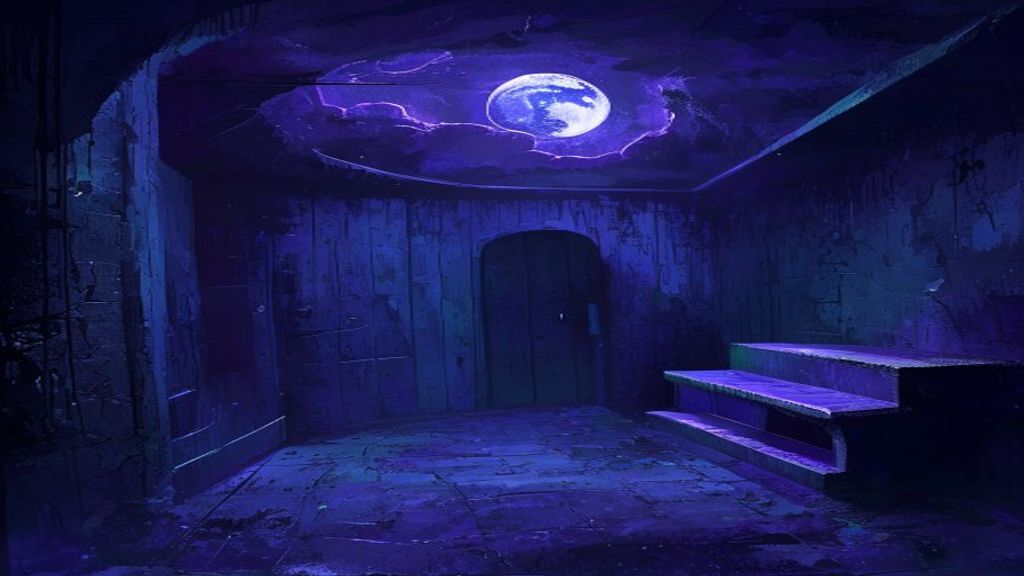
One hand rests on the cold edge of the doorframe, and you are standing at the top of a flight of stairs. Somewhere below, something makes a sound you can’t place: not a growl, not a voice, just a small settling noise. The light from the hallway stops a few steps down. You haven’t been frightened yet, but you have gone completely still. That going-still, more than anything waiting at the bottom, is what a mysterious basement dream is about.
The symbol is almost too obvious, the kind of dream a first-year psychology student would diagnose without pausing, and it earns its reputation anyway. Basement dreams tend to carry a very particular reluctance. Not fear, exactly. The sound isn’t necessarily threatening, but you wait. That waiting is the dream’s real subject, and it tends to have nothing to do with your actual basement.
A mysterious basement in a dream usually represents something you’ve pushed below the level of daily awareness: an unresolved feeling, an avoided truth, or an instinct you’ve been pretending not to have. The mystery is a function of how long you’ve stayed at the top of the stairs.
The architecture of avoidance
The Jungian tradition places the basement at the unconscious end of the house-as-self model: the deeper you go, the older and less controlled the material. That is a specific theoretical claim, but the experiential truth in it is simpler. Basements are genuinely where we put things we don’t want to deal with. That’s not metaphor. That’s how houses actually work. The dream is using the architecture you already understand.
What makes a basement dream mysterious rather than frightening is often the uncertainty about what’s down there. You might be descending stairs that seem too long. You might be standing in a room that seems to expand as you look at it. Or you might simply know there’s a door you haven’t opened, and the whole dream is the feeling of not opening it. That closed-door version is usually about something you already know but aren’t saying. If the staircase itself keeps appearing, the dream of stairs shares the same image of going down toward something, and the two are probably the same conversation.
| Tradition | How it reads the symbol |
|---|---|
| Greek (Asclepius tradition) | Temple incubation rituals required descent before healing. The dreamer slept below the sanctuary. Going down preceded revelation. |
| Ibn Sirin tradition | Underground spaces in dreams often indicated secrets held close. The interpreter asked what the dreamer had not told anyone. |
| Artemidorus (2nd c.) | Subterranean spaces could mean hidden wealth, hidden sickness, or hidden knowledge. Context of feeling determined which. |
| Jungian analysis | The basement is the personal and collective unconscious. What you find there represents material that has not yet been integrated into conscious life. |
What you find when you go down
If the dream lets you reach the bottom, the contents matter. A flooded basement carries a different weight than a dry one with old furniture. Water tends to amplify whatever emotional reading was already present: flooding often signals that the thing you’ve been containing has started to overflow in waking life, slowly and without announcement.
An empty basement is one of the stranger variants. People expect to find something, and finding nothing can feel more unsettling than finding a monster. I think that’s because an empty basement suggests you’ve been afraid of something that doesn’t exist, or that you’ve been so thorough in your avoidance that you can no longer identify what you were avoiding. Both of those are worth some time.
G. William Domhoff would point out, usefully if unsentimental, that dreams reflect current concerns rather than deep archaeological excavations. So the basement your mind builds probably isn’t hiding something from your childhood. It’s more likely holding something from the last six months that you’re processing at a level below narrative. I find that framing useful when people want the dream to mean something enormous. Sometimes it’s just showing you the back room of a recent feeling.
The thing that lives there
When there’s a figure or creature in the basement, resist the horror-movie reading. The dark shape at the bottom of the stairs in these dreams tends to behave less like a threat and more like a caretaker of something you own. It’s not coming for you. It’s been down there with the thing you left.
That reframe changes the dream considerably. The figure waiting in the basement isn’t an enemy. It’s more like a memory with its hands full, waiting for you to come back and take what’s yours. Dreams of an unknown but familiar place operate on a similar instinct: your mind has prepared the setting, and the familiarity is a signal that you already have access to whatever you’re about to find.
If you never reach the bottom
This may be the most common version. The stairs go on. Or the door won’t open. Or you reach the bottom and wake up. It’s a dream that ends at the threshold.
Older dream traditions often treated unresolved dreams of descent as prospective: the journey was still ahead. I don’t push the literal interpretation, but there’s something psychologically sound in it. If you keep dreaming the descent without completing it, something in waking life is probably still in the approach phase too. You’re close to something. You haven’t yet decided to look at it directly. The dream will keep resetting the staircase until you do, or until the thing you were avoiding resolves itself by other means. Dreams of an endless corridor carry the same forward-blocked quality.
These threshold dreams can feel frustrating, but they can just as easily read as kind. There’s something patient about them. They don’t drag you down. They just leave the light on.
- What was the feeling at the top of the stairs, before you went down?
- Did you find something, or were you stopped before you could?
- Is there something in your waking life you’ve been standing near the edge of without stepping toward?
- If there was a figure down there, what might it have been holding for you?
Quick answers
What does a mysterious basement mean in a dream?
Usually it represents something you’ve pushed below conscious attention: an unexamined feeling, an avoided decision, or an instinct you’ve been ignoring. The degree of mystery tends to correspond to how long you’ve been not looking.
Is a basement dream scary or negative?
Not necessarily. The dread in these dreams often comes from the approach, not the destination. What you find at the bottom, if the dream lets you get there, is rarely as threatening as the anticipation. The basement tends to hold things you left there, not things that came in from outside.
What does it mean to dream of a flooded basement?
Water in a basement dream usually amplifies the emotional stakes of whatever you’ve been containing. Flooding often appears when something held below the surface has started moving into daily life. It’s the dream noticing what you may have been pretending not to notice.
Why do I keep dreaming about a basement I can’t fully explore?
The threshold that won’t let you through usually points to something in waking life you’re still in the approach to. Recurring versions of this dream tend to stop once you look at the unexamined thing directly, not necessarily by resolving it, but by acknowledging that it’s there.
Sources for this reading
- Domhoff, G. W. (2003). The Scientific Study of Dreams: Neural Networks, Cognitive Development, and Content Analysis. American Psychological Association.
- Domhoff, G. W. (1996). Finding Meaning in Dreams: A Quantitative Approach. Plenum Press.
- Artemidorus of Daldis (2nd century CE). Oneirocritica. English edition: Harris-McCoy, D. E. (2012). Artemidorus’ Oneirocritica: Text, Translation, and Commentary. Oxford University Press.
Full bibliography on Sources and method. Found a mistake? Tell us and see the corrections log.