- Tradition
- Psychological readingFood dreams
- Draws on
- Domhoff, Hobson, Artemidorus
- Reviewed
- 5 min read
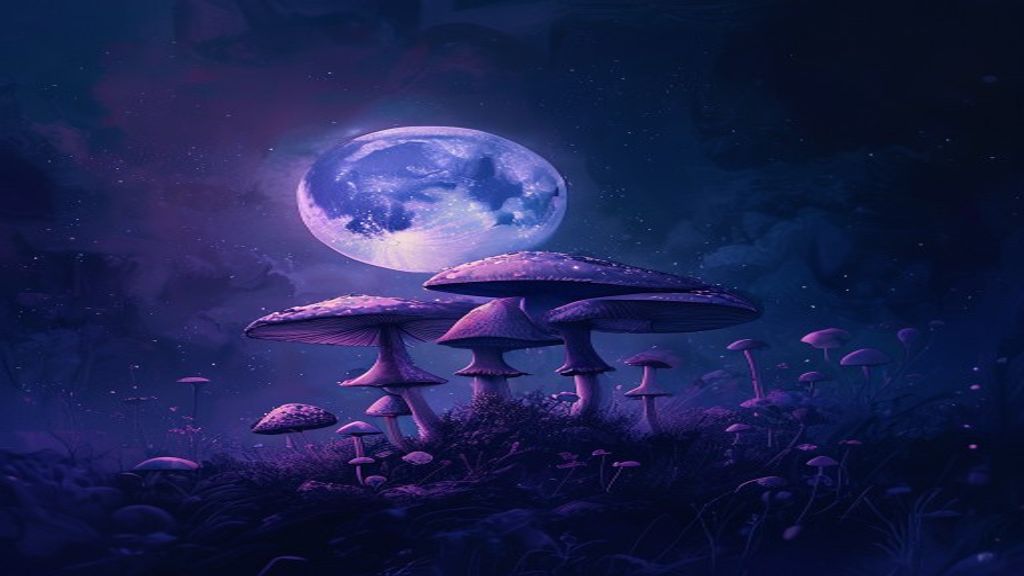
A single mushroom, half-buried in dark soil, lit the way a lamp lights a table in a painting. That is all. No plot. You wake oddly certain something is about to happen, though nothing in particular does for weeks. The dream looks small and means something slow: the cap is the last thing to form, and by the time you see it, most of the work was done in the dark.
A mushroom in a dream usually signals something developing below the surface of your life, something you haven’t seen yet but that’s already underway. The soil is context, the cap is what’s about to emerge. Pay attention to whether you found it, grew it, ate it, or were startled by it.
What mushrooms actually do (and why that matters)
Mushrooms don’t grow the way you’d expect. The visible part, that pale dome pushing through dirt or bark, is the last thing to show up. The real work happens underground, in threads so fine you’d need a lens to see them, for weeks or months before any cap appears. Your dreaming mind may well know this without knowing it consciously. When a mushroom arrives in a dream, the symbol it carries is not sudden growth. It’s patient, invisible growth that has already been happening.
That’s what makes it different from, say, dreaming of fruit on a visible tree. With fruit you watch it ripen. With a mushroom you find it complete, or nearly so, emerging from a substrate you couldn’t see through. The dream is telling you something finished in the dark. Whether that’s good news depends entirely on what you’ve had buried.
Found versus given versus eaten
You found the mushroom
Discovering a mushroom in a dream usually points at an insight, opportunity, or capacity you didn’t know was ready. You weren’t cultivating it consciously. It just appeared. The finding is the point, and so is the slight surprise that goes with it.
Someone gave or cooked it for you
When another person is involved with the mushroom, whether handing it to you or serving it in a meal, the symbol shifts toward relationship. Something is being offered. The question is whether you trusted it enough to eat, or left it on the plate.
Eating the mushroom is its own thing. Food consumption in dreams carries themes of taking something in, accepting something, making it part of yourself. Dreaming of rice is about that act too, though rice is about sustenance and dailiness where mushrooms are about the surprising and the rare. If you ate the mushroom without hesitation, something in you is ready to absorb a change. If you hesitated, or refused, the dream is noting your ambivalence about that same thing.
A note on the darker readings
Mushrooms can be toxic. Most people know this in a body-level way even if they can’t name a single poisonous species. So a dream mushroom that feels threatening, that you know not to touch, that appears in a quantity that feels wrong, is probably speaking about something in your life with a similar quality: appealing on the surface, not quite safe underneath. That’s a useful signal, not a disaster.
What the long history says
Artemidorus, writing in the second century, was practical in a way I find bracing. He wasn’t interested in cosmic symbolism. His central rule, that the same dream means different things for different dreamers, puts the weight on the dreamer’s own situation and on the feeling about the food: delighted? suspicious? indifferent? I’m not suggesting we take a Roman dream manual as gospel. But that emphasis still holds up perfectly well, and it suits a food as strange as the mushroom, which sits closer to the unfamiliar than to the everyday.
Domhoff’s continuity hypothesis holds that dreams don’t symbolize hidden truths so much as they extend what’s actually going on. If you’ve been waiting for something, feeling like results are underground and unreachable, a mushroom dream is your mind replaying that exact texture of experience. It’s not a prophecy. It’s a portrait. Domhoff would probably find the whole ancient tradition of dream interpretation endearing and not entirely wrong, just dressed in the wrong clothes. I think he’d have a point.
A mushroom dream that comes back, with the same lamp-lit image and the same sense of imminence, is rarely followed by anything dramatic. What arrives is more like a slow realization than a revelation, but it is real and it has clearly been forming for a long time. Dreaming of a potato shares this underground logic, but it leans toward sustenance and groundedness rather than emergence. The mushroom is specifically about appearance, about the moment the invisible becomes visible.
If the mushroom felt wrong
Hobson would tell you the whole symbol is the brain generating narrative from random activation, and on some nights he’d probably be right. But even if the imagery is partly noise, the feeling it produces is not. A mushroom that made you uneasy in the dream, that you circled without touching, is worth taking seriously regardless of where the image came from. Something in your life has that same shape. Worth knowing what it is.
And if it was just a mushroom on a plate that you enjoyed and forgot? Then maybe it was just that. Not every dream carries a cargo. Some are furniture. Some are just the day’s leftovers reshuffled. The ones that stay with you past breakfast are the ones worth sitting with.
- Did you find the mushroom, receive it, or eat it? The action shapes the meaning more than the mushroom itself.
- What was the feeling underneath: anticipation, unease, or something close to wonder?
- Is there something in your life right now that’s been developing out of sight, something you haven’t seen the results of yet?
- Did the mushroom feel safe, or was there something about it you didn’t quite trust?
Quick answers
What does dreaming of a mushroom mean?
Usually it points to something that’s been developing below the surface of your life, something not yet visible but already underway. The mushroom’s cap is the last thing to emerge, and that’s often the dream’s whole point: results are coming from a process you couldn’t watch.
Is dreaming of a mushroom a good sign?
More often than not, yes. The symbol tends toward quiet growth, hidden potential, and things ripening in the dark. A threatening or poisonous-feeling mushroom flips that, pointing to something appealing on the surface that may not be what it seems.
What does eating a mushroom in a dream mean?
Eating anything in a dream generally carries the idea of taking something in, accepting it, making it part of yourself. Eating the mushroom without hesitation suggests readiness for change. Refusing it, or hesitating, points to ambivalence about something you’re being offered.
Why did I dream of finding a mushroom I didn’t expect?
That’s the most common version, and it tends to mirror the experience of coming across an opportunity or insight that was quietly ready before you noticed it. The finding, especially the surprise of it, is often the whole message.
Sources for this reading
- Domhoff, G. W. (2003). The Scientific Study of Dreams: Neural Networks, Cognitive Development, and Content Analysis. American Psychological Association.
- Domhoff, G. W. (1996). Finding Meaning in Dreams: A Quantitative Approach. Plenum Press.
- Hobson, J. A., & McCarley, R. W. (1977). The brain as a dream state generator: An activation-synthesis hypothesis of the dream process. American Journal of Psychiatry, 134(12), 1335-1348.DOI
- Artemidorus of Daldis (2nd century CE). Oneirocritica. English edition: Harris-McCoy, D. E. (2012). Artemidorus’ Oneirocritica: Text, Translation, and Commentary. Oxford University Press.
Full bibliography on Sources and method. Found a mistake? Tell us and see the corrections log.