- Tradition
- Psychological readingPlace dreams
- Also read in
- The BibleSame symbol, other tradition
- Draws on
- Domhoff, Artemidorus
- Reviewed
- 4 min read
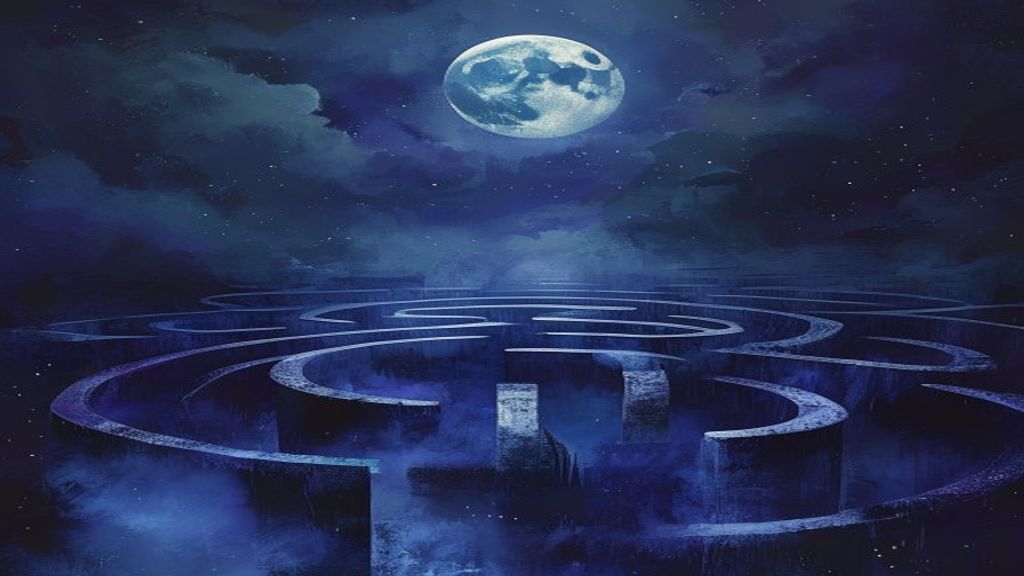
Labyrinth dreams are rarely about being lost from the start. You go in feeling fine, confident even, make a few sensible turns, and move with purpose for what feels like ten minutes. Then you round a corner and you are back at the entrance: same gravel, same gap in the right-hand hedge. That particular flavour of humiliation, the kind that’s too small to complain about and too large to shake off, is what labyrinth dreams feel like when you wake from them.
A labyrinth in a dream usually stands for a decision or situation that keeps circling back on itself. You’re not lost because you’re careless. You’re lost because the path genuinely doesn’t reveal itself until you’ve already committed to a direction.
The way in is never the problem
Most labyrinth dreams begin with a confident entrance. That detail matters. The maze doesn’t ambush you at the gate. It waits. You make a few reasonable turns and then the walls stop cooperating. The dreaming mind builds mazes specifically for problems that looked solvable at the start, problems where your initial read of the situation was genuine and wrong at the same time.
What kind of problem? Usually one with multiple paths that all seem plausible. A job decision where both options have merit. A relationship that keeps returning to the same conversation. A creative project where you’ve drafted the beginning four times. The labyrinth doesn’t mean you’re confused because you’re weak. It means the actual situation doesn’t have a clear arrow pointing forward.
Getting more lost
You take a turn and the corridor stretches. The walls feel closer. Choices multiply and none resolves. This version tends to show up in waking life when you’re adding options rather than eliminating them, gathering more information past the point where more information helps. The maze expands to match the overthinking.
Finding the center
You reach the middle of the labyrinth, or the exit, often without understanding how. This is worth taking seriously. The dreaming mind sometimes solves a problem it hasn’t announced to the waking mind yet. If you had this version, sit with what changed in the last stretch before you arrived. That shift was probably the point.
What you feel in there
The emotional texture is the real reading. A labyrinth dream can feel tense but interesting, a puzzle with walls. It can feel like flat dread, the kind where you know something is wrong without knowing what. Or it can feel like a specific loneliness, moving through something enormous and entirely alone. Those three versions point in different directions. The interesting-puzzle version usually belongs to someone who genuinely enjoys the problem they’re circling, even if it’s exhausting. The dread version is for something you’re stuck in but don’t want to be. The lonely version is about carrying a decision that other people can’t help you make.
Old walls, old arguments
I’m cautious about leaning on very old readings, but the ancient tradition read an inescapable tangle in plain, practical terms: the dreamer is entangled in something, and it’s hard to argue with that. The labyrinth reached the ancient world as myth, the Minotaur at the center, the thread Ariadne provided, yet the practical reading survives the myth. The specific something still depends on the dreamer’s life, which is Artemidorus’s old point that the same dream means different things for different dreamers.
A Jungian reading would push further and say the labyrinth points inward, that the walls your mind builds at night are built from the same material as the ones you don’t acknowledge during the day. In that tradition the house is a common image of the self, each room a different layer of psyche, and a labyrinthine basement would interest it more than the ground floor ever could. I find the reading useful precisely when the maze in a dream doesn’t match any external problem. When the walls feel familiar but you can’t quite say why, that’s the interior kind.
Domhoff would call all of this less mysterious, and he’d be right to. His continuity hypothesis is pretty unglamorous: dreams extend waking concerns, and if you’re dreaming of a labyrinth, you’re probably working through something that hasn’t resolved yet. He’d ask what’s unresolved in your life this month. Often, you already know.
One ending deserves a note: the one where you stop fighting it. You sit down in the middle of the path and just wait, then wake before anything happens. That is the kind of ending that feels meaningful even if it isn’t, and it means most if stopping and waiting is exactly what you’re avoiding in waking life.
If your labyrinth had other people in it, people moving with apparent purpose while you circled, the crowd is its own subject: dreaming of a market follows what it feels like to move among others who seem to know where they are going. And if the corridors were bare and nobody else was there, dreaming of an empty room reads that hollow quiet directly.
- Did the maze feel like a puzzle or a trap? That difference tells you how you actually feel about the situation.
- Was I alone, or were there other people also lost, or people who seemed to know the way?
- Did I reach the center or the exit, and if so, what changed in the last few moves before I arrived?
- What in my waking life right now keeps looping back to the same junction?
One symbol, two traditions
Read side by side, the two traditions pull in different directions: labyrinth as a signal from your own mind, or labyrinth as an image to test against the text. Knowing which question you are asking is half the interpretation.
A labyrinth in a dream usually stands for a decision or situation that keeps circling back on itself. You’re not lost because you’re careless. You’re lost because the path genuinely doesn’t reveal itself until you’ve already…
You are reading this oneThe labyrinth doesn’t appear in Scripture. But Scripture is unusually rich on the themes this dream presses: paths, lostness, divine guidance, and what trust looks like when you can’t see the next turn. This is where the biblical…
Read the biblical meaning →Quick answers
What does dreaming of a labyrinth mean?
It usually stands for a situation that loops back on itself, a decision with no obvious path forward. The maze reflects real complexity, not personal failure. The emotional tone during the dream, curious, dread, lonely, tells you how you actually feel about that stuck situation.
Is dreaming of a labyrinth a bad sign?
Not inherently. The labyrinth that feels like an interesting puzzle is quite different from the one that feels like a trap. The dream is a map of your engagement with the problem, not a verdict on the outcome.
What does it mean to find the exit in a labyrinth dream?
Often it means part of your mind has worked out a path you haven’t consciously recognized yet. If you reached the exit, pay attention to what shifted in the final stretch of the dream. That move or change is probably the insight.
Why do I keep having labyrinth dreams?
Recurrence usually means the underlying situation hasn’t resolved or been acknowledged. The dream stops when either the real-life tangle clears or you accept that it isn’t going to resolve the way you wanted and adjust accordingly.
Sources for this reading
- Domhoff, G. W. (2003). The Scientific Study of Dreams: Neural Networks, Cognitive Development, and Content Analysis. American Psychological Association.
- Domhoff, G. W. (1996). Finding Meaning in Dreams: A Quantitative Approach. Plenum Press.
- Artemidorus of Daldis (2nd century CE). Oneirocritica. English edition: Harris-McCoy, D. E. (2012). Artemidorus’ Oneirocritica: Text, Translation, and Commentary. Oxford University Press.
Full bibliography on Sources and method. Found a mistake? Tell us and see the corrections log.