- Tradition
- Psychological readingObject dreams
- Also read in
- The BibleSame symbol, other tradition
- Draws on
- Domhoff, Hobson, Artemidorus
- Reviewed
- 5 min read
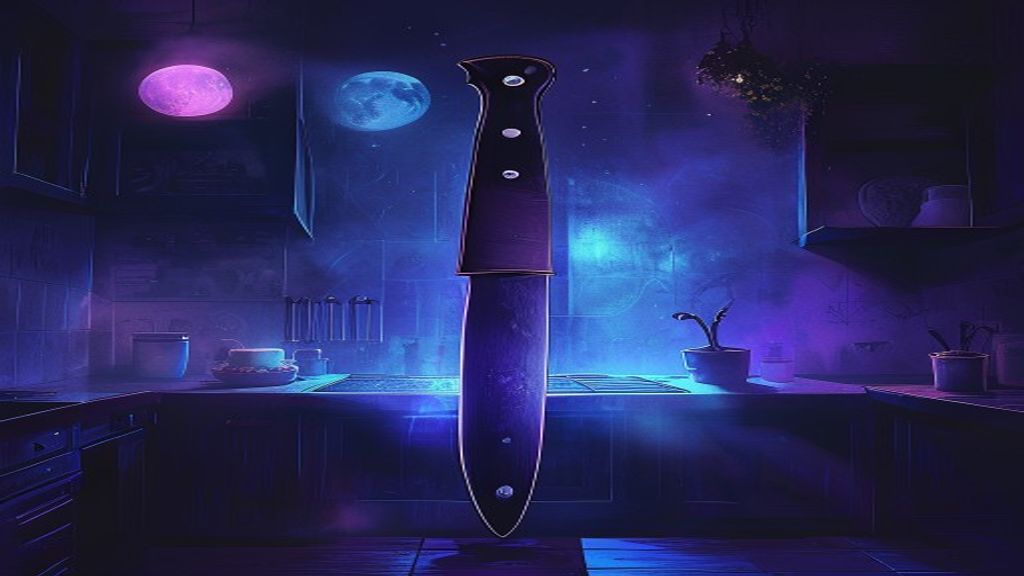
The knife is just there, on the counter, gleaming a little under the kitchen light. Nobody is holding it and nothing is happening. You still can’t stop looking at it. Kitchen knives have that quality even when everything is accounted for. They sit in plain sight, completely familiar, and they carry a charge that forks and spoons don’t.
That charge is exactly what your sleeping mind is reaching for when a kitchen knife shows up in a dream. Not drama. Not danger. Charge.
A kitchen knife in a dream is almost never about violence. It’s about cutting: what needs to be separated, what’s being prepared, and who in your life is holding the tool. The blade’s meaning shifts almost entirely depending on whether it’s in your hand, someone else’s, or lying on the counter doing nothing.
The knife on the counter
When the knife appears as an object rather than an event, when it’s just there, noticed, maybe gleaming under kitchen light, the dream is asking you to look at something in your life you already know needs cutting but haven’t touched yet. A conversation. A commitment you made when you were a different person. A habit that’s been sitting on the counter of your days for months, functional-looking, waiting.
The knife-on-counter version tends to come with a strange guilt, as if noticing the knife makes you responsible for it. That sense is probably picking up something true. The dream put it there for you. The discomfort is the content.
Context bleeds in from the whole scene: a clean, sharp knife in a bright kitchen reads very differently from a dull, rust-spotted one in a dark room. The first is capacity. The second is a tool that’s been neglected, or a skill you haven’t used. Both are worth sitting with.
Knife in your own hand
You’re the one doing the cutting. This is usually about agency: you’re separating yourself from something, or preparing something, or defending a boundary you’ve been soft about. The action matters more than the blade. Chopping vegetables is not the same dream as pointing a knife at someone.
Knife in someone else’s hand
The emotional weight shifts to the relationship. Fear means you feel threatened, but threat in dreams is often metaphorical: this person has the power to cut something away from you, to change your situation, to say something that lands hard. Anger, not fear, in their hand is rarer and usually points to a specific unresolved conflict.
The one version people get wrong
Being cut in a dream isn’t necessarily the nightmare reading. Pain in dreams doesn’t always translate to pain in waking life. Artemidorus, writing in the second century, held that the same dream means different things for different dreamers, and a blade is a clear case: it depends enormously on who held it and toward what end. A cut that produces something useful, that opens something, has a different flavor than a cut that’s simply harm.
The cut-dream often carries more relief than you’d expect. As if something tight had finally been released.
Whose kitchen is it, and does that matter
Kitchen dreams are their own category because the kitchen carries so much freight in most people’s inner lives. It’s where daily care happens, the unglamorous sustaining kind. If the kitchen in the dream is yours but feels wrong, too large or someone else’s layout, that displacement is part of the message. If it’s a stranger’s kitchen, the knife is operating in territory you don’t fully own yet. If it’s your childhood kitchen, well. That’s a different essay.
I’m skeptical of interpretations that lean too hard on fixed symbolism here. G. William Domhoff has spent decades making the case that our dreams reflect our actual concerns with very little disguise, and I think the kitchen knife is a good example of his point. You don’t need to decode it. You need to ask what in your current life involves cutting, separating, or preparing, and who has the power to do it.
Hobson would push back on even that much interpretation, calling the kitchen knife a random activation of a familiar object and suggesting the meaning gets assembled after waking. He’s not wrong that the brain does a lot of post-hoc narration. But the objects that get “randomly” activated aren’t quite random, in my reading. The knife carries a charge that a fork and spoon don’t. Something chose the knife.
A broken mirror shares this quality: an object that exists peacefully in daily life and yet carries an edge in dreams, an emotional temperature that shifts everything around it. And if your dream placed the knife next to a suitcase, your mind might be staging a departure that requires cutting something loose first.
If the knife keeps coming back
Recurring knife dreams, especially ones that wake you, tend to cluster around sustained tension that hasn’t been acknowledged or addressed. Not dramatic conflict. Sustained tension: the kind that lives in your shoulders, in the way you go quiet in certain rooms with certain people. The dream isn’t predicting violence. It’s a lit match held near paper, not a fire.
Sometimes what’s needed is the conversation you’ve been deferring. Sometimes it’s cutting something out of your life that’s quietly draining you. The knife in the dream is already in your hand. The question is what you’re going to do with it when you’re awake.
Sometimes the honest answer to what the knife means is that you don’t know yet, and that the asking is the beginning of the answer. A phone that won’t work is about connection interrupted. The kitchen knife is about connection that can be both severed and sharpened. That’s a harder thing to hold.
- Whose hand held the knife, and what does that person have the power to cut away from me?
- Was the knife being used, or just present? What in my life is sitting there waiting to be used?
- Did the cut in the dream feel like harm or like release?
- What have I been putting off cutting loose because the timing never seems right?
One symbol, two traditions
The two schools are not reading the same book: psychology asks what kitchen knife is doing in your waking life, while the biblical tradition tests the image against Scripture and leaves the meaning with God.
A kitchen knife in a dream is almost never about violence. It’s about cutting: what needs to be separated, what’s being prepared, and who in your life is holding the tool. The blade’s meaning shifts almost entirely depending on…
You are reading this oneScripture is silent about kitchen knives in dreams specifically. But the cutting tool appears in several significant contexts: sacrifice, division, preparation, and the Word of God itself described as sharper than a sword. The…
Read the biblical meaning →Quick answers
What does it mean to dream of a kitchen knife?
A kitchen knife in a dream almost always points to something that needs to be cut, separated, or prepared in your waking life. The blade itself matters less than who’s holding it and what it’s doing. Passive presence on a counter suggests something you know needs addressing. Active use suggests you’re already in the process of separating something.
Is dreaming of a kitchen knife a bad omen?
Not by default. Most knife dreams are about agency and decision rather than threat. A knife that’s helping you do something is a very different symbol from one pointed at you.
What does it mean when someone else holds the knife in your dream?
It usually points to a relationship where you feel the other person has the power to change your situation, end something, or deliver news that cuts. The emotion you feel toward them in the dream, fear, anger, calm, shifts the reading significantly.
Why do I keep dreaming about kitchen knives?
Recurring knife dreams tend to cluster around unacknowledged tension: something in your life that needs cutting or separating that you haven’t quite committed to yet. The dream keeps returning because the underlying situation hasn’t shifted. Naming what needs to be cut, even privately, often changes the frequency.
Sources for this reading
- Domhoff, G. W. (2003). The Scientific Study of Dreams: Neural Networks, Cognitive Development, and Content Analysis. American Psychological Association.
- Domhoff, G. W. (1996). Finding Meaning in Dreams: A Quantitative Approach. Plenum Press.
- Hobson, J. A., & McCarley, R. W. (1977). The brain as a dream state generator: An activation-synthesis hypothesis of the dream process. American Journal of Psychiatry, 134(12), 1335-1348.DOI
- Artemidorus of Daldis (2nd century CE). Oneirocritica. English edition: Harris-McCoy, D. E. (2012). Artemidorus’ Oneirocritica: Text, Translation, and Commentary. Oxford University Press.
Full bibliography on Sources and method. Found a mistake? Tell us and see the corrections log.