- Tradition
- Psychological readingObject dreams
- Also read in
- The BibleSame symbol, other tradition
- Draws on
- Domhoff, Hobson, Artemidorus
- Reviewed
- 5 min read
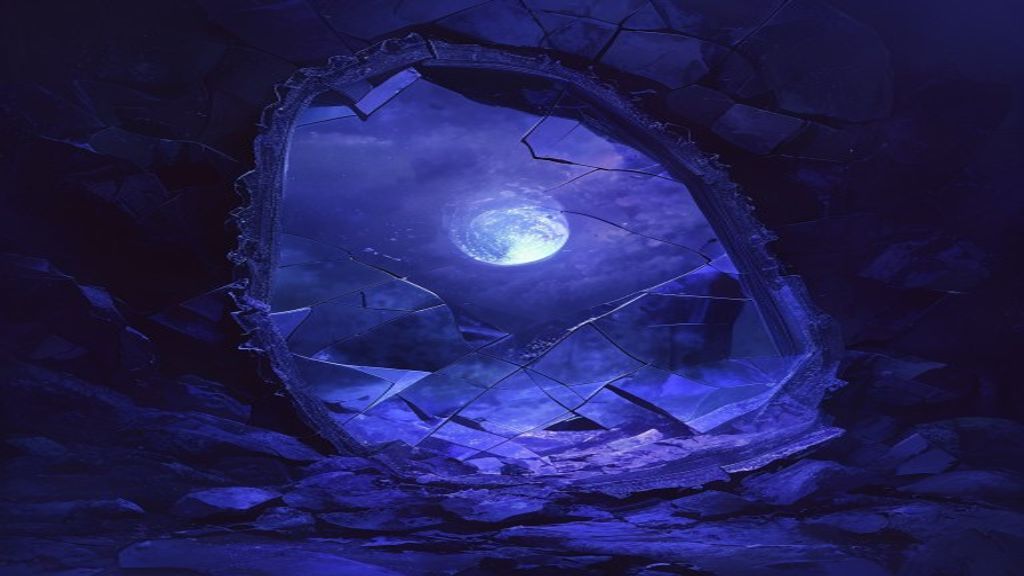
Glass breaks in a specific direction. Not randomly, not gently. It shatters outward from the point of impact, and every crack is its own straight line toward nowhere. That matters more than seven years of bad luck, a superstition with Roman roots. The folklore survived. The meaning didn’t. Artemidorus of Daldis noted in the second century that the same dream means different things for different dreamers, and a mirror is where that is plainest, since it shows each person only themselves.
A broken mirror in a dream usually points to a cracked or altered self-image: something you believed about yourself just came apart. The shards matter less than the moment before the break, because that’s where the real question lives.
The thing about mirrors
Mirrors aren’t only for information. We use them for confirmation. We check ourselves before we go out not just to see how we look, but to settle something. A brass-backed hand mirror, slightly foxed, the kind that makes everything look a little warmer than it is, does that settling gently. When a mirror breaks in a dream, that confirmation process has broken too.
The self-image angle is the most common reading, and it’s the one I find most convincing. Not vanity, not narcissism. Just the ongoing private project of knowing who you are. When the mirror shatters, something in that project has been disrupted. Maybe you saw yourself clearly and didn’t like it. Maybe you’ve been performing a version of yourself and the performance cracked. Maybe someone handed you information about yourself that you weren’t ready for.
What you were doing when it broke
This is the detail almost everyone skips over in favor of symbolism. Were you the one who broke it? Did it fall on its own? Did someone else break it, and you were watching? These three scenarios read completely differently.
You broke it
When you shatter the mirror yourself, especially with something like anger or force, the dream’s more about agency than loss. You’re done with a particular self-image. You’re destroying it deliberately, even if you didn’t know you wanted to. That can be grief, but it can also be something much closer to liberation. The feeling on waking will tell you which.
It broke without you
A mirror that falls, cracks by itself, or shatters without your involvement suggests something you believed about yourself is coming apart without your consent. This version has more shock in it. Helplessness or stunned silence is typical, like watching a small accident happen in slow motion. The self-image wasn’t something you chose to give up.
The third scenario, watching someone else break it, is the one that takes the longest to interpret. Usually it’s about how another person’s perception of you has shattered, or how their image of themselves (in relation to you) has changed. It’s a social break, not a private one. And honestly, those are often the hardest to name.
What’s in the shards
Broken mirrors in dreams almost always have a specific quality to the reflection, right before or right after the break. A dreamer may see themselves older, younger, distorted, missing altogether, or see someone they don’t recognize looking back. I think those variations are each their own category of dream, and they matter.
If the reflection was distorted, your sense of how others see you may be the real subject. If your face was gone from the mirror entirely, that’s a different kind of disruption, closer to an identity question than a self-image one. There’s a useful contrast here with dreaming of a bloody knife, where the wound is often literal or external. A broken mirror turns the wound inward, onto the act of looking itself.
The seven years question
Worth dispatching quickly.
The seven-years-of-bad-luck rule is usually traced to Roman belief, the idea being that a broken mirror injured the soul it reflected. Dream interpretation asks a different question: what the dream says about the dreamer’s circumstances, not their literal fate. The superstition and the dream interpretation were always separate threads, and conflating them now mostly just adds anxiety to a dream that doesn’t need it.
Hobson’s activation-synthesis model would argue the broken mirror is just the brain assembling a coherent image from random neural noise, and that the “meaning” is something we project afterward. I’m not dismissing him. I just think projection is the right word for something that’s actually happening, not a mistake.
When it keeps coming back
Recurring broken-mirror dreams tend to appear when there’s a sustained gap between how you see yourself and how your life is actually going. Not a crisis. Just a slow divergence that you haven’t quite named yet. Something about the person you planned to be and the person you’re turning out to be isn’t quite lined up, and the mirror breaks again and again until you look at the misalignment directly.
G. William Domhoff’s continuity hypothesis would predict exactly this pattern: the dream tracks the ongoing concern, returning until the waking situation changes. That fits the way these dreams loop. The mirror doesn’t stop breaking until you either update the self-image or close the gap that created the pressure.
Some reflections are inherited, and then you have no idea what to do with them. A broken mirror can carry that kind of inherited weight, and dreaming of a sceptre is the same weight in the form of authority passed down.
One variant is stranger than the rest: the shattered frame with the face intact. Maybe that doesn’t need solving. Or maybe it points to a self that is still whole behind a cracked image. In the other direction, dreaming of a balloon is about things that look whole but are one small thing away from suddenly not being.
- Were you the one who broke it, or did it break without you?
- What was your reflection doing right before or after the break?
- Which part of your self-image has been under pressure lately?
- Is there a version of yourself you’ve been performing that might be cracking?
One symbol, two traditions
The disagreement is honest: one school sees broken mirror as self-communication, the other as an image to be discerned against Scripture. They can inform each other, but they do not merge.
A broken mirror in a dream usually points to a cracked or altered self-image: something you believed about yourself just came apart. The shards matter less than the moment before the break, because that’s where the real question…
You are reading this oneNo dream in the Bible involves a mirror, broken or otherwise. But the mirror appears in Scripture as one of its most powerful images of knowledge and self-perception. That’s the thread worth pulling.
Read the biblical meaning →Quick answers
What does dreaming of a broken mirror mean?
It usually points to a disruption in how you see yourself, your self-image has cracked or something you believed about yourself has come apart. The key details are whether you broke it or it broke on its own, and what the reflection looked like before or after.
Is a broken mirror in a dream bad luck?
That’s the Roman superstition, not a psychological reading. Dreams about broken mirrors aren’t omens. They’re more often signals that a gap has opened between how you see yourself and how your life is going. Anxiety-inducing, maybe. Bad luck, no.
What does it mean if your reflection is missing from the broken mirror?
An absent reflection is a sharper version of the identity disruption. It tends to appear when you’re genuinely uncertain who you are right now, not just a cosmetic self-image question but a deeper one about direction, role, or continuity of self.
Why do I keep dreaming about breaking mirrors?
Recurring broken-mirror dreams usually mean the gap that triggered the original dream, some misalignment between the person you think you are and the one you’re currently being, hasn’t been acknowledged or addressed yet. The dream loops until you look at what’s actually cracked.
Sources for this reading
- Domhoff, G. W. (2003). The Scientific Study of Dreams: Neural Networks, Cognitive Development, and Content Analysis. American Psychological Association.
- Domhoff, G. W. (1996). Finding Meaning in Dreams: A Quantitative Approach. Plenum Press.
- Hobson, J. A., & McCarley, R. W. (1977). The brain as a dream state generator: An activation-synthesis hypothesis of the dream process. American Journal of Psychiatry, 134(12), 1335-1348.DOI
- Artemidorus of Daldis (2nd century CE). Oneirocritica. English edition: Harris-McCoy, D. E. (2012). Artemidorus’ Oneirocritica: Text, Translation, and Commentary. Oxford University Press.
Full bibliography on Sources and method. Found a mistake? Tell us and see the corrections log.