- Tradition
- Psychological readingObject dreams
- Also read in
- The BibleSame symbol, other tradition
- Draws on
- Domhoff, Freud, Hobson
- Reviewed
- 5 min read
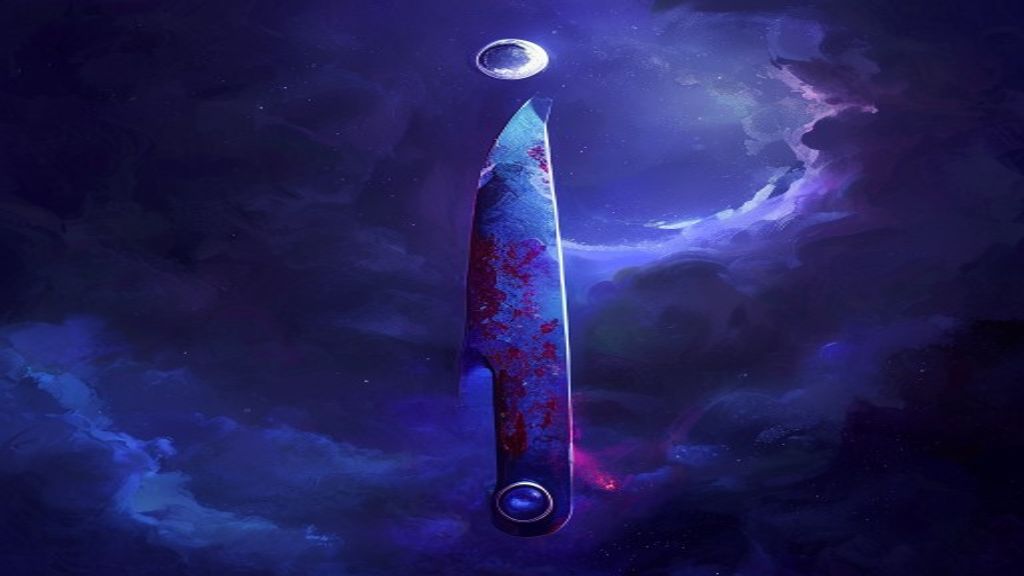
Does a bloody knife in a dream mean violence is coming? Almost never. It is an image of aftermath, not threat: the blood marks something that has already been cut, a relationship, a decision, a word said in a way that couldn’t be unsaid. A plain kitchen knife with blood on it can leave you shaking all the same, because something in you registers the weight of what happened and carries it into the morning.
The bloody knife is one of those dream images that lands with more weight than the content seems to justify. No chase, sometimes no other person present, just the object itself on a counter or in a hand or lying somewhere it shouldn’t be. And yet.
A bloody knife in a dream almost never means what it looks like. It’s usually an image of conflict that’s already happened, a cut that’s been made in a relationship, a decision, or a sense of yourself. The blood marks something that didn’t end cleanly. The knife itself tells you who or what made the cut.
What the blood is actually marking
Clean knives cut. Bloody knives carry the evidence of what was cut. That’s the distinction worth holding: this isn’t a dream about danger so much as a dream about aftermath. Something has already happened. The blood is proof of it.
Which means the most useful question isn’t “what was the knife threatening?” but “what has been cut recently?” A relationship that ended sharply. A decision that hurt someone. A word you said that you can’t unsay. A part of your routine, your identity, your sense of who you are that you’ve had to cut away. The knife doesn’t always do something in these dreams. It just sits there, already marked. Your brain set it on the counter of the dream so you’d look at it.
Whether you were holding it matters enormously. More on that in a moment.
How people have read this image across time
- 2nd century
Artemidorus held that the same dream means different things for different dreamers, depending on age, status, and occupation. Applied to a knife, that separates the surgeon from the stranger: what a bloody knife means depends on whose trade it is and whose hand it is in. He was interested in who the dreamer was, not just what the image looked like.
- 19th century
Freud read pointed objects as phallic, which made knives, in his framework, about aggression with a sexual undertone. His 1900 framework treats the knife as something wielded. Most contemporary researchers have moved past this, but the emphasis on the person holding the knife as the interpretive key remains useful.
- 20th century
Hobson’s activation-synthesis model would argue that the bloody knife is a narrative the sleeping brain assembled from random activation. The specific emotional response, the shaking, the dread, the guilt, is harder to call random. That part seems to come from somewhere in the dreamer’s waking experience.
- Contemporary
Domhoff’s continuity hypothesis predicts that violent dream imagery will track conflict in waking life, even conflict that hasn’t been directly confronted. The knife covered in blood is a common marker of something unresolved between people, or within a person’s sense of themselves.
Whose hand was it in
This is the question I’d ask before anything else, and it’s worth being direct about it.
If the knife was in your hand, the dream is almost certainly about something you did, something you said, a boundary you drew that hurt someone, a relationship you ended, a choice you made at someone else’s expense. The blood doesn’t make you a violent person. It makes the dream honest. The guilt or ambivalence you’re carrying has taken an object to hold.
If the knife was in someone else’s hand, the injury is one you received. Not necessarily a physical one. The person holding the knife might represent someone who cut something short in your life, or someone you feel has wounded you in a way you haven’t fully processed.
If no one was holding it, the knife was just present, then you’re in the aftermath without anyone to assign it to. That’s sometimes harder, not easier. A knife on a counter with no hand around it tends to mark the kind of damage that happened in slow motion, without a clear moment, without a single person responsible.
If a cross appears in the same dream, it adds the weight of guilt or moral judgment to whatever the knife represents. And if the image also connected to a letter, a message, something written, dreaming of a letter is about words left unsent, which often sit behind a sharp ending.
When it’s about a real-world break
Not every bloody-knife dream is subtle. Some arrive right after a falling out, a termination, a conversation that went somewhere neither party expected. The brain is sometimes just processing what happened, running it back in an image that makes the emotional truth legible without the social complexity.
A coat hanging on a hook in a crime scene is one thing. A knife you recognize, with blood that has the color and weight of something real: your mind is telling you that what was severed left a mark. And that the mark is worth acknowledging, not just moving past.
The dreamer who finds this image hardest to dismiss is usually the one who hasn’t decided yet whether the cut they made was right. They’re holding the knife, they feel the weight of what they did, and they haven’t finished feeling it. That’s not pathology. That’s the moral imagination doing its work through the only channel available at three in the morning.
A plausible pattern is that the knife fades from the dream once the dreamer decides, really decides, how they feel about what happened. Not whether it was justified. That’s different. Whether they’ve allowed themselves to feel the weight of it. Once that happens, the counter in the dream is bare. Once the acute phase passes, the same story can turn up as protection instead of injury, and dreaming of a coat is about that: what you put on after the cut.
That pattern isn’t guaranteed, and it should be held lightly. Take it for whatever it’s worth.
- Was the knife in my hand, someone else’s hand, or lying loose? That one detail changes everything.
- What has been cut recently in my waking life, a relationship, a decision, a version of myself?
- Do I feel like the one who made the cut, or the one who received it?
- Is there something I did, or that was done to me, that I haven’t quite let myself fully feel yet?
One symbol, two traditions
Where the psychological read treats bloody knife as a mirror of your inner state, the biblical tradition treats it as something to weigh, prayerfully, against what Scripture actually says.
A bloody knife in a dream almost never means what it looks like. It’s usually an image of conflict that’s already happened, a cut that’s been made in a relationship, a decision, or a sense of yourself. The blood marks something…
You are reading this oneNo biblical dream features a knife. But Scripture has a great deal to say about blood, weapons, guilt, and the cleansing of conscience - and those themes are where a biblical reading of this dream does its real work.
Read the biblical meaning →Quick answers
What does it mean to dream of a bloody knife?
It’s almost always an image of aftermath, not threat. The blood marks something that was cut: a relationship, a decision, a word said in a way that couldn’t be unsaid. The knife itself, particularly whose hand it was in, points to whether you were the one who made the cut or the one who received it.
Is dreaming of a bloody knife a bad sign?
It’s a serious image that rarely means something literally violent. It tends to mark a period of conflict, sharp endings, or unprocessed guilt. Not a bad sign so much as an honest one. The dream is flagging that something cut didn’t end cleanly and hasn’t been fully acknowledged.
What does it mean if I’m holding the bloody knife in my dream?
The knife in your hand almost always points to something you did that hurt someone or something, including a version of yourself you chose to leave behind. The blood isn’t an accusation. It’s the dream acknowledging weight. The guilt or ambivalence attached to that choice is probably still active.
Why do I keep dreaming about a bloody knife?
Recurring knife dreams usually mean the cut they represent hasn’t been processed. Either the loss hasn’t been grieved, the guilt hasn’t been worked through, or the injury received hasn’t been named. The dream stops needing to return once the weight of what happened has been genuinely felt rather than just survived.
Sources for this reading
- Domhoff, G. W. (2003). The Scientific Study of Dreams: Neural Networks, Cognitive Development, and Content Analysis. American Psychological Association.
- Domhoff, G. W. (1996). Finding Meaning in Dreams: A Quantitative Approach. Plenum Press.
- Freud, S. (1900). The Interpretation of Dreams (Die Traumdeutung; first published November 1899). English translation by James Strachey, Basic Books.
- Hobson, J. A., & McCarley, R. W. (1977). The brain as a dream state generator: An activation-synthesis hypothesis of the dream process. American Journal of Psychiatry, 134(12), 1335-1348.DOI
- Artemidorus of Daldis (2nd century CE). Oneirocritica. English edition: Harris-McCoy, D. E. (2012). Artemidorus’ Oneirocritica: Text, Translation, and Commentary. Oxford University Press.
Full bibliography on Sources and method. Found a mistake? Tell us and see the corrections log.