- Tradition
- Psychological readingObject dreams
- Also read in
- The BibleSame symbol, other tradition
- Draws on
- Domhoff, Hobson, Artemidorus
- Reviewed
- 6 min read
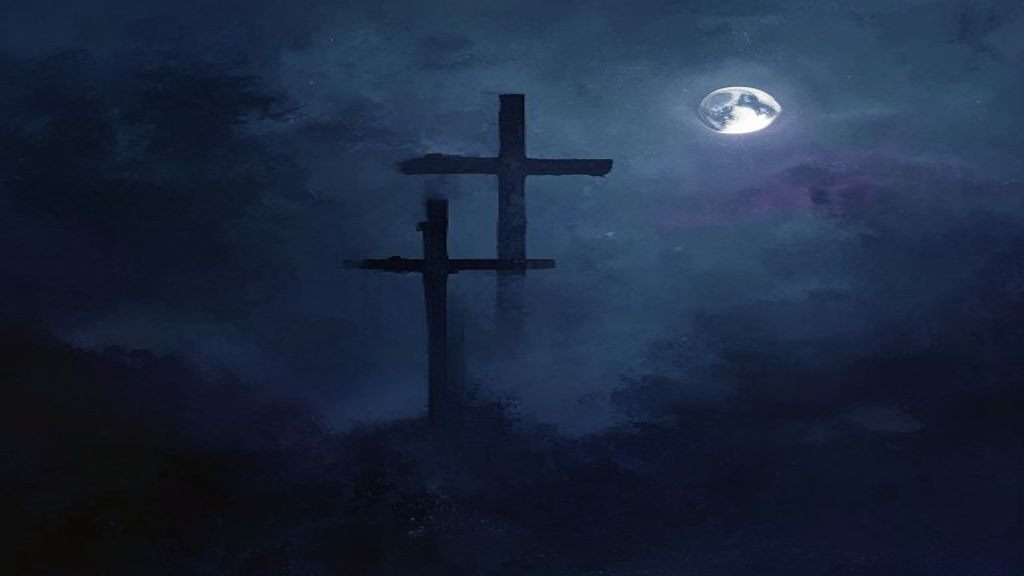
In the dream there is a cross, and the first thing you register is how plain it is: two lines, one vertical, one horizontal, meeting at a single point. It may stand above you, rest on your back, or mark the spot where two paths cross underfoot. Either way the shape is precise and unambiguous. You go this way. You go that way. You stop here, at the intersection, and choose. Religion is the loud reading of this dream, and it’s sometimes right. But the shape predates Christianity by millennia, and your sleeping mind almost certainly knew the symbol long before it knew the theology.
A cross in a dream usually signals a crossroads, a burden you’re carrying consciously or not, or a need for orientation when your waking life feels directionless. Religious meaning is one layer, not the only one.
The weight of the horizontal
What stands out in cross dreams is how physical they feel. People don’t just see the shape. They feel it. Either it’s pressing down on them, they’re carrying it, they’re looking up at it from below, or they’re standing exactly where the lines meet. That physical grammar matters a lot. Carrying a cross in a dream is almost never about faith. It’s about weight. The thing you’ve been hauling without deciding to haul it: a family obligation that attached itself to you years ago, a project that grew a second life while you weren’t looking, a role you agreed to play before you understood the contract. The dream is quite literal here. You’re carrying something. That’s worth sitting with. Looking up at a cross is different. That version tends to come in moments of real uncertainty, when something feels larger than you are, when you need an organizing frame and can’t quite find one. It’s not necessarily about awe or dread. It’s more like standing in a room where the ceiling is very high and noticing, for the first time, that you haven’t looked up in a while. And then there’s standing at the intersection itself. I find that the most interesting. Two paths. No movement. Just the moment before a choice that hasn’t been made yet.
Which cross, though
This is where I probably disagree with most dream dictionaries. They collapse the cross into a single symbol and assign it a meaning. But the type of cross your mind chose is actually the first thing to notice. A plain wooden cross in a churchyard is doing different work than a golden cross hanging from a neck, which is doing different work than a red cross on a white background, which is entirely different from a stone cross by the road, which is different again from a crossroads sign in the middle of nowhere. The shape is the same. The context has loaded it with completely different associations, and your brain brought one specific version. That specificity is a signal, not decoration.
Weight you’ve accepted without examining it. A burden you carry on behalf of others, or a responsibility that accumulated rather than being chosen.
Something that feels larger than you. Needing a frame, a structure, an organizing belief in a period when your life feels without direction.
A crossroads moment. Two real paths. The dream has paused you at the exact point of decision, which suggests you already know you have to choose.
Often a dream about meaning-making itself: searching for significance, or finding it unexpectedly. Less about religion and more about the hunger for transcendence.
Something you believed in has shifted. A framework that once organized your life has gone unstable. This can feel like loss or relief, depending on the framework.
The detail that your waking mind dismissed or minimized. Your dreaming mind put it back. Easy to miss a second time. Try not to.
The very old readings
Artemidorus, writing in the second century, held that the same dream means different things for different dreamers, depending on their age, status and occupation. Apply that here and the cross stops being one symbol: a churchgoer and someone standing at a crossroads in their life are not having the same dream. What looks like a religious image might actually be your mind processing a literal intersection, a physical threshold, a moment of risk. I find that a useful corrective against over-mystifying the symbol, and our instinct to jump straight to theology may be a bit naive. And if you’re not Christian, or only loosely so, your dreaming mind may be drawing on a much older vocabulary. The equal-armed cross, the quartered circle, appears in cultures that had never heard of Calvary. It’s a way of dividing space into meaningful parts: up, down, left, right; past, future, near, far; the four winds, the four humors, the four directions of a map. That’s a map reading, not a religious one, and it’s worth sitting with too. Domhoff would probably note, sensibly, that we dream about what we’ve been exposed to and what we’ve been thinking about. If you’re a practicing Christian, the cross carries that weight. If you’ve been standing at a literal crossroads in your life, the shape arrives as a structural metaphor your brain is already using. Neither reading cancels the other. They can run alongside each other, which is exactly what makes the symbol so stubborn.
What Hobson would say
Hobson, whose activation-synthesis theory treats dreams as the brain making sense of internal signals, would probably say the brain chose a cross because it’s a simple, high-contrast visual form: easy to generate, memorable, emotionally loaded by a lifetime of exposure. The meaning we’re layering onto it? That’s waking interpretation, not the dream’s intention. I think he’s partly right. I also think that being partly right isn’t the same as being done.
When it keeps coming back
Recurring cross dreams often seem to track unresolved decisions more than unresolved beliefs. Not always, but often. The crossroads version, in particular, keeps cycling back as long as the person is avoiding the fork. If you’ve had this dream more than once in a short stretch, it might be worth asking what decision you’ve been sitting next to without making. Not the big abstract ones. The specific, embodied, calendar-level ones. The ones with a deadline you keep extending. A cross and a sword are both shapes you can pick up, and dreaming of a magic sword asks a similar question from another angle: whether you’re willing to take something up and act with it. And if the cross stood in a building, dreaming of a church looks at what that setting adds, beyond the obvious reading.
It remains two lines, one vertical and one horizontal, and still we can’t fully explain why it holds our attention. Maybe that’s the point. Some things we carry because they mean something and we haven’t figured out what yet. The dream knows. We’re usually about six months behind. There are also versions where you wake feeling that something was confirmed rather than questioned. That one is harder to read, and it deserves to be treated as its own dream, not a failed version of the questioning kind.
- What type of cross was it, exactly? The specifics are the message.
- Were you carrying it, looking at it, or standing at the intersection? The posture changes the reading entirely.
- Is there a choice you’ve been standing beside without making?
- Does the weight in this dream match a weight you’ve been carrying in your waking life?
One symbol, two traditions
The two schools are not reading the same book: psychology asks what cross is doing in your waking life, while the biblical tradition tests the image against Scripture and leaves the meaning with God.
A cross in a dream usually signals a crossroads, a burden you’re carrying consciously or not, or a need for orientation when your waking life feels directionless. Religious meaning is one layer, not the only one.
You are reading this oneThe cross is Christianity’s central symbol, but no biblical dream features one. The New Testament writings about the cross use it to carry at least four distinct meanings: execution and shame, substitutionary sacrifice…
Read the biblical meaning →Quick answers
What does dreaming of a cross mean?
Most often it signals a crossroads, a burden you’re carrying, or a need for some organizing meaning in your life. Religious readings are one layer, not the whole picture. The physical relationship between you and the cross in the dream tells you most of what you need to know.
Is dreaming of a cross a bad sign?
No. It can point to weight you’re carrying, but it can also mark a moment of clarity, a decision about to be made, or a reconnection with something that matters to you. Context and feeling do the heavy lifting.
What does it mean to carry a cross in a dream?
It almost always represents a burden: something you’re hauling on behalf of others, or a responsibility you accepted without fully examining it. The dream isn’t asking you to justify the weight. It’s asking you to notice it.
What if the cross in my dream was glowing or golden?
That version tends to be about meaning-making itself rather than religion specifically: a hunger for significance, or a moment of unexpected transcendence. Less about doctrine and more about the human need for things to have a point.
Sources for this reading
- Domhoff, G. W. (2003). The Scientific Study of Dreams: Neural Networks, Cognitive Development, and Content Analysis. American Psychological Association.
- Domhoff, G. W. (1996). Finding Meaning in Dreams: A Quantitative Approach. Plenum Press.
- Hobson, J. A., & McCarley, R. W. (1977). The brain as a dream state generator: An activation-synthesis hypothesis of the dream process. American Journal of Psychiatry, 134(12), 1335-1348.DOI
- Artemidorus of Daldis (2nd century CE). Oneirocritica. English edition: Harris-McCoy, D. E. (2012). Artemidorus’ Oneirocritica: Text, Translation, and Commentary. Oxford University Press.
Full bibliography on Sources and method. Found a mistake? Tell us and see the corrections log.