- Tradition
- Psychological readingSpiritual dreams
- Draws on
- Domhoff, Hartmann, Artemidorus
- Reviewed
- 5 min read
A figure made entirely of light, standing at the foot of the bed. Or a voice with no source, filling a room that has no walls. Or a presence so enormous you can’t look at it, only register that it’s there, the way you register a thunderstorm before you’ve opened your eyes.
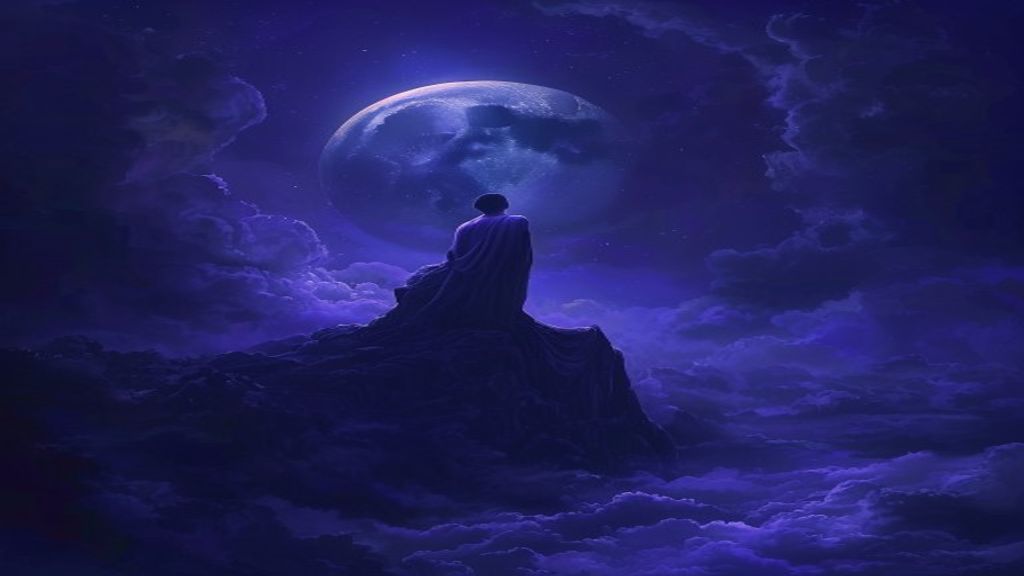
That’s what divine apparition dreams tend to look like. And they’re different from other supernatural dreams in one specific way: the scale. A ghost is person-sized. A demon is threatening but bounded. A divine apparition is something else. It fills the entire dream. There’s no remainder, no corners of the scene that belong to ordinary life. The whole space has been taken over. That quality of total occupation is the anchor for understanding what this dream is doing.
Dreaming of a divine apparition is your mind reaching for its largest available image to hold an emotion that has no smaller container. It’s not a sign, not a prophecy, not a test. It’s the dream equivalent of a room that’s too small for what you’re carrying, so your sleeping mind builds a cathedral instead.
The dream that filled every corner
Take a dreamer in the middle of deciding whether to leave a relationship held for eight years. The figure has no face they could describe, but they know it is looking at them. Not with judgment. With the kind of attention that doesn’t waver. They wake weeping, not from fear, from something like recognition. That detail matters. Not because the apparition is advising anyone. But because the dream arrives precisely when something needs to be acknowledged at the largest possible scale. Whatever they feel about that relationship, it isn’t small. And the sleeping mind refuses to give it a small image. That’s Hartmann’s core observation in action: intense emotion seeks a central image proportionate to its size. The divine apparition is the largest image the human dream vocabulary contains. When it shows up, the emotion it’s holding is genuinely enormous.
What history has done with this dream
Artemidorus, in the Oneirocritica, held that the same dream means different things for different dreamers, depending on age, status and occupation. His interpretive instinct was sound: keep asking what the dreamer’s waking situation is. The divine dream is best read in context, never in isolation. The temples of Asclepius were built specifically to receive dreams of the divine. Pilgrims slept in the sanctuary hoping for a healing vision. This practice, called incubation, assumed that the right conditions could open a channel. Whether or not you share that belief, what’s interesting is the assumption underneath it: that these dreams don’t come randomly, that the dreamer’s state and situation shape what arrives. That part holds up. For some dreamers, the divine apparition arrives in the form of an angelic or spirit figure rather than an abstract presence. The image in dreaming of a demon speaking to you is the shadow of this same archetype: the overwhelming figure that arrives with a message too large for ordinary words.
Working through what the dream is carrying
- Notice the quality of the presenceWarm and overwhelming, or cold and overwhelming? The scale is the same either way, but the temperature tells you whether the emotion underneath is love, awe, grief, guilt, or something that needs to be distinguished more carefully before you can name it.
- Find the proportionWhatever you’re carrying in waking life, divine apparition dreams tend to arrive when that thing has grown larger than the containers you’ve given it. Ask what you’ve been minimizing. The dream doesn’t minimize.
- Look at the timingDomhoff’s continuity hypothesis points you straight here: when did this dream arrive? Look for major thresholds. Before a large decision. After a death or a diagnosis. On the edge of a change you haven’t fully admitted to yourself. The timing is usually the most honest part of the interpretation.
- Sit with the feeling rather than the symbolIt’s tempting to decode the figure: which deity, which tradition, what the light color signifies. That’s usually a way of staying in your head. The dream wasn’t primarily a puzzle. It was a feeling. Stay with the feeling first.
- Bring it into waking life gentlyWrite down what you felt, not what you saw. That’s the part that belongs to you. The imagery belongs to the universal dream vocabulary. The feeling is specific to this moment, this life, this particular weight you’re carrying.
When the apparition speaks
Occasionally the figure in these dreams says something. A single sentence, usually, or even just a word. Such words can stay with a dreamer for decades. I’m cautious about them, not dismissive. What the dream says reflects what the dreamer most needs to hear, which is worth taking seriously. But I’d resist treating it as external instruction. The voice that speaks in your dream knows your situation with unusual precision because it is you, the part of you that’s been paying attention while the rest of you was busy. A more traditional reading would disagree with me here, wanting to know which god spoke and to verify the message against the dreamer’s circumstances. My version is less dramatic but I think more useful: the message is from you, to you, via the largest possible megaphone.
These dreams seem to be rare, once or twice in a life for those who have them at all. They can leave something behind that’s hard to describe: not a belief, not a conviction exactly, more like having been shown the actual size of something. The change that follows is usually quiet, not a dramatic conversion, just a knowing-something-different. I think that’s the dream doing its work. Not as prophecy. As scale. It hands you something big enough to hold the feeling you’ve been carrying smaller than it actually is. Dreams of astral travel and dreaming of your soul show the self confronting its own largest questions while the body sleeps. The divine apparition is that same impulse at full volume. I don’t have a tidy ending for this one. I’m not sure there is one.
- What was the quality of the presence: warm, cold, neutral, demanding?
- What in my waking life is currently larger than the containers I’ve given it?
- Did the figure speak, and if so, what did it say that I already knew?
- What changed in how everything felt after the dream, even if I can’t explain why?
Quick answers
What does it mean to dream of a divine apparition?
It means your sleeping mind reached for its largest available image to contain an emotion or situation that’s genuinely overwhelming in your waking life. These dreams tend to arrive around major thresholds: grief, a large decision, a change you haven’t fully accepted. The figure’s scale reflects the scale of what you’re carrying.
Are divine apparition dreams spiritual or psychological?
Honestly, they can be both, and you don’t have to choose. Psychologically, they function as high-intensity emotional processing. Whether something spiritual is also happening is a question that research can’t settle. Many people who have these dreams find them meaningful on both levels simultaneously.
Why did a divine figure speak to me in a dream?
The voice in a divine dream tends to say what you most need to hear, which is why it can feel external and authoritative. But it knows your situation too precisely to be fully external. Think of it as the part of you that’s been paying close attention, borrowing the most credible possible amplifier.
Does dreaming of a divine apparition mean I’m religious?
Not necessarily. These dreams appear across religious and non-religious dreamers alike. The mind reaches for its largest symbol regardless of what you consciously believe. Someone who hasn’t prayed in twenty years may still dream in the vocabulary of the sacred when the emotion they’re processing is large enough.
Sources for this reading
- Domhoff, G. W. (2003). The Scientific Study of Dreams: Neural Networks, Cognitive Development, and Content Analysis. American Psychological Association.
- Domhoff, G. W. (1996). Finding Meaning in Dreams: A Quantitative Approach. Plenum Press.
- Hartmann, E. (1998). Dreams and Nightmares: The New Theory on the Origin and Meaning of Dreams. Plenum Trade.
- Artemidorus of Daldis (2nd century CE). Oneirocritica. English edition: Harris-McCoy, D. E. (2012). Artemidorus’ Oneirocritica: Text, Translation, and Commentary. Oxford University Press.
Full bibliography on Sources and method. Found a mistake? Tell us and see the corrections log.