Nature Dreams
Dreaming of a Cliff: Exposure, Choice, and the Ledge You Keep Visiting
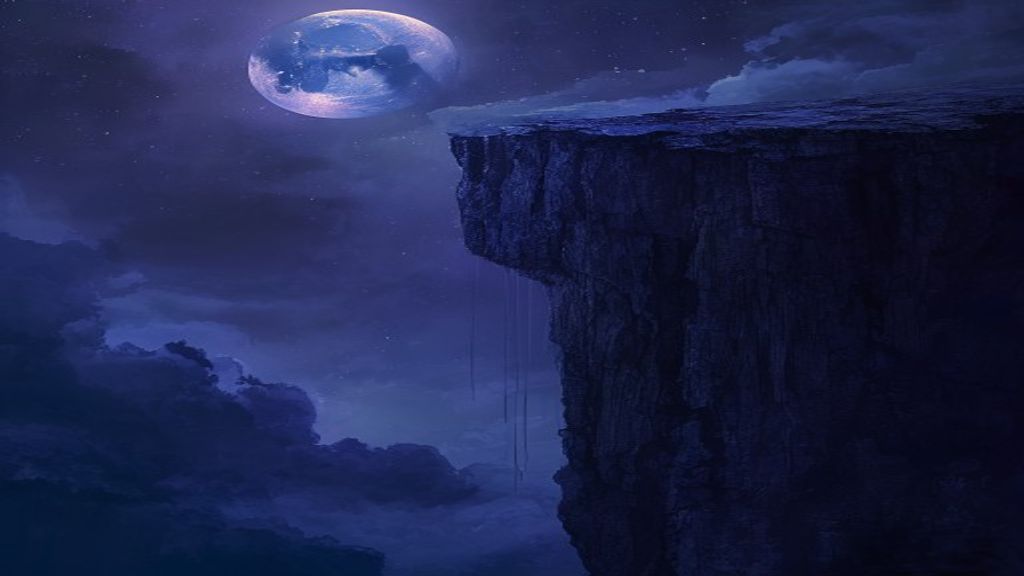
Cliff dreams are the most misread of all the height dreams, because everyone assumes the threat is downward. It isn’t. The cliff isn’t a hazard. It’s a position. You went there, or you were brought there, and now you’re standing somewhere with nothing in front of you and everything visible from where you stand.
There’s a road sign near where I grew up, a yellow diamond at the top of a long descent into a valley. Trucks use low gear. It’s been there for decades, and I drove past it so many times it stopped registering. Then one winter it was fogged over, completely invisible from a hundred meters away, and I nearly missed the turn. The cliff in a dream works something like that sign: usually it’s in your peripheral vision, something you’ve learned to route around, until the fog lifts and suddenly you’re face to face with the drop.
A cliff in a dream is most often about exposure and an uncommitted position. You’re at a high point where the consequences of your current path are suddenly visible, and you haven’t decided whether to hold, retreat, or go over into the next thing. The cliff doesn’t judge. It just makes the height undeniable.
Standing somewhere exposed
The distinguishing feature of the cliff, as opposed to the abyss or the full meteorological chaos of a storm dream, is that you can see clearly from up there. That’s the discomfort. The height gives you perspective you didn’t ask for. You can see how far you’ve come and how far there is to fall. In the dream, those two things are usually equally true and equally uncomfortable.
Jung read elevated positions in dreams as moments of consciousness, standing above the terrain of ordinary life and looking at its shape from outside it. I’d nuance that a little: the cliff specifically tends to represent the high point of a position you’ve been building toward, a relationship, a professional commitment, a version of yourself you’ve been constructing, that has now left you somewhere exposed. You climbed to get here. Now what?
| Tradition | How it reads the cliff |
|---|---|
| Ancient Greek / Asclepius temples | Heights in dream incubation were read as divine proximity, the gods spoke from peaks, so a cliff vision was sought, not feared. Standing at the edge was a threshold to revelation. |
| Artemidorus (2nd c. Oneirocritica) | Falling from a height meant loss of standing or reputation; holding steady at a cliff edge was an omen of maintained position. The steadiness mattered as much as the location. |
| Jungian tradition | The elevated position represents conscious awareness looking down at the unconscious, the shadow life below. The cliff makes the gap visceral: how much of yourself is still unlived? |
| Ibn Sirin tradition (Islamic dream interpretation) | Steep descents and heights were read relationally: who was with you on the cliff mattered enormously. Alone at the top suggested isolation; accompanied suggested shared trials or honors. |
| Contemporary dream research (Domhoff) | Cliff dreams follow real-life contexts of risk and transition. They cluster around moments when people have committed to an irreversible path and are feeling the exposure of that commitment. |
The version where you’re not afraid
This one surprises people. A cliff dream doesn’t always carry dread. Some people describe standing on a cliff with a feeling closer to clarity, even exhilaration. That version tends to belong to people who are mid-commitment to something large, a creative project, a life change, a hard conversation they’ve been building toward for months. The height is real and they can see it, and they’re not running. That’s not a warning dream. That’s a confidence dream wearing a vertiginous costume.
When someone else is at the cliff
Worth separating out, because it changes everything. Watching someone you love stand at the edge of a cliff is rarely about them and almost entirely about your own anxiety around their choices. You can’t control where they’re standing. The cliff is theirs. Your panic is yours.
Red snow and the edge
The cliff dream has a particular neighbor in the dream catalogue: the landscape that looks familiar until the color is wrong. Both of them work by making the terrain suddenly strange, legible but off. I’ve noticed that people who dream of cliffs in unusual weathers, fog, wrong light, snow on a warm cliff, are usually processing something that was always there but has recently become undeniable. The cliff was always at the end of that road. It just took the fog lifting for them to see it.
The road sign I mentioned at the start of this. That winter fog. I was, in fact, in the middle of a year when several things I’d been quietly approaching without fully admitting were becoming impossible to ignore. I didn’t connect the sign to anything until later, which is usually how it works. You don’t realize the cliff was there until you’ve already had the dream three times.
Domhoff would say there’s nothing surprising about any of this: the dream is continuous with waking life, and the cliff appears when you’ve arrived somewhere high-stakes that you climbed toward on purpose. I think he’d be right, and I also think there’s something the continuity hypothesis doesn’t quite capture, which is the specific quality of realizing you’ve climbed somewhere you can’t easily come back from. That’s not just continuity. That’s a reckoning.
And the sign in the fog. I still slow down for it now even when I can see it clearly. Not because I’m afraid of the descent. Because it’s worth remembering that the drop was always there, visible or not.
- Was I afraid of the height, or just aware of it?
- What position in my waking life has left me somewhere exposed and visible?
- Was there anyone else on the cliff with me, and what did that feel like?
- What would it mean to step back from this height, and what would it mean to stay?
Quick answers
What does it mean to dream of a cliff?
A cliff in a dream usually points to a moment of exposure: you’ve arrived somewhere high-stakes that you climbed toward, and the height is now undeniable. It’s less about the danger of falling than about the visibility of where you’re standing. The feeling on the cliff, fear, clarity, or exhilaration, shifts the reading considerably.
Is dreaming of a cliff a warning?
Not generally. It’s more of a reckoning. Your mind is acknowledging that you’re at a high point in some part of your life, with real consequences visible below you. Whether that’s uncomfortable or clarifying depends on how you feel about where you’ve climbed to.
What does falling off a cliff in a dream mean?
The fall typically signals that a position you’d been holding has given way, either by your own choice or external circumstances. It’s rarely literal. More often it represents the sensation of letting go of something you’d been standing on, a role, a relationship, a version of yourself that kept you steady.
Why do I keep dreaming about cliffs?
Recurring cliff dreams tend to appear when you’ve been at a high-stakes position for a sustained period without fully acknowledging the exposure. The dream keeps returning because the height is still real in your waking life, and you haven’t yet decided what to do with where you’ve ended up.