- Tradition
- Psychological readingPlace dreams
- Draws on
- Domhoff
- Reviewed
- 5 min read
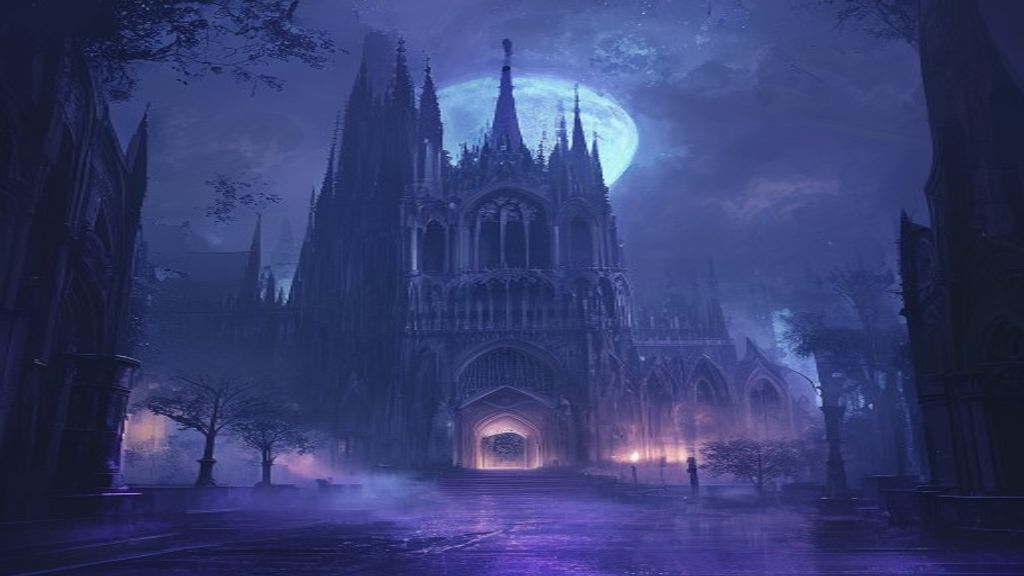
At first glance, a cathedral dream looks religious: a dream about faith, guilt or God. Read more carefully, it is about scale. A building engineered to make you feel small does exactly that in sleep, and then your eye drops to something tiny, a worn coin between two pews, and the contrast does something strange to your sense of what matters.
The cathedral dream operates on exactly this principle. The height of the ceiling is what you notice first. What you feel standing under it comes a moment later.
What it means to dream of a place built to make you feel small
Cathedrals were designed with specific psychological intent. The verticality, the filtered light, the acoustics that make ordinary speech sound inappropriate: all of it is built to shift your sense of scale. You arrive as someone who matters. You walk in and you become, briefly, a very small person inside something enormous.
In a dream, your mind chose that. Not a house, not a garden, not a market. It chose the building that was specifically engineered to humble. That choice is worth sitting with before you go anywhere near interpretation.
A Jungian framework treats the great religious building as the part of the psyche that holds the numinous: whatever each person encounters as larger than themselves. You don’t have to be a Jungian, or a churchgoer, to find that useful. The cathedral in the dream is the part of your inner landscape that knows it’s answerable to something. The question is what that something is for you right now.
Two readings that pull in opposite directions
Awe and refuge
You’re inside and the scale feels right. Expansive, not crushing. This version of the dream tends to arrive when you’ve been living too small: worrying about details, losing track of what actually matters. The cathedral offers you a larger container. You wake up oddly settled.
Judgment and weight
You’re inside but the scale presses down. The ceiling isn’t inspiring; it’s demanding. Something expects something of you here, and you’re not sure you can deliver. This is the version that arrives when a real-life decision carries more moral weight than you’ve admitted.
What you’re doing inside matters enormously
Dreaming of wandering a cathedral alone, in the quiet, is a different event from dreaming of a service you don’t understand, a wedding you’re late to, a choir you can’t join. The action inside the building is the dream’s second language.
The coin on the floor
Tiny objects in enormous spaces. That’s the detail easiest to overlook in the cathedral dream, and it’s often the one that holds the most.
If something small appeared in your dream amid all that grandeur: a candle, a book left on a pew, a face you recognized in the crowd, a coin worn smooth, something dropped, that small thing is likely the actual message. The cathedral provides the scale. The small object provides the specific frequency. Your mind arranged the contrast deliberately.
That’s probably obvious, but it’s also correct: the building is shared by everyone who dreams of it, and the object you noticed or touched inside it is yours.
A question that tends to follow this dream is whether it needs faith to mean anything, and the answer is genuinely reassuring. The cathedral doesn’t require faith. It requires scale. Your mind reached for the largest interior it could imagine, the one most charged with the weight of consequence, and it doesn’t matter whether you last attended a religious service in childhood or never. The symbol works architecturally, not doctrinally.
Domhoff’s continuity research would predict that if you have a strong lived memory of a cathedral, the dream is likely processing something from your actual emotional life that carries similar weight. If you’ve never set foot in one, your mind assembled the image from something else entirely. The charge is the same either way.
If the dream dropped you somewhere that felt less like a cathedral and more like a labyrinth of corridors and alcoves, dreaming of a labyrinth is the closer match. Where the cathedral is about scale, the labyrinth is about not seeing the way through a space larger and more complex than you expected.
And if the space felt sacred but also somehow commercial, full of people and transactions, check dreaming of a market, because some cathedral dreams blur the line between consecration and exchange in ways that say something specific about how you’re relating to your own values right now.
What you were holding
Say the dream lets you pick up that coin and close your hand around it. The pull to put it back, because it feels wrong to keep something that has sat in that building for years without anyone claiming it, is not a rational response.
But that’s the thing about spaces that ask something of you. They don’t always ask clearly. They just make certain actions feel correct and others feel wrong. The cathedral dream tends to leave you with that same slightly charged uncertainty. Something was communicated. You’re not entirely sure what. If the dream keeps coming back, that uncertainty is probably the thing to stay with, not explain away. If the cathedral was empty, dreaming of an empty room asks the same question at a smaller scale: what is missing, or not yet moved in? The building is patient, and it’ll wait.
- Was the scale awe-inspiring or oppressive, and what does that say about my current relationship to something larger than me?
- Was I alone, part of a gathering, or somehow excluded from what was happening?
- Did I notice anything small against all that grandeur, and what was it?
- Is there a decision or commitment in my life right now that carries more moral weight than I’ve been willing to acknowledge?
Quick answers
What does it mean to dream of a cathedral?
A cathedral in a dream usually signals a confrontation with scale, weight, or consequence. Your mind chose the largest, most charged interior it could build, which means something in your waking life is asking to be taken seriously. The feeling inside the building, whether awe or pressure, tells you whether this is an invitation or a demand.
What if I’m not religious but I dream of a cathedral?
The building doesn’t require faith to function as a symbol. Your mind is using it architecturally: the cathedral is the container for whatever you find most consequential right now. The religious trappings are the packaging, not the content.
What does it mean if the cathedral in my dream is ruined or abandoned?
A ruined sacred space usually means something you once held as foundational has been hollowed out. A belief, a relationship, a sense of purpose that used to feel important. The ruin isn’t a verdict. It’s a prompt to decide whether to rebuild or move on.
Why do I dream of being lost in a cathedral?
Scale without orientation. You’re in territory that feels important and you haven’t got a map yet. This version tends to arrive in the early or confusing stages of a significant change. You’re inside the thing that matters; you just haven’t found your footing in it.
Sources for this reading
- Domhoff, G. W. (2003). The Scientific Study of Dreams: Neural Networks, Cognitive Development, and Content Analysis. American Psychological Association.
- Domhoff, G. W. (1996). Finding Meaning in Dreams: A Quantitative Approach. Plenum Press.
Full bibliography on Sources and method. Found a mistake? Tell us and see the corrections log.