- Tradition
- Psychological readingBody dreams
- Also read in
- The BibleSame symbol, other tradition
- Draws on
- Domhoff, Artemidorus
- Reviewed
- 5 min read
Seeing your own dead body is usually read as a forecast of your death, or at least of something terrible. The feeling in the dream is rarely horror, which undercuts that forecast. It is closer to the calm you get looking at a photograph of yourself as a child, a mild dissociation, the sense of watching someone who was you but isn’t quite you anymore. That is not how people expect it to feel, and it can unsettle more than fear would.
Dreaming of your own dead body is one of those images people hesitate to mention, even to close friends. It sounds worse than it is. It rarely means what people are afraid it means, and the fear of it can sometimes overshadow something the dream is quietly trying to say. That would be a shame, because the image tends to be precise.
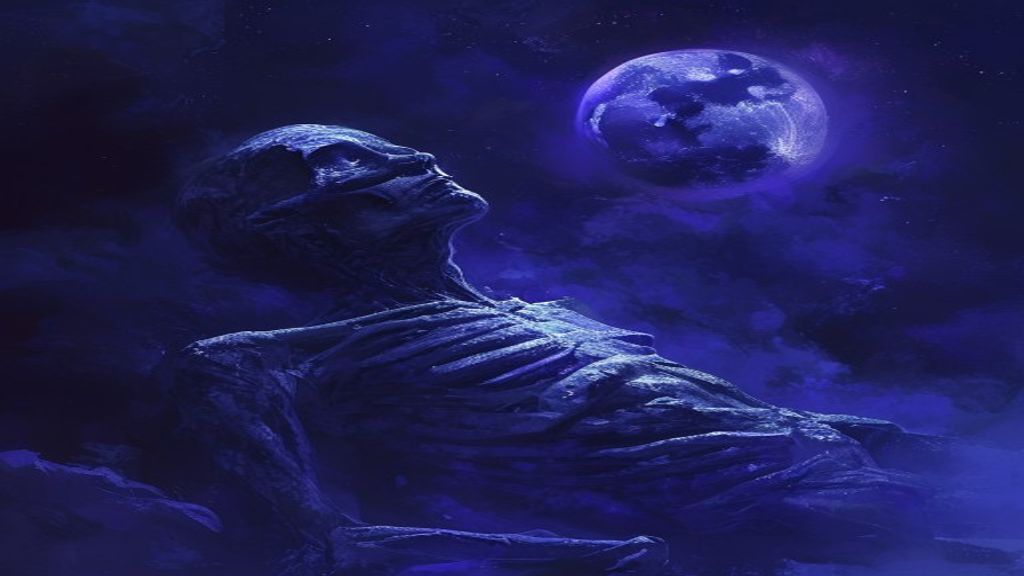
Seeing your own dead body in a dream is almost never a premonition. It’s more often an image of transition: something about who you’ve been is ending, and your mind staged the ending literally. The body is what’s being left behind.
What your mind is watching
The structure of this dream is worth paying attention to: you are both the dead body and the observer. You’re split. That duality is the whole message. Some version of you is over, lying there, and another version is standing at a distance watching it. Dreams don’t stage that by accident.
What I find compelling about this image is how precisely it maps onto certain life experiences. Finishing a long chapter, leaving a job you’d had for years, ending a relationship that had shaped your identity, recovering from something that changed you without your full consent. In all those cases, there really is a body: the old self, horizontal, no longer running. And you, the one who survived into whatever comes next, looking back at it.
Domhoff’s continuity hypothesis puts it simply: the dream reflects what’s genuinely happening in your life, not a fear of dying so much as a change underway. The death in the dream is a death in the waking world, just not a literal one. I appreciate the flatness of that reading, even if it doesn’t capture the weight the dream can carry.
How old traditions read the same image
| Tradition | How it reads the symbol |
|---|---|
| Ancient Greek (Artemidorus) | Artemidorus, writing in the second century, insisted that the same dream means different things for different dreamers, depending on age, status and occupation. By that logic a dream of your own death was never a simple verdict. It had to be read against the dreamer’s own life. |
| Egyptian tradition | The Chester Beatty papyrus, dated to roughly 1200 BC, sorts dreams into good and bad omens. Dreams were read for what they promised or warned, which is a different way of asking the question this page asks. |
| Ibn Sirin tradition | Islamic dream interpretation, in the tradition associated with Ibn Sirin, treats a dream as something to be read against the dreamer’s own situation and character rather than as a fixed verdict. |
| Western psychological tradition | Jungian psychology reads dreams through symbol and transformation. The body that’s ended is something psychological, an old identity, a worn-out way of being, a chapter that has closed. |
What the traditions share, despite every difference, is the instinct that this image has to be read against a life rather than in isolation, and modern psychology keeps that instinct. It doesn’t prove anything about dream mechanics, but it does suggest the image has a natural gravity toward a reading about the dreamer’s circumstances. The same split between the watcher and the watched is the whole subject of dreaming of seeing yourself from outside, which is built on that dissociated observer.
The thing the photograph was trying to say
Back to that feeling of looking at an old photograph. The dissociation isn’t indifference. It’s more like perspective: here is who I was, and I am no longer exactly that person, and something between sadness and clarity lives in the gap. The dead-body dream has that quality too. It can be a moment of unusual honesty about how much you’ve changed, or how much you need to.
The version where you’re watching yourself from a distance, floating above the scene, is worth separating from the version where you find yourself lying there and then somehow still experience the dream. Both involve the split self, but the floating version has a clinical quality, almost reportorial, while the embodied-despite-being-dead version is stranger and shares a feeling with dreaming of paralysis, where the body is present but cannot act. In REM sleep the muscles really are switched off, which may be part of why that sensation is so easy for a dream to borrow.
If your dream had a cause, an accident, a violence, a specific circumstance, that context matters more than the death itself. The manner of dying is often the real content. Quietly, in sleep, often means a gentle letting-go of something. Suddenly, violently, often points to something that was cut short against your wishes. Surrounded by others or completely alone changes the emotional register entirely.
What to do with the image
Not much, actually. This is one case where I’d resist the impulse to analyze aggressively. The dream usually knows what it’s about, and your first feeling on waking, before you start interpreting, is often closer to the truth than anything you’ll arrive at by interrogating the symbolism. If the first feeling was relief, that’s significant. If it was grief, that’s significant too.
Take someone who has this dream at a genuinely pivotal moment: leaving a long career, finishing chemotherapy, ending a marriage that had slowly become unrecognizable. The reaction on waking is often something like: it felt true. Not scary. True. That matters. Dreams can be theatrical about things your waking mind refuses to acknowledge plainly. The dead body is often the most honest image for something you already know but haven’t said.
The photograph of yourself as a child, the one you barely recognize, is a useful way to hold this dream. You don’t need it on display. But it helps that it exists. I think that’s roughly how you’re supposed to feel about this dream. You don’t need to live in it. It’s just documentation of a transition. You can put it back in the drawer.
- Was I the observer, the body, or somehow both? What did the position tell me?
- What feeling came first, before interpretation: relief, grief, strangeness, or something quieter?
- What version of myself might have reached its end recently, what identity or chapter has closed?
- Did the manner or setting of the death tell me something the death itself didn’t?
One symbol, two traditions
A psychologist asks what own dead body felt like and what it echoes in your week. The biblical reader asks a different question entirely: what does Scripture say when this image appears, and what does it stay silent about?
Seeing your own dead body in a dream is almost never a premonition. It’s more often an image of transition: something about who you’ve been is ending, and your mind staged the ending literally. The body is what’s being left…
You are reading this oneScripture doesn’t record anyone dreaming of their own dead body. But the Bible’s engagement with death, bodily identity, and resurrection is extensive and philosophically serious, and those passages give us something honest to…
Read the biblical meaning →Quick answers
Is dreaming of your own dead body a bad omen?
Psychologically, it almost never signals actual danger. It’s one of the more consistent images for life transitions, endings that make way for something new.
What does it mean to see your own body in a dream?
The split observer structure, you watching yourself, usually points to a moment of self-awareness about something changing or ending in your life. The body is the old version. The observer is the current you, still present, watching a chapter close.
Why did I dream I was dead but could still experience the dream?
Being dead but still experiencing the dream is common, and it tends to feel stranger than simply seeing your body from outside. It points to the threshold between identities: something has ended, but you’re still here, continuing on. It’s often associated with transitions that feel incomplete or that you haven’t fully accepted yet.
Does dreaming of dying mean you’re going to die?
No. Researchers consistently find that death imagery in dreams clusters around psychological and life transitions rather than any correspondence with actual mortality. The vast majority of people who have vivid death-of-self dreams are in the middle of change, not in danger.
Sources for this reading
- Domhoff, G. W. (2003). The Scientific Study of Dreams: Neural Networks, Cognitive Development, and Content Analysis. American Psychological Association.
- Domhoff, G. W. (1996). Finding Meaning in Dreams: A Quantitative Approach. Plenum Press.
- Artemidorus of Daldis (2nd century CE). Oneirocritica. English edition: Harris-McCoy, D. E. (2012). Artemidorus’ Oneirocritica: Text, Translation, and Commentary. Oxford University Press.
Full bibliography on Sources and method. Found a mistake? Tell us and see the corrections log.