- Tradition
- Psychological readingNumber dreams
- Draws on
- Domhoff, Hobson
- Reviewed
- 5 min read
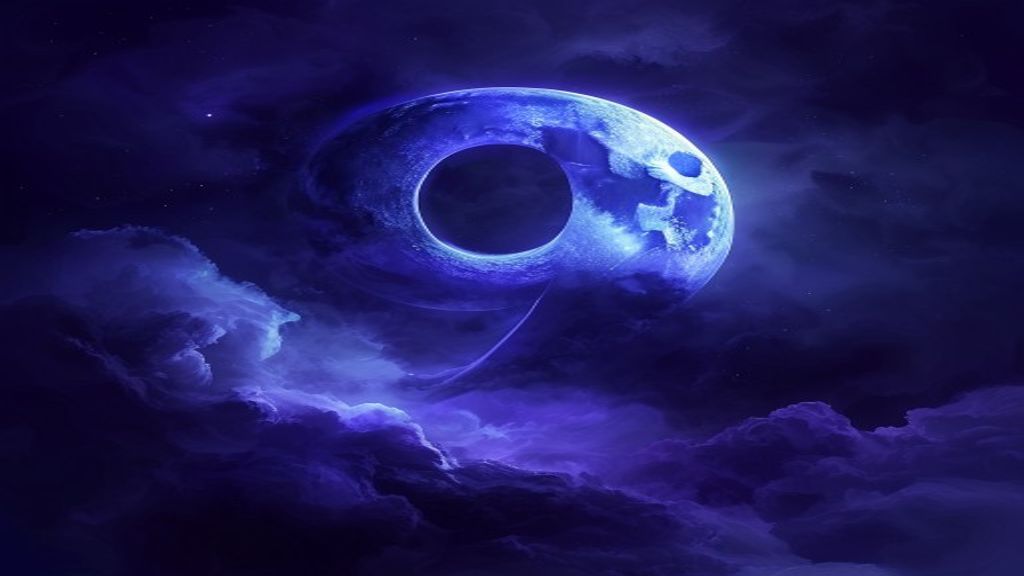
A 9 on a wall, a 9 on a clock face, a 9 chalked on a pavement: it feels less like a scare than like a station announcement. That is because nine sits at an edge. Something has been arrived at, or something is about to depart, and the dream marks the spot without explaining it. The connection is rarely obvious while the dream is fresh. Afterwards it turns out not to be subtle at all.
Nine is the last single digit. After it comes ten, which is 1 and 0, which means you’ve started again. Every culture that has worked with numbers for long enough has noticed this, and almost every one has made something of it. That numerological weight isn’t superstition. It’s humans responding to an actual feature of how we count. Your dreaming mind is responding to the same thing.
Dreaming of 9 almost always has something to do with completion, transition, or the particular discomfort of being almost-but-not-quite done. It’s the number for endings that haven’t fully landed yet, and for the anticipation of what comes next.
Why nine carries this weight across so many traditions
- Ancient numerology
Nine as the last single digit appeared in Pythagorean thought as a symbol of completion: the final stage before a return to unity. This idea spread through mystery traditions in ways that are genuinely difficult to trace, but it turns up with unusual consistency.
- Norse cosmology
Nine worlds in the Norse cosmological system, nine nights Odin hung on Yggdrasil. Whether these choices were deliberate references to the number’s completeness symbolism or independent convergences is debated. Either way, nine meant totality.
- Chinese tradition
In Chinese culture nine is associated with the Emperor and with the highest point, the culmination of earthly power. It sounds different from Western completeness symbolism but is structurally similar: nine as the ceiling, the last step up.
- Western religious symbolism
Nine orders of angels in medieval Christian cosmology. Nine fruits of the Spirit. Again and again, the number appears at the edge of something maxed out, before transformation or transcendence.
- Modern dream accounts
Dreamers who notice a 9 often link it to a life transition: the end of a relationship, the last year of a degree, the final stretch of a project, pregnancy’s ninth month. The thread runs from ancient numerology to this morning.
I’m usually careful with sweeping historical claims, but this one is genuinely consistent across independent traditions, and I think it’s because nine’s symbolic meaning is rooted in something structural rather than arbitrary. The last digit before a new cycle really is a threshold. It doesn’t need to be invented. It just needs to be noticed.
What the dream is usually measuring
Numbers in dreams are often read as a way of marking precision that images alone can’t carry. A vague feeling of ending might produce an image of autumn, a closing door, a retreating figure. But nine tends to appear when the ending is more specifically at that threshold stage: not arrived, not departed, just there at the edge of the count.
The version I find most interesting is the one where nine appears without any particular anxiety attached to it. Just the number, noticed. A clock showing 9:00. A door labeled 9. That version fits a dreamer who is actually quite close to finishing something. Not in distress about it. Just… almost there. The dream is running a kind of progress check. Nine rungs of ten. Last lap. One more to go before the cycle flips.
Domhoff would probably say this is just continuity: the dreaming mind surfacing whatever preoccupation is live in waking life, and if you’re near a completion point, that’s what comes up. He’d be right about the mechanism. What the continuity idea doesn’t say is how the dream feels, and a nine dream can settle rather than alarm. It can feel like a kind of confirmation.
When nine feels like a warning instead
Not all of them feel settled. The urgent version, the nine that wakes you up feeling pressed, tends to come when the thing approaching completion has been resisted. A relationship you’ve known for a long time is reaching its natural end and you’re still treating it like the middle. A chapter you needed to close years ago. The number nine in that version is a deadline the rest of your mind has already accepted.
The activation-synthesis view of Hobson and McCarley, which treats dreams as essentially random neural activation organized by the brain into narrative after the fact, would suggest that any meaningful pattern here is coincidence shaped into story by a mind that loves patterns. I can’t fully refute that. But if nine keeps showing up near endings rather than in open-ended stretches where everything is ongoing, that’s not nothing.
Nine as the last stretch before everything resets
If dreaming of numbers interests you, the contrast between nine and the numbers earlier in the sequence is worth sitting with. Dreaming of 2 tends to be about pairs and choices at the beginning of something. Five often appears in the middle of a process, at the pivot. Nine is the approaching end, the moment before the odometer rolls. They’re not separate symbols so much as positions on the same arc.
When the nine comes back night after night, the dream has moved into repeating number dreams, which is its own case: the repetition itself becomes part of the message.
The station announcement from the opening is still the best description of how this dream works. Something is finishing, not dramatically, not in a way you could have named on a Tuesday, but winding down all the same, and part of you knows before you know. The nines tend to fade once the announcement is no longer needed. That is either a story about how symbolic language works or a story about how the brain reinforces what it’s already processing. Maybe both. There is no need to pick one.
- What in my life is genuinely near completion, even if I haven’t admitted it?
- Did the number feel like a countdown, a confirmation, or a warning?
- What comes after for me? Am I ready for the cycle to reset?
- Is there something I’m holding in the ninth position, treating as almost-done, that I keep not finishing?
Quick answers
What does it mean to dream about the number 9?
Nine is almost always about completion, transition, or a threshold moment. The dream tends to appear when something in your waking life is genuinely near its end, whether you’ve acknowledged that consciously or not.
Is dreaming of 9 a good or bad sign?
Neither, really. It’s a positional symbol: the last step before something resets. Whether that feels good or difficult depends entirely on what’s ending. Completions we’ve chosen feel different from endings we’ve been avoiding.
Why does 9 appear in so many different cultural traditions?
Probably because its meaning is rooted in something structural: it’s the last single digit, the ceiling before the count restarts. That feature is noticed independently by cultures that work with numbers, which is why the symbolism keeps re-emerging without any direct borrowing.
What does it mean if I keep dreaming about 9?
Recurring appearances usually mean the thing near completion in your waking life hasn’t been fully acknowledged. The dream keeps returning because the transition hasn’t been consciously processed. Naming what’s ending, to yourself and maybe out loud, tends to quiet it.
Sources for this reading
- Domhoff, G. W. (2003). The Scientific Study of Dreams: Neural Networks, Cognitive Development, and Content Analysis. American Psychological Association.
- Domhoff, G. W. (1996). Finding Meaning in Dreams: A Quantitative Approach. Plenum Press.
- Hobson, J. A., & McCarley, R. W. (1977). The brain as a dream state generator: An activation-synthesis hypothesis of the dream process. American Journal of Psychiatry, 134(12), 1335-1348.DOI
Full bibliography on Sources and method. Found a mistake? Tell us and see the corrections log.