- Tradition
- Psychological readingNumber dreams
- Draws on
- Domhoff, Hobson, Artemidorus
- Reviewed
- 5 min read
You’re standing at a crossing and the light changes. Green, amber, red. You notice it this time, really notice it, because you’ve been waiting longer than usual and your mind went quiet enough to count. Three states. Three and you can move. Three and something is either beginning or over, depending on which light you’re watching.
Dreams about the number three carry that same quality of a system running. Not chaotic, not finished, but in motion toward something. The feeling they leave is tension with direction, which is different from anxiety. It’s the feeling of something that wants to resolve.
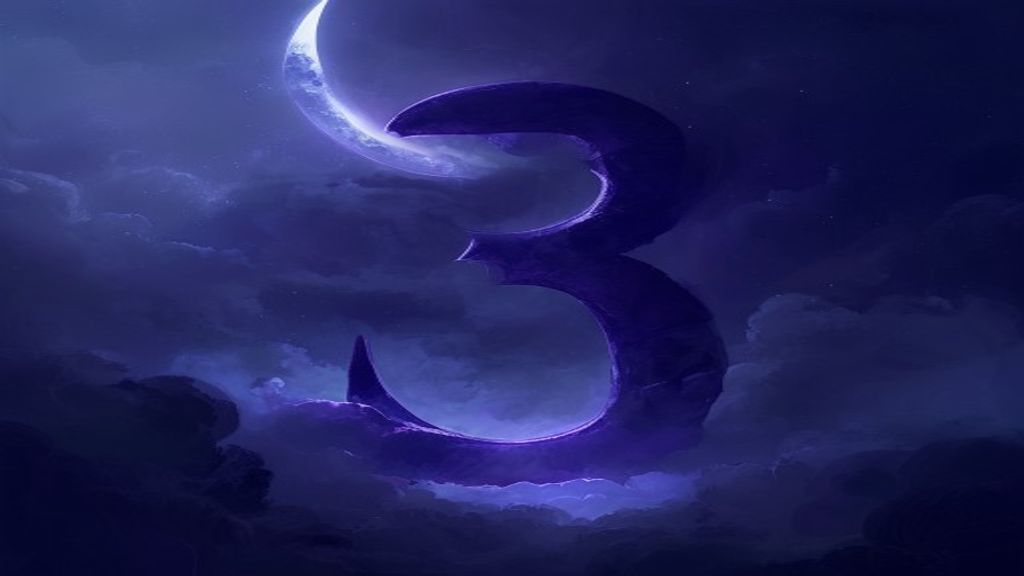
Three in a dream is the number of things in motion toward completion. It points at tension seeking a third beat: a decision waiting for one more piece of information, a conflict that needs resolution, a pattern you’re one step away from understanding.
Why three doesn’t sit still
Here’s the observation worth starting from: two creates opposition, four creates containment, but three creates motion. A triangle has a direction. Put three people in a room and something happens. Three beats in a pattern and your mind automatically completes a fourth. Three doesn’t arrive in a dream as a settled thing.
Jungian readings treat three as a symbol of incompleteness, specifically in contrast to four’s wholeness: three represents the point before integration, one element still outside the circle. I usually find that numerology a little elaborate, but on this I think it’s onto something structural: three dreams do tend to appear when something in your life needs a fourth move, a resolution, a step that’s being withheld or postponed.
Three thousand years of the same impatience
- Ancient world
Numbers have long figured in dream interpretation. Artemidorus’s second-century Oneirocritica held that the same dream means different things for different dreamers, so a recurring three would be read against the dreamer’s own situation rather than by a fixed table.
- Classical mythology
Three-fold structures run through Greek myth: three Fates, three Graces, the three-headed doorkeeper. It is easy to see how a number with that much mythic weight would feel like a signal of something approaching its turning point.
- Medieval dream books
Medieval dream books worked in a Christian world where three already carried sacred weight, in the Trinity, and threefold repetition in a dream is easy to read as emphasis, the mind underlining something it considers urgent.
- Modern psychology
The rhythm of three is familiar from jokes, where two beats set up a third. Jungian psychology formalized the incompleteness reading: three rarely indicates rest.
- Contemporary research
Domhoff’s continuity hypothesis, that dreams extend waking concerns, gives no magical properties to specific numbers. It does suggest that a number in a dream mirrors whatever the dreamer is actively tracking. Three showing up likely means something countable is at three in your life right now.
What I find useful in that long thread isn’t the supernatural weight but the consistency: across very different traditions and very different dreamers, three produces the same emotional flavor. Urgency. Proximity to something. The light about to change.
The three variants
Three objects, three people, three doors: the specific image matters. Three objects tend to map onto categories in your life, three things of a kind that might not all be equal. Notice which one felt different. Three people often represent three positions in a conflict or a decision, not necessarily three individuals you know. Three doors, three paths, three choices: the dream is being unusually honest about the fact that you have options, which sometimes people find more unsettling than having none.
Counting to three in a dream, stopping before you reach it or exactly reaching it, carries slightly different weight. Not reaching it suggests something blocked. Reaching it precisely, with finality, usually signals something completed that you haven’t consciously acknowledged yet. A chapter that closed while you were looking elsewhere.
What it isn’t
Hobson’s activation-synthesis model deserves a mention here because three is exactly the kind of thing it’s good at explaining away. The brain produces narrative, and narrative runs on rhythms of three. Beginning, middle, end. Setup, complication, resolution. You might dream of three simply because your storytelling machinery defaults to it. Not every three is a symbol. The ones worth examining arrive with weight, with a feeling that you woke carrying.
The light that changes
Domhoff’s continuity work suggests the dream is mirroring your waking preoccupations, which, for three, usually means: something is close. Three attempts, three years, three people involved in something unresolved. The dream marks the count because you’ve been pretending not to keep it.
Back to the crossing. Red, amber, green. The third state is permission. Or it’s a stop. Depends entirely on the direction you’re facing.
That’s the quality a three-dream leaves you with when it’s doing its real work: not an answer but a pressure. You’re close enough to something that not moving feels increasingly strange. The light is cycling. You can count the stages. What you’re waiting for is still up to you.
If the three in your dream felt more like a loop than a countdown, dreaming of repeating numbers is about what happens when the pattern stops moving forward and just circles. The number before it, the number 2, is the push-and-pull that three so often grows out of: two options not yet chosen between.
And if the three kept turning up awake rather than asleep, on clocks and receipts, 333 meaning separates the genuine Trinity history from the modern angel-number story.
- What in my life is currently at three: attempts, years, people involved?
- Did reaching three in the dream feel like arrival or like a countdown still running?
- Is there a decision I’ve been framing as two options when there’s actually a third?
- What would the fourth move be, if there was one?
Quick answers
What does it mean to dream of the number 3?
Three in a dream usually points to something in motion toward resolution, a decision pending, a conflict with one beat missing, a pattern one step from clarity. It’s the number of tension with direction, not chaos. The feeling underneath, urgent, expectant, or pressured, tells you most of what you need.
Is the number 3 lucky or unlucky in dreams?
Neither, really. Three carries energy rather than luck. It tends to arrive when something is close to tipping one way or another, which can feel like warning or like anticipation depending on what’s actually happening in your life. Most people who dream of three are on the verge of something, not in danger from it.
Why does three appear in so many traditions?
Because narrative and pattern both run on three. Beginning, middle, end. Setup, tension, resolution. The number sits at the edge of completion in almost every story structure humans use, which is why it feels so loaded when the dream stops there without resolving.
What does it mean to count to three in a dream?
It depends heavily on whether you reach it or not. Completing the count with finality often signals something that’s ended without your full acknowledgment. Getting stuck before three, or feeling the count interrupted, usually points to something unfinished that you’re avoiding naming.
Sources for this reading
- Domhoff, G. W. (2003). The Scientific Study of Dreams: Neural Networks, Cognitive Development, and Content Analysis. American Psychological Association.
- Domhoff, G. W. (1996). Finding Meaning in Dreams: A Quantitative Approach. Plenum Press.
- Hobson, J. A., & McCarley, R. W. (1977). The brain as a dream state generator: An activation-synthesis hypothesis of the dream process. American Journal of Psychiatry, 134(12), 1335-1348.DOI
- Artemidorus of Daldis (2nd century CE). Oneirocritica. English edition: Harris-McCoy, D. E. (2012). Artemidorus’ Oneirocritica: Text, Translation, and Commentary. Oxford University Press.
Full bibliography on Sources and method. Found a mistake? Tell us and see the corrections log.