- Tradition
- Psychological readingFood dreams
- Draws on
- Domhoff, Freud, Hobson
- Reviewed
- 6 min read
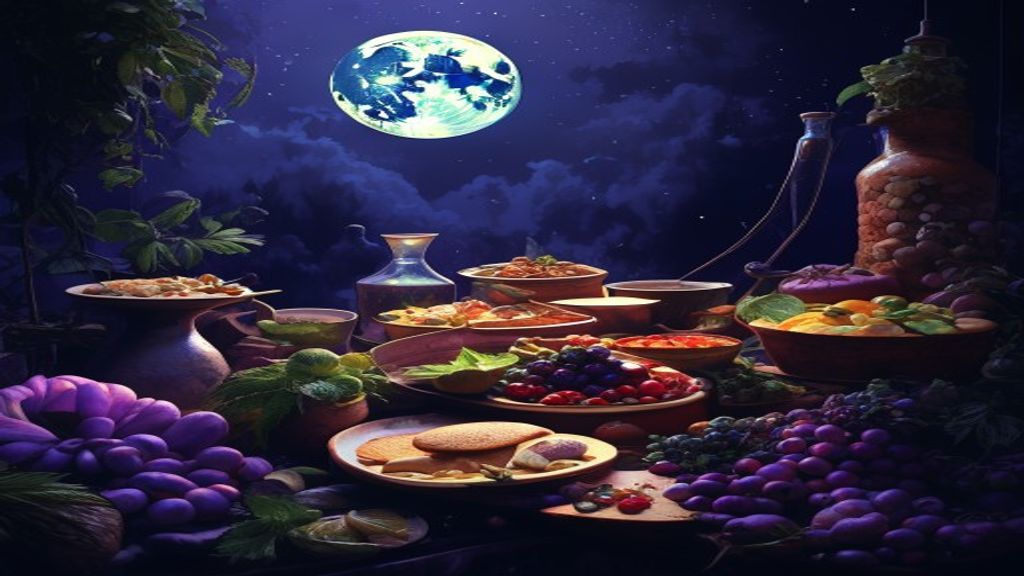
What does your dream table actually look like? Because abundance isn’t one thing. There’s the feast that fills you with warmth, and there’s the table so loaded you feel obscurely guilty just looking at it, and there’s the one where more keeps arriving and nobody’s eating and the food starts to feel like a threat dressed as generosity.
A holiday table with fourteen dishes for eight people is a useful picture. The host can’t sit down, keeps adding things, and near the end of the meal there is always a moment where the abundance tips past pleasure into something else. Not gluttony exactly. More like need. Like the table is making an argument nobody can make out loud.
A table like that can turn up in a dream. It doesn’t always feel like memory. Sometimes it feels like a question.
Dreaming of food in abundance usually reflects feelings about plenty, generosity, or excess in your waking life. A feast that feels warm and easy points to real fulfillment. One that feels overwhelming, untouched, or guilty points to anxiety about having too much, giving too much, or wanting more than you’ve allowed yourself to want.
The feast as wish, and the feast as pressure
Traditional dream books were bullish on abundance dreams. Plentiful food was read as straightforwardly good news: prosperity, success, social esteem. Those were cultures that understood feasting as publicly meaningful, a signal of status and favor. That reading still lives in the warm version of this dream, the one where you wake feeling genuinely nourished, almost cheerful. Those dreams tend to arrive at moments of real growth, when something in your life is genuinely giving back.
But the other kind. The table that’s too full. The host who won’t stop serving. The dream where you can’t eat fast enough and the food keeps piling up and something in you wants to leave but you feel you can’t. That’s a different creature altogether. It’s abundance as obligation, as performance, as the expression of a love that’s really a control.
Domhoff’s continuity hypothesis would trace both versions back to waking life, which I think is right. Warm, easy feasts fit periods of expansion. Suffocating abundance fits periods where plenty has become its own kind of burden: too many obligations, too many people to feed, too much given out and not enough held back. The overloaded table is a self-portrait in food.
A short history of the dream feast
- ~1200 BC
The Chester Beatty papyrus dream book sorts dreams into good and bad omens, the template for a long tradition of asking whether an image promises fortune or trouble. A full table is an easy image to read either way, depending on the dreamer.
- 2nd century
Artemidorus, in the Oneirocritica, insists that the same dream means different things for different dreamers, depending on age, status and occupation. A full table is a good test of that rule: prosperity for one dreamer can be an obligation for another.
- 1900
Freud, in The Interpretation of Dreams, treated dreams as wish fulfilment. On that account a feast is the simplest case of all, a wish for plenty answered in the dream, and the interesting cases are the ones where the feast brings guilt instead.
- 20th century
Psychological interpretation shifts the question from what the food means to what the dreamer feels. Abundance that produces guilt, anxiety, or obligation becomes a diagnostic of the dreamer’s relationship to desire and permission, not prosperity.
Who’s at the table, and who’s watching you eat
The social dimension of these dreams doesn’t get enough attention. Abundance dreams are rarely solitary. Almost always there are other people, and their presence changes everything. A table full of food shared with people you love reads completely differently than a table full of food where you feel watched, or where you’re eating alone despite the feast, or where someone keeps piling your plate without asking.
The watching figure is the one I find most interesting. Someone in the dream who isn’t eating, just observing. Sometimes approving, sometimes vaguely judgmental, sometimes impossible to read. I think that figure is usually an internalized voice about deserving. About whether you’re allowed to have this much, whether you should take seconds, whether pleasure is something you’ve earned or something that will cost you later.
Hobson, whose activation-synthesis theory with McCarley in 1977 deflated the significance of dream content, would say the narrative of a feast dream is largely confabulation, the dreaming brain fitting a story around whatever activation pattern it’s running. Maybe. But the specific anxieties that show up around abundance in dreams, the guilt, the feeling of not deserving, the sense that the food will be taken away, feel too consistent to be random. Hobson would be unimpressed with that argument, and I’d understand why.
When abundance feels like grief
This is the version nobody talks about. Sometimes the overflowing table is a dream about someone who used to fill it. The grandmother who isn’t there anymore. The family dinner that no longer happens. The abundance is real in the dream and the loss is what makes it almost unbearable. You wake and the warmth and the ache are inseparable, which is exactly what grief does to memory.
I’d call this an abundance dream that’s secretly a loss dream. The table is full because that’s how memory preserves the people who fed us. It keeps filling the plates of those who are gone.
- Notice the feeling firstWarm and easy, or overwhelming and guilty, or bittersweet and full of someone specific. The emotional temperature does most of the interpretive work.
- Look at who’s at the tableClose people who nourish you, strangers, absent people, anyone watching without eating. Each tells you something different about the social layer of what you’re processing.
- Notice what you do with the foodDo you eat freely? Hesitate? Give it to others before yourself? Feel you have to finish it all? Your behavior toward the food often mirrors your behavior toward good things in waking life.
- Ask what the abundance representsAbundance in dreams is almost never literal food. It tends to stand for something you have a lot of, or want more of, or feel complicated about having: love, work, money, time, recognition.
If the dream comes with an anxious edge, the sense that the food will run out or be taken, it’s worth setting dreaming of a peanut beside it as a counterpoint: the smallest unit of provision, single and exact, and what that precision means. The distance between a peanut and a banquet is where a lot of our feelings about enough live. Dreaming of a raspberry sits at the same small end of the scale: one bright, sweet thing, enjoyed briefly, instead of a table that never empties.
The table in a dream like this is still there when the person who laid it isn’t. And it can be hard to say whether such a dream is about missing them or about something they were trying to say with all that food that you never quite understood while they were alive. Probably both. The table keeps holding both things, which is what tables do.
- Did the abundance feel warm and generous, or excessive and pressured?
- Who was at the table, and was anyone absent who should have been there?
- Did I eat freely, or did I hold back, or feel guilty?
- Is there something in my waking life I have a lot of but feel complicated about wanting?
Quick answers
What does it mean to dream of food in abundance?
It depends heavily on the emotional tone. Warm, easy abundance usually reflects genuine fulfillment or a period of real growth. Overwhelming or anxious abundance tends to point at complicated feelings about plenty: guilt about having enough, obligation to give to others first, or a fear that the good things will run out.
Is dreaming of a feast a good sign?
Often, yes. But the dream shifts meaning with the feeling. A feast you can’t enjoy, or one where you’re watching others eat, or one you feel guilty about, tells a different story.
Why do I feel guilty in a dream about having too much food?
That guilt usually isn’t about food. It tends to be about the dreamer’s relationship to having enough in general: whether they feel they deserve good things, whether abundance feels safe or threatening, whether pleasure is allowed or always followed by a cost. The dream is just using food to ask the question.
Why do I dream of a feast that reminds me of someone who died?
Food and memory are wired together closely, and loss tends to surface through the images it used in life. A table laid the way someone you loved used to lay it is both a memorial and the mind’s way of keeping them present a little longer. These dreams are usually kind ones, even when they hurt.
Sources for this reading
- Domhoff, G. W. (2003). The Scientific Study of Dreams: Neural Networks, Cognitive Development, and Content Analysis. American Psychological Association.
- Domhoff, G. W. (1996). Finding Meaning in Dreams: A Quantitative Approach. Plenum Press.
- Freud, S. (1900). The Interpretation of Dreams (Die Traumdeutung; first published November 1899). English translation by James Strachey, Basic Books.
- Hobson, J. A., & McCarley, R. W. (1977). The brain as a dream state generator: An activation-synthesis hypothesis of the dream process. American Journal of Psychiatry, 134(12), 1335-1348.DOI
- Artemidorus of Daldis (2nd century CE). Oneirocritica. English edition: Harris-McCoy, D. E. (2012). Artemidorus’ Oneirocritica: Text, Translation, and Commentary. Oxford University Press.
Full bibliography on Sources and method. Found a mistake? Tell us and see the corrections log.